
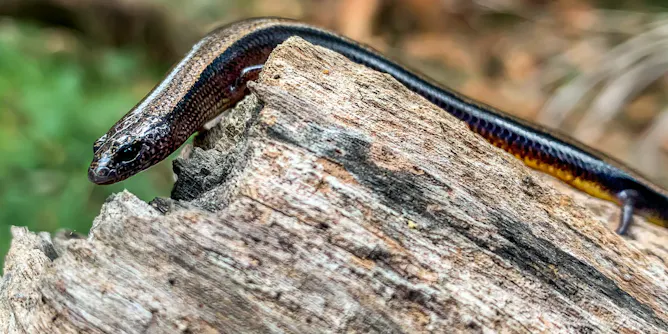
The three-toed skink can give birth to live young and lay eggs in the same pregnancy. What can this little critter teach us about the evolution of live birth?
Articles on Lizards
Displaying 41 - 60 of 68 articles
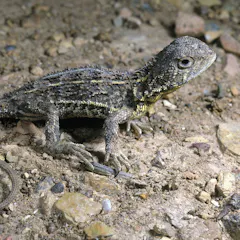
The Victorian grassland earless dragon may well be the first lizard species driven to extinction on Australia’s mainland. But conservationists aren’t ready to declare it dead just yet.
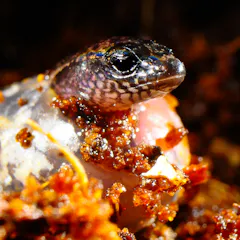
The evolution of live birth from egg-laying is no mean feat. Now new research reports on the first known example where both eggs and a live birth come from the same lizard pregnancy.
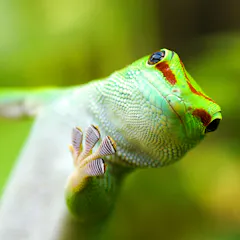
Understanding geckos’ movements could lead to better robots.
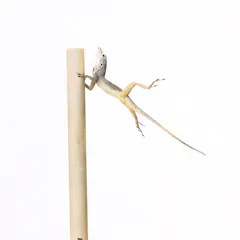
In the wake of two hurricanes in the Turks and Caicos Islands, researchers document for the first time that catastrophic storms can be agents of natural selection, influencing how species evolve.
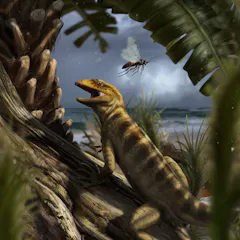
A new study of an ancient fossil has found it to be the earliest lizard known, so far. It shows they survived one the greatest mass extinctions on Earth.
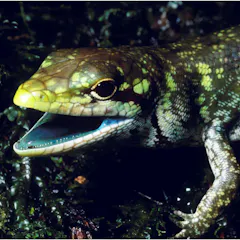
New research shows green-blooded skinks have evolved multiple times, which could help lead to explanation as to why.
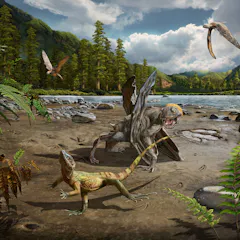
Bipedal movement has existed in modern reptiles for much longer than we previously knew.
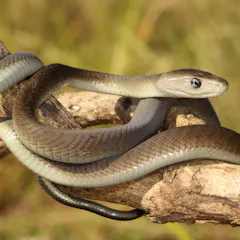
Reptiles add socioeconomic value but when it comes to accessing detailed reference information about them, students and naturalists can face serious challenges.

Indian-made antivenoms, common throughout Africa because they are affordable, showed little-to-no neutralisation of the African Echis venoms.
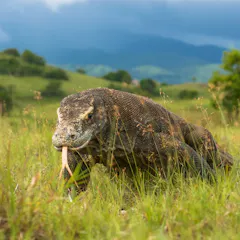
Venom from lizards such as the Komodo dragon has the potential to treat heart attacks, strokes and blood clots.
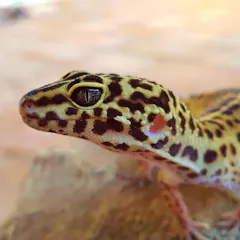
A group of lizards in Brazil have evolved bigger heads in just 15 years thanks to their new environment.
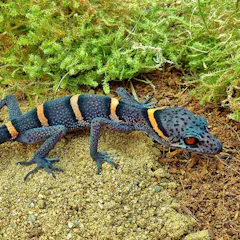
Biologists have a centuries-old tradition of publishing on rare and endangered species. But poachers are using open-access information to target valuable and fragile new species.

Mammals’ ancestors had a third eye and the fossil record of its disappearance tells us the story of the evolution of one of our most important features: warm blood.
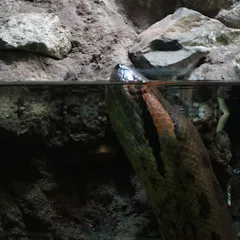
One of the enduring controversies in evolution is why snakes evolved their long, limbless bodies. A new study suggests snakes may have lost their legs at sea, before crawling ashore.

Embryos greedily want more resources than their fair share. New research investigates how early in evolution their hormonal tactics arose.

If you’re hearing a strange chatter in your home, you may have gecko housemates.

Have a look in your garden - you might be surprised at some of the native animals that thrive there when the weather’s hot.
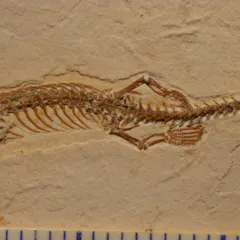
A new study of the first ever snake fossil with legs suggests that snakes evolved on land rather than in the ocean, as previously thought.

While it’s tempting to dismiss conspiracy theorists as nothing more than a loopy minority, on a growing range of contemporary issues they in fact make up a loud and vocal majority. Consider the nearly…
Top contributors
-

Assistant Professor of Ecology and Evolution, Georgia Institute of Technology
-
Senior Curator, Terrestrial Vertebrates, Museums Victoria Research Institute
-
Senior Research Scientist, South Australian Museum; Flinders University
-
Research Officer Herpetology, Museums Victoria Research Institute
-
PhD Student, Biological Sciences, Brock University
-
Professor in Ecology and Conservation, Monash University
-
Director of the Gothenburg Global Biodiversity Centre, University of Gothenburg
-
Research Associate in Evolutionary Biology, Adelaide University
-
Lecturer, Lúrio University
-
Post-doctoral fellow, Australian Landscape Trust, Calperum Station, James Cook University
-
Professor in Zoology, James Cook University
-
Senior Lecturer, Evolutionary Biology, University of Sydney
-
Associate Professor in the School of Humanities and Communication Arts, Western Sydney University
-
Associate Professor, School of Arts and Media, UNSW
-
Associate professor in Vertebrate Palaeontology, University of the Witwatersrand