
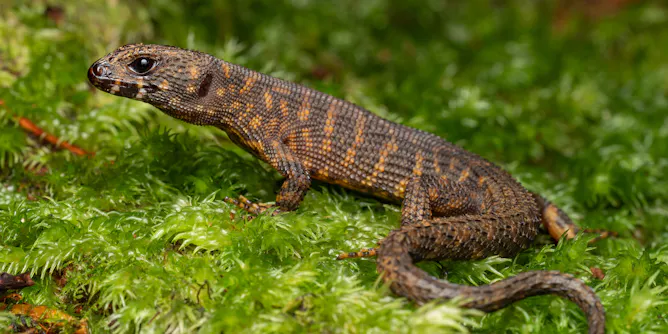
A new study finds the incredible diversity of lizards in Australia relates to a major upheaval in the continent’s climate more than 20 million years ago.
Articles on Skinks
Displaying all articles
All but four of New Zealand’s 120 lizard species are threatened or at risk. But little consideration is given to lizards during most land development projects.

There are 401 indigenous terrestrial reptiles in South Africa.
Researchers have found an armoured fossil skink 1,000 times heavier than the ones in your garden. Its closest living relative is the shingleback lizard.

Detailed field notes can help researchers track down rare species.
Spiny-tailed skinks, also known as meelyu, are culturally significant to the Badimia people in Western Australia. But habitat degradation and mining have put them at threat of extinction.
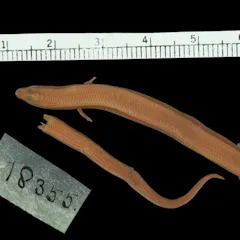
Species distribution data – or a lack thereof – can have a major bearing on how a country’s Key Biodiversity Areas and protected areas are designated.
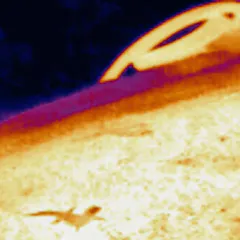
Some skinks have been known to kill their babies – but one remarkable species goes to any lengths to save them.

The Kaputar rock skink is thought to have have one of the smallest ranges of any reptile in New South Wales – at the summit of a single extinct volcano, Mount Kaputar.

The three-toed skink can give birth to live young and lay eggs in the same pregnancy. What can this little critter teach us about the evolution of live birth?
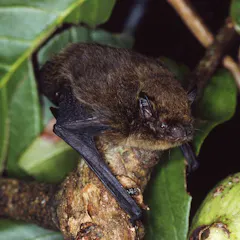
Current environment laws are manifestly failing Australian animals.
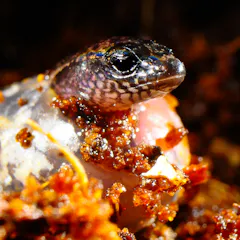
The evolution of live birth from egg-laying is no mean feat. Now new research reports on the first known example where both eggs and a live birth come from the same lizard pregnancy.

Have a look in your garden - you might be surprised at some of the native animals that thrive there when the weather’s hot.
Top contributors
-

Lecturer, Lúrio University
-
Director of the Gothenburg Global Biodiversity Centre, University of Gothenburg
-
Senior Lecturer, Evolutionary Biology, University of Sydney
-
Professor in Wildlife Ecology and Conservation, School of Life & Environmental Sciences, Deakin University
-
Postdoctoral Research Associate, UNSW
-
Postdoctoral Fellow, University of Otago
-
Curator, Amphibian & Reptile Conservation Biology, Australian Museum, UNSW
-
Senior Lecturer in Wildlife and Conservation Biology, School of Life and Environmental Sciences, Deakin University
-
Senior Research Scientist, South Australian Museum; Flinders University
-
PhD candidate, Curtin University
-
Casual academic, Flinders University
-
Honorary Research Fellow, University of Sydney
-
Professor in Terrestrial Ecology, Deakin University
-
Associate Professor, Deakin University
-
Professor of Herpetology, Environmental Physiology and Physiology, Ecology and Evolution, University of the Witwatersrand