
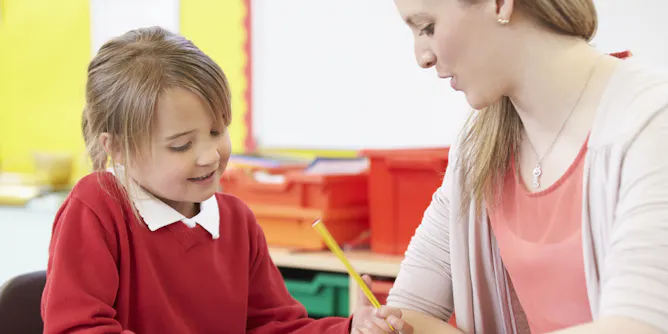
By the age of five, most children can name at least ten letters. In our study, 58.6% of children living with disadvantage could not name the expected number of alphabet letters.
Articles on Learning to read
Displaying 21 - 38 of 38 articles

One way to help children learn the words they need to thrive academically is by reading aloud from books and news sources that use both narrative and expository writing.

When children write out treasure hunt clues and shopping lists to play grocery store, they’re learning to read and write.

To “warm up” a book, use the K-W-L strategy: Talk with your child about what you both KNOW about the subject, what you WONDER and afterwards, what you’ve LEARNED.

Early intervention with reading challenges has very high success rates for supporting reading development, but it is much more difficult to improve reading skills in older students.
With a complex language, like English, learning to sound out words is critical but not enough for learning how to read.

Early experiences sharing and developing positive connections, language and communication set the stage for home reading to start children on the path to literacy.
Reading involves more than decoding letter-sound relationships and making meaning from isolated texts.
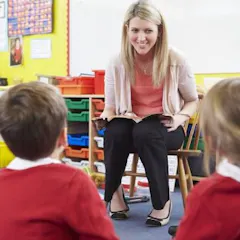
Children in the early stages of learning to read should be given decodable books to practise and generalise their developing alphabetic skills.

Learning music in the early years of schooling can help children learn to read.

Teaching children how to break down words into their meaning and origin can help them be better spellers.
We are not hard-wired to read. It has taken thousands of years of practice to forge connections in our brains to help us do this.

Many young children can give the false impression that they are learning to read, when in fact they are mostly guessing words from pictures or context. This test will help to identify these students.
A new font designed called ‘Dyslexie’ was labelled ‘a breakthrough’ by the media for reportedly being about to help increase the reading speed of those with dyslexia. But does it really work?

Family meals – with lively conversation, storytelling and discussions of books and the tales they contain – feed children’s literacy skills.
A child’s reading progression isn’t based on age, so you need to know what stage your child is up to in order to help them.

As school resumes for the new year, the “home reader” routine for primary school children also recommences. For many parents and children, reading these short texts can be the most agonising part of the…
In 1982, the late, great NZ reading researcher Marie Clay identified a group of children having difficulty learning to read as “tangled tots (with) reading knots”. She was referring to children who, despite…
Top contributors
-

Head of Department, Early Years Education, Edge Hill University
-
Associate Professor in Language, Literacy and TESL, University of Canberra
-
Associate Professor, Werklund School of Education, University of Calgary
-
Professor of Language and Literacy Development, University of Reading
-
Professor, Werklund School of Education, University of Calgary
-
Sessional Tutor, Charles Sturt University
-
Principal Fellow, Faculty of Education, University of Wollongong
-
Emeritus Professor of Education, Macquarie University
-
PhD Candidate, Sessional Academic, Edith Cowan University
-
Honorary Fellow, Macquarie University
-
Associate Clinical Professor of Psychology, Harvard University
-
Professor of Early Childhood and Primary Education, UCL
-
Professor, Canada Research Chair in Determinants of Child Development, Owerko Centre at the Alberta Children’s Hospital Research Institute, University of Calgary
-
Professor, Department of Education, Concordia University
-
Adjunct assistant professor, University of Canberra