
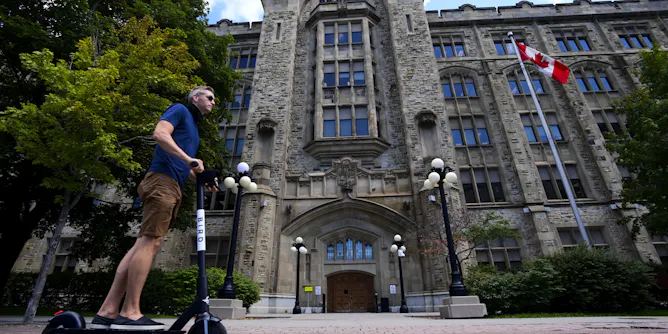
Canadian governments are in a perilous situation as young Canadians view the public sector with rising suspicion and have little interest in public service careers.
Articles on Labour shortage
Displaying 1 - 20 of 21 articles

Hiring managers in the food service industry often emphasize the importance of finding the right “fit” when hiring new employees. But does everyone have the same chance to fit in?

Job listings now often demand that applicants have degrees and experiences that were previously unnecessary, with some job requirements even surpassing the qualifications of current employees.

When CEOs and workplace leaders communicate their personal values and ethics clearly, they inspire individuals to want to work for their organizations.

The social care sector has been struggling for years, and relying on migrant workers to support it.

Gaps in swimming lessons, lifeguard shortages and climate change may make water-based activities even riskier this summer.

Australia is rapidly expanding visa programs for Pacific Islanders to fill labour shortages. More needs to be done to overcome cultural tensions in local communities.

For immigrants to be a panacea for our demographic and economic challenges, they must be able to find skills-appropriate employment and settle into communities.

For a long time, arts organisations retained staff attracted to the ‘romance of being creative’. That’s no longer enough.

Since borders reopened, backpacker numbers have have failed to recover as hoped.

Canada is facing a critical shortage of skilled tradespeople, only doomed to get worse with retirement rates. Our only hope is to attract more workers before it’s too late.

Jim Chalmers & Michelle Grattan
For Treasurer Jim Chalmers, this week's jobs and skills summit is the prelude to what will be his main game, the October budget.

300,000 more workers in this age group in UK are now economically inactive, pointing to a major challenge for the government.
With employers struggling to hire enough workers, reliance on automation is becoming more of a necessity than just a source of competitive advantage.

The claim that workers are simply moving to white-collar sectors obscures structural barriers to labour mobility, including racism and discrimination.

This is a proportional response to managing risk at this stage of the pandemic, with so many of us vaccinated and receiving boosters. However, we need to monitor these changes.

As global travel slowly resumes and many young people start thinking about working overseas again, global competition for this market will be intense.

Wind turbines need building, heat pumps need installing – but Britain has a chronic skills shortage.

It could push up prices and pay.

A new report by the Migration Advisory Committee on the impact of EU migration on the UK has highlighted the reliance of farms on migrant labour.
Top contributors
-

Senior Lecturer, Griffith University
-
Associate Professor, Faculty of Business Administration, University of Regina
-
Assistant Professor, Bryan School of Business and Economics, University of North Carolina – Greensboro
-
Distinguished Business Research Professor of Organizational Behaviour, McMaster University
-
PhD Candidate, DeGroote School of Business, McMaster University
-
Associate Professor of Human Resources and Management, McMaster University
-
Professor of Human Resources and Organizational Behaviour, University of Saskatchewan
-
Professor of Practice, Associate Dean, Warwick Business School, University of Warwick
-
Canada Research Chair, Organizational Behaviour & Human Performance, McMaster University
-
Professor in Human Kinetics, L’Université d’Ottawa/University of Ottawa
-
Assistant Professor of Economics, University of Essex
-
Lecturer in Arts Management and Human Resources, The University of Melbourne
-
Research Associate in Talent and Skills, Energy & Environment Institute, University of Hull
-
Associate Professor, University of King's College
-
Chair in Epidemiology, Deakin University