
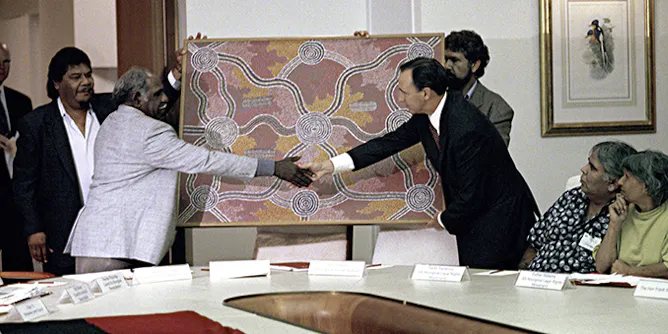
Cabinet papers reveal the extent to which the Keating government was torn between concern for fiscal responsibility and a desire to tackle Indigenous disadvantage and pursue meaningful reconciliation.
Articles on Indigenous policy
Displaying 41 - 60 of 93 articles

No treaty between Indigenous and non-Indigenous Australians has ever been recognised, but developments at the state level suggest this may soon change.
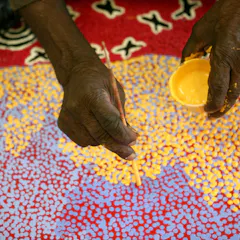
Waves of policies from successive Coalition and Labor governments have followed a paternalistic lead. This has created further impediments to thousands of Indigenous peoples who are doing plenty.
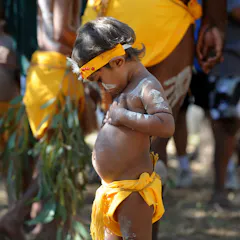
Why, despite substantial spending, do serious difficulties continue to plague efforts to improve Indigenous wellbeing?
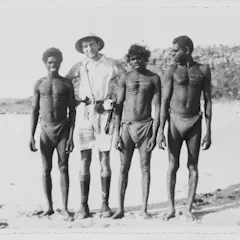
The book Red Professor: the Cold War Life of Fred Rose tells of a progressive anthropologist who was stymied by non-Indigenous people in powerful positions. Sadly, it’s a narrative that still resonates today.

How we think about wellbeing depends on where we come from, who we are and our experiences and aspirations. One study took account of this by involving Yawuru people in every aspect of the research.

Chair of the Prime Minister’s Indigenous Advisory Council, Warren Mundine, told Q&A that $30 billion is spent every year on 500,000 Indigenous people in Australia. Is that right?
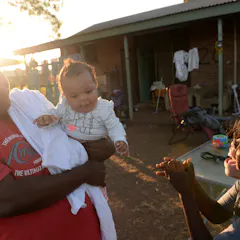
A new report highlights how little we know about what works and what doesn’t when it comes to publicly-funded Indigenous programs. It’s a similar story in other policy areas – but we can do better.
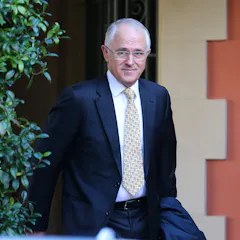
What’s in store for key policy areas, from health to education to infrastructure to asylum seekers, under a returned Coalition government?

On the big national policies affecting non-metropolitan Australia, such as agriculture and trade, the major party differences are minor. That’s why the election focus turns to local projects.
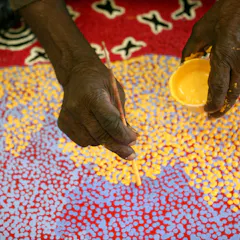
Public policy no longer requires the imprimatur of the Aboriginal people; Aboriginal participation in the decisions taken about their lives is negligible.
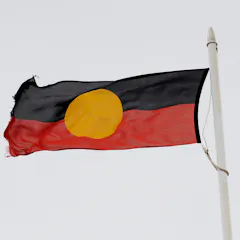
Political parties should commit to supporting the evidence-based recommendations of decades worth of reports into family violence.
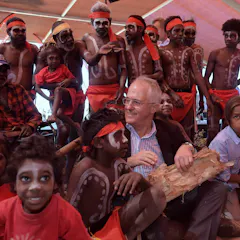
Malcolm Turnbull is at his best when he can rise above the overtly partisan fray. So it was on Tuesday that he gave one of the most powerful speeches of his campaign, at a hand-back ceremony marking the…
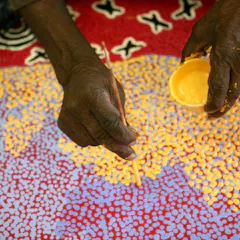
Serious policy focus on Indigenous affairs has been notably absent during the early weeks of the long election campaign.

Despite significant shortcomings in the negotiation, content and honouring of treaties, they continue to define the nature of the relationship between most Native Americans and the United States.
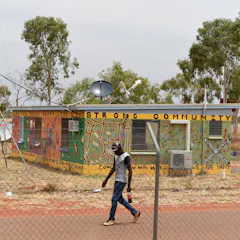
In some Indigenous communities, the ratio of programs to people served is possibly the highest in the world. Somehow, for many, Closing the Gap remains an elusive goal. A rethink is needed.
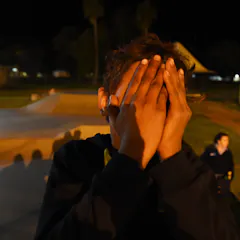
Rosie Anne Fulton, a young Northern Territory Indigenous woman with foetal alcohol spectrum disorder, highlights how the system is failing.
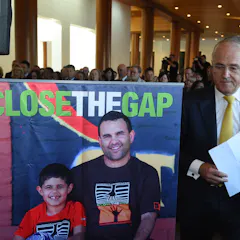
Across Indigenous Australia, innovation is occurring locally, under the radar of government policies and support. We can look to this innovation and stop fixating on finding the elusive policy solution.

Aboriginal heritage has had significant protections removed in Western Australia. Following principles of respect and consultation would be a huge step forward for Aboriginal cultural management.

Sarah Hanson-Young told Q&A that Indigenous children are currently ten times more likely to be living out of home. Is that right?
Top contributors
-

Professor of Economics and Public Policy, ANU College of Arts and Social Sciences, Australian National University
-
Professorial Fellow, Jumbunna IHL, University of Technology Sydney
-
Associate Professor of Public Policy, Crawford School of Public Policy, Australian National University
-
ARC DECRA Fellow, Australian National University
-
Professorial Fellow, University of Canberra
-
Senior Lecturer in Social Research and Policy, UNSW
-
Senior Lecturer In Public Policy, School of Social and Political Sciences, The University of Melbourne
-
Professor of Indigenous Health, Executive Director, Carumba Institute, Queensland University of Technology
-
Associate Professor, UNSW
-
Advisor, Author and Researcher, The University of Queensland
-
Pro Vice-Chancellor Indigenous UNSW and Professor of Law, UNSW ; University of Pennsylvania
-
Professor, School of Social and Political Sciences, Director, The (so-called) Australian Centre, The University of Melbourne
-
Lecturer, Faculty of Health Sciences, Australian Catholic University
-
Associate Professor, Macquarie University
-
Senior Lecturer in Criminology and Social Policy, The University of Queensland