
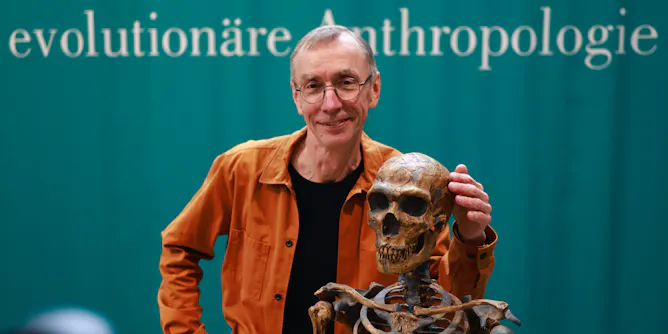
The Nobel Prize in physiology or medicine for 2022 has been awarded to Svante Pääbo, whose discoveries have been pivotal to the way we understand our evolutionary history.
Articles on Humans
Displaying 21 - 40 of 52 articles
Rainwater may be contaminated with chemicals and scientists are still uncertain about their effects.
Children are taught to value the lives of other species less, according to a new study.

Several scholars weigh in with tips on how to support college students’ emotional well-being during the pandemic.

A new study finds more than one early human species lived on the landscape in Northern Tanzania 3.66 million years ago. But there are reasons to be cautious about the findings.
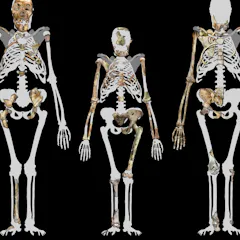
Walking has taken a very long time to develop, with evidence of bipedalism among early humans in Africa roughly 4.4 million years ago.

It is important to remember in this time of crisis that the need for social connection is vital.

Our biggest evolutionary advantages are an ability to walk on two legs and our big brains.

If all of humanity was wiped out tomorrow, it’s estimated that the natural world would take at least five million years to recover from the damage humans have done to the world.

Language can express some of the results of our thinking, but it’s not the thinking itself.

Cats and humans have different ways of communicating and sometimes that can lead to problems.

Having different coloured eyes is quite unusual, but it happens in many species throughout the animal kingdom.

Understanding the evolutionary roots of what draws us to delusions of legacy and distractions of leisure will help us address the environmental challenges of the 21st century.

Catnip can induce changes in cat behavior. An expert argues that giving it to cats raises questions about human power and animal autonomy.
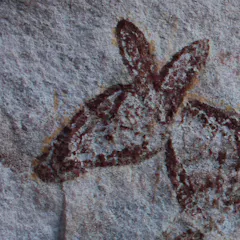
Researchers in human evolution used to focus on Africa and Eurasia – but not anymore. Discoveries in Asia and Australia have changed the picture, revealing early, complex cultures outside of Africa.

Australia’s Chief Scientist Alan Finkel says while it’s possible to build robots to take over jobs – including his own – humanity still has the edge over machines.
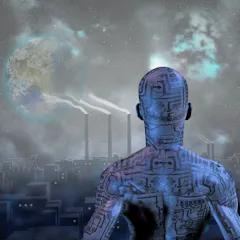
The quest for technology to be the salvation of humankind neglects to consider some darker truths that lead to dystopia.

On the Tibetan plateau, the village of Yunta shows that animals and humans can live peacefully and care for each other.

New research on Indonesian fossils reveals clues to an ancient expansion out of Africa.

Robots are strange creatures, and not only because they might steal our jobs. We humans actually have good reason to be a little worried about these machines.
Top contributors
-

Associate Professor of Psychology, Rose-Hulman Institute of Technology
-
Chair of ARC Centre of Excellence for Quantum Biotechnology, The University of Queensland
-
Professor for Biology, Peking University
-
Professor of Clinical Neuropsychology, University of Cambridge
-
PhD Candidate in Anatomical Sciences, University of the Witwatersrand
-
Professor of AI and Public Policy, University of Salford
-
Lecturer of Palaeolithic and African Archaeology, University of Tübingen
-
Associate Professor, University of Wollongong
-
Professor of Wildlife Conservation, University of Oxford
-
Associate Professor of Archaeology, Griffith University
-
Postdoctoral research fellow, Macquarie University
-
PhD candidate in Archaeological Science, University of Wollongong
-
Lecturer in Management, SPRU, University of Sussex Business School, University of Sussex
-
Emeritus Professor, Fenner School of Environment & Society, Australian National University
-
Associate professor, The Ohio State University