

Growing numbers of women are using testosterone for menopause symptoms, but female-specific products remain scarce and evidence patchy.
Articles on Hormone replacement therapy
Displaying 1 - 20 of 35 articles

Some women can’t take hormone replacement therapy to alleviate hot flashes and night sweats. This medication is one alternative.

Menopausal hormone therapy no longer has the highest-level warning label about the risk of breast cancer, opening a gray area on who would benefit most from treatment.

The latest research on menopause hormone therapy is reassuring, showing little to no association with stroke and blood clots, but benefits for bone health.

Don’t cut your patches in half, as this stops them working. There’s no need to ration your supplies – here are other options to ease your menopause symptoms.
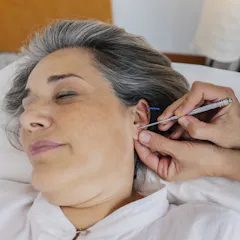
Hot flushes, night sweats or swinging mood changes can be debilitating. So it’s tempting to look to complementary therapies. Here’s what the evidence says.

A study tracking women for more than two decades adds to growing evidence that when menopause hormone therapy is started may influence dementia risk later in life.

We also investigated whether taking HRT post-menopause had any impact on these health outcomes.

Testosterone is widely promoted as an essential part of menopausal hormone therapy to treat low mood, brain fog and low energy. But new research challenges this.

A more nuanced understanding of hormone therapy now suggests that its benefits for heart health depend on how soon after menopause onset it is prescribed.

These three examples of statistical mistakes have had major consequences for our health and shopping habits.

When patients can’t access their MHT patches, they may consider switching to different formulations, such as tablets or gels. Here’s how they differ.

Some studies say menopause hormone therapy increases the risk of dementia, while others say it reduces it. Here’s how to make sense of the conflicting results.

The number of patients prescribed hormonal therapy plummeted after 2002, due to findings experts have since questioned. With better understanding, more and more people are using these treatments.

Here’s what the evidence says.

Tracking the many physical and emotional symptoms of menopause with a website, app or diary can help women better monitor their health.
Despite what some media outlets have reported, this latest study only shows a link between the two.

Testosterone therapy is often essential for the health and well-being of transmasculine people. The choice to stop it to pursue pregnancy can be a difficult one.

It’s still unclear whether HRT can protect brain function and prevent dementia.

A sudden uptick in demand for HRT may be one reason behind the sudden shortages.
Top contributors
-

Chair of Women's Health, Monash University
-
Associate Professor, Cancer Survivorship and Primary Care, Caring Futures Institute, Flinders University; Western Sydney University
-
Professor of Biological Psychology, Loughborough University
-
Professor of Reproductive Health, University of Edinburgh
-
PhD student in health literacy, Deakin University
-
Professor of Paediatrics, University of Wisconsin-Madison
-
Professor of Epidemiology and Public Health, Australian National University
-
Professor of Epidemiology and Medical Statistics, Loughborough University
-
Member, IMPART (Inflammation & Metabolism, Physical Ability, & Research Translation) Network, Dalhousie University
-
Director of the Centre for Epidemiology and Biostatistics, The University of Melbourne
-
Associate Professor of Psychology, Michigan State University
-
Clinical Associate Professor of Pediatrics and co-director of the Child and Adolescent Trans/Gender Center for Health, Boston University
-
Assistant Professor of Sociology, Michigan State University
-
Adjunct Clinical Associate Professor and Endocrinologist, Monash University
-
Assistant Professor of Philosophy