
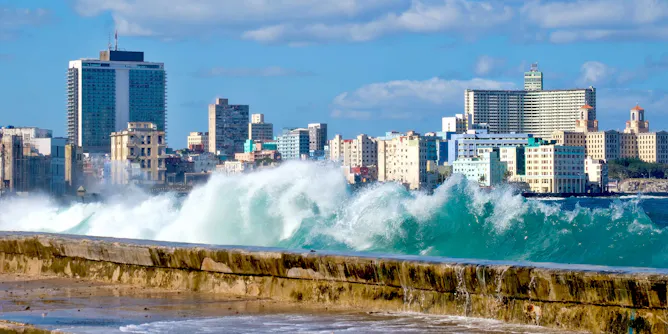
Sea-level rise isn’t the only climate-related problem for our coasts – extreme waves that cause flooding and erosion are also changing, but exactly how is hard to predict.
Articles on Forecasting
Displaying 41 - 60 of 63 articles
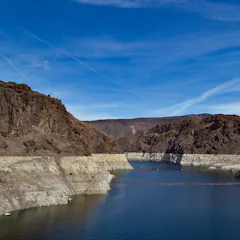
Unprecedented droughts leave the subsurface drier than usual, affecting water supply in subsequent years.

The assumption that more detail is better is questioned by a new study.

Buying and selling stocks – with real or play money – is a way to harness the wisdom of the crowd about questions like who is going to win a competition.
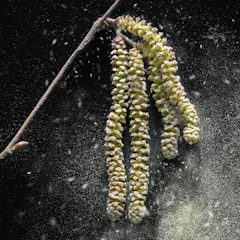
Pollen brings seasonal misery to millions of Americans, but it serves a critical purpose: fertilizing many kinds of plants, including food crops.

Could South Africa’s flooding in 2022 have been foreseen? It has long been a challenge for scientists and engineers around the world.
Weather forecasting is complex and challenging. The process entails three steps: observation, analysis and communication.
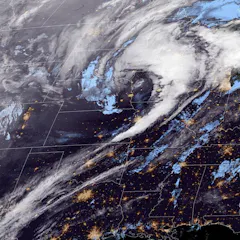
Forecasters described it as a ‘historical weather day.’ An atmospheric scientist who was at the heart of the storms explains what happened.

Part of the 2021 Nobel Prize in Physics was awarded for work modeling Earth’s climate using its chaotic, complex weather. To scientists, chaos lies in the gray zone between randomness and predictability.

Some so-called superforecasters are claimed to have predicted the course of the pandemic better than scientific experts.
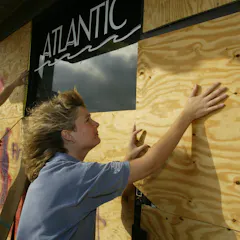
New Orleans has about a 40% chance of getting hit by a tropical storm in any given year. Here’s how heat, winds and the shape of the seafloor raise the hurricane damage risk.
Can political prediction models pick the election winner better than the polls, the weather or Washington’s football team?
Many of the more formal models for predicting the pandemic try to understand why changes happen – but often it can be more accurate to ignore the reasons and simply look at the data.
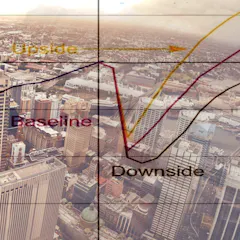
The global financial crisis taught us recoveries needn’t be V-shaped.

Learning from past epidemics about the long-term future of COVID-2019.
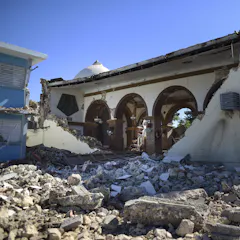
Puerto Rico’s January earthquakes came after many foreshocks and have been followed by numerous aftershocks. Scientists are studying these sequences to improve earthquake forecasting.

The summer forecast from the Bureau of Meteorology predicts a hot, dry summer.
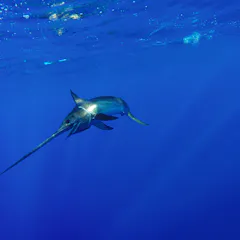
A new tool called EcoCast helps fishermen in the West Coast figure out where it’s best to fish that day.

Technology can only go so far in making sense of our vast and intricate atmosphere.
The warm period will occur even on top of regular climate change.
Top contributors
-

Meteorologist and Research Program Manager, University of Wisconsin-Madison
-
Adjunct Professor (Practice) in the School of Earth, Atmosphere and Environment, Monash University
-
Professor of Economics, University of Arizona
-
Climatologist, Australian Bureau of Meteorology
-
Professor of Operations Research, Brock University
-
Assistant Professor of Geology and Geological Engineering, Colorado School of Mines
-
Senior Climatologist, Australian Bureau of Meteorology
-
Project Scientist, University of California, Santa Cruz
-
Researcher in Ecosystem Dynamics, University of California, Santa Cruz
-
Senior Research Fellow, University of Oxford
-
Assistant Professor, Université Mohammed VI Polytechnique
-
Research Hydrologist, USDA-ARS, University of California, Berkeley
-
Professor of Floriculture and Ornamental Horticulture, Mississippi State University
-
Associate Professor of Atmospheric Science, Texas A&M University
-
Research scientist, University of Reading