
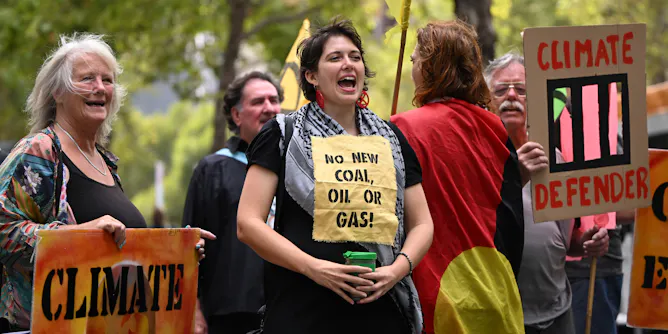
Taking small, personal actions doesn’t seem to stop people from seeing the big picture on climate change.
Articles on Environmental footprint
Displaying all articles

From corflutes and how-to-vote cards to 250,000 pencils, 240,000 volunteer vests and 80,000 ballot boxes, here’s what happens to election materials after polling day.

The AI industry is expending vast resources on growth, fuelled by unrealistic optimism about technology and the future.

The last thing we want to do is take the pleasure away from eating. But bite-sized changes add up to significant environmental benefits.

Four graphs that show us how humanity’s impact on the planet is growing.

Shall I order the chicken, or the salmon? What does the science say about reducing pressure on the environment? When you take a big-picture view, the results can be surprising.

As the FIFA World Cup kicks off, researchers take a look at the impact of climate change on the future of soccer.

Environmental footprint calculators may promise to help consumers lead a greener life. But they may in fact encourage choices that don’t benefit – or even harm – the environment.

A new study puts numbers to the health and environmental benefits – or impacts – of individual foods and shows how small changes can make a significant difference.

Six hours of streaming video may be the equivalent of burning one litre of petrol.

To be clear, I’m not advocating compulsory population control, here or anywhere. But we do need to consider a future with billions more people, many of them aspiring to live as Australians do now.

The adverse environmental impacts of academic travel are known. It is now up to institutions to determine how to adapt to these impacts.

July 29, 2019 is ‘Earth Overshoot Day,’ a date coined by the nonprofit Global Footprint Network to publicize overuse of Earth’s resources. But their estimates may actually understate the problem.

August 1, 2018 is ‘Earth Overshoot Day,’ a date coined by the nonprofit Global Footprint Network to publicize overuse of Earth’s resources. But their estimates actually understate the problem.
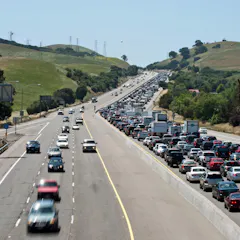
Cognitive dissonance: scholars need to confront the undeniable conflict of pushing for action on climate change, while maintaining a high-energy lifestyle.

Food is a big part of everyone’s carbon footprint – about the same as electricity use. How can our diet make farming more planet-friendly?

A philosopher’s thoughts on how an individual can overcome the feeling of helplessness in the face of global climate change.
Top contributors
-

Professor of Sustainable Development, Michigan State University
-
Holcim (US) Professor of Sustainable Enterprise, Ross School of Business, School for Environment & Sustainability, University of Michigan
-
Associate Professor, Environmental Studies, University of California, Santa Cruz
-
Adjunct Professor, Australia-China Relations Institute, University of Technology Sydney
-
Adjunct Professor, University of New England
-
Professeur adjoint, Faculté des sciences de l'activité physique, Université de Sherbrooke
-
Research Associate in Environmental Health Sciences, University of Michigan
-
Visiting Researcher, Anglia Ruskin University
-
Professor of Physics, Monash University
-
Lecturer, School of Environment and Science, Griffith University
-
Postdoctoral fellow, Université de Montréal
-
Visitor, School of Life and Environmental Sciences, Deakin University
-
Senior Lecturer in Environmental Sustainability, School of Life and Environmental Sciences, Faculty of Science, Engineering & Built Environment, Deakin University
-
Senior Communication Coordinator, Monash University
-
Adjunct Senior Research Fellow, University of New England