

There are any more sophisticated programs available for managing health data. Why did Public Health England use Microsoft Excel?
Articles on Data
Displaying 161 - 180 of 494 articles

Internet technologies and the devices that enable information access and transfer are useful in crisis management. Accessing these readily available digital technologies can help community resiliency.
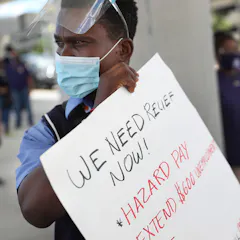
Slow, unreliable labor force data have consequences for out-of-work Americans and the economy.

Poor and inconsistent pricing data makes it hard to assess agricultural markets.

Six hours of streaming video may be the equivalent of burning one litre of petrol.

A recent report by the CDC estimated that the true number of COVID-19 cases in the US could be six to 24 times more than the number of confirmed cases. A public health scholar explains the implications.

A White House decision to take over collection of COVID-19 data from the CDC sparked worries over political interference. A public data expert talks about the importance of transparent public data.
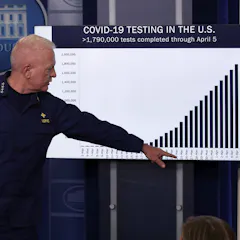
Visualizations can help you understand data better – but they can also confuse or mislead. Here, some tips on what to watch out for.

A close look at Florida’s economy shows just how vulnerable the state and its population are to a pandemic, and some of the reasons state officials hesitate to take action.

Just because YouTube recommends a video doesn’t mean it has medically valid information.

The prospects of elimination remain elusive but even with the current Victoria outbreak, Australia is maintaining a high number of tests per thousand people.
Police departments have suggested using contact tracing approaches to track protesters, raising concerns about data and privacy.

Artificial intelligence insatiable data needs has encouraged the mass collection of personal data, placing privacy at risk. But AI can help solve the very problem it creates.
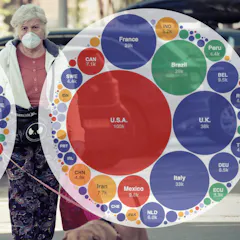
Australia is performing better than many other countries with comparable populations and geographies, a new COVID-19 data visualisation reveals.
Why one city suffers significantly more deaths than another isn’t always obvious. A simple experiment shows how failing to consider certain factors can point policy makers in the wrong direction.

Collecting, analyzing, aggregating and communicating data collected from businesses and industries can help consumers make purchasing decisions that align with their values.

The social impacts of the coronavirus will leave a legacy long after the virus itself.

Coronavirus is hitting some communities harder than others. But a lack of very basic data categorisation means it’s difficult for the UK government to tailor its response.

Gathering race-based data during the coronavirus pandemic is essential for Indigenous communities, racialized people and those with disabilities and mental health challenges.

The government doesn’t know how many people have died of COVID-19, in part because it didn’t require nursing homes to report cases to the CDC. In some states, over half of deaths are in nursing homes.
Top contributors
-

Co-Founder of The Data Tank and Co-Founder and Chief Research and Development Officer of the Governance Laboratory (GovLab), New York University
-
Associate Professor of Human Development and Family Studies, Demography and Public Policy, Penn State
-
Associate Professor of Political Science, University of Richmond
-
Associate professor, University of Sydney
-
Professor of the Practice of Data Science, Washington University in St. Louis
-
Professor of Health Services and Policy Research, University of British Columbia
-
Clinical Senior Research Associate, MRC Epidemiology Unit, University of Cambridge
-
Honorary Enterprise Professor, School of Population and Global Health, and Department of General Practice and Primary Care, The University of Melbourne
-
Director of the International Laboratory of Demography and Human Capital, Russian Presidential Academy of National Economy and Public Administration
-
Professor of Health Economics, University of Hong Kong
-
Professor of Economics, emeritus, Stony Brook University (The State University of New York)
-
Former postdoctoral researcher on machine learning applied to chemical engineering and currently science communicator for the National Museum of Emerging Science and Innovation (Miraikan), University of Tokyo
-
Lecturer in Data & Society, University of Edinburgh
-
Scientia Professor of Economics, UNSW
-
Associate Professor of Health Studies