
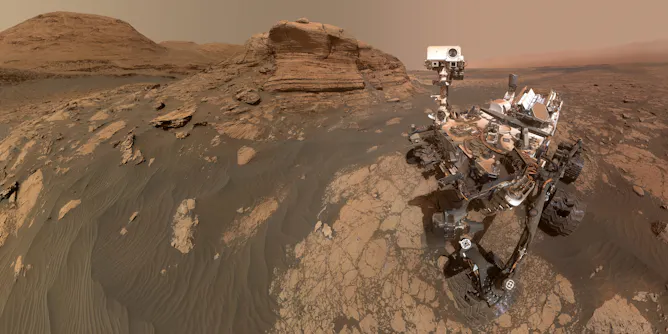
Each day in the control room of the Curiosity rover is jam-packed with important scientific decisions, as a NASA project scientist describes.
Articles on Curiosity Rover
Displaying 1 - 20 of 21 articles
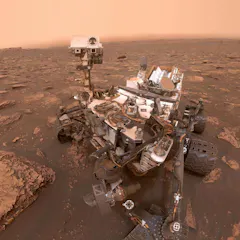
Analysis of a rock examined by the Curiosity rover reveals an abundance of organic matter.
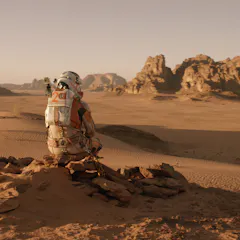
NASA hasn’t landed humans on Mars yet. But thanks to robotic missions, scientists now know more about the planet’s surface than they did when the movie was released.
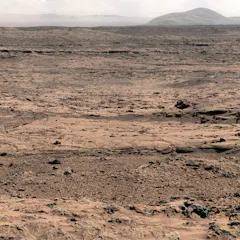
NASA’s Curiosity rover has spotted carbon-containing minerals that can tell scientists more about what ancient Mars’ atmosphere may have looked like.

A rock from a presumed ancient lakebed contains complex organic molecules.

It’s not easy to collect rocks on a budget when the rocks are 140 million miles away.
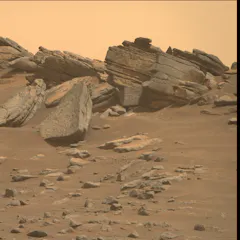
Determining whether or not life exists on another planet is an extraordinarily complicated – and expensive – scientific endeavor.

Among the missions being planned is a huge helicopter drone to explore Saturn’s moon Titan.

AI poses a variety of ethical conundrums, but the NASA teams working on Mars rovers exemplify an ethic of care and human-robot teamwork that could act as a blueprint for AI’s future.
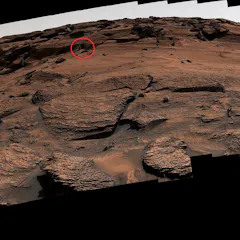
We should not be surprised that some of the innumerable rocks on Mars have weird shapes, because many have been sand-blasted by wind erosion for billions of years.
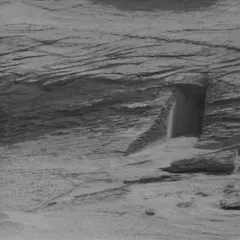
A photo of ‘doorway’ on Mars shows how ready our minds are to see significance and signs of life in the natural world.
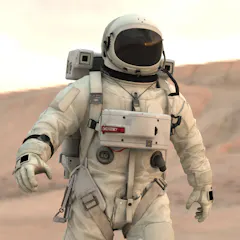
Mars is the fourth planet from the Sun and one of our closest neighbors in space. But it’s not a very welcoming place for an Earthling to visit.

The first Martian might just be a human being.
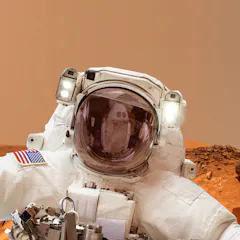
As commercial spaceflight companies lower the cost of reaching space, nations can launch more missions. But while astronauts are great for whipping up enthusiasm, is a manned mission worth the cost?
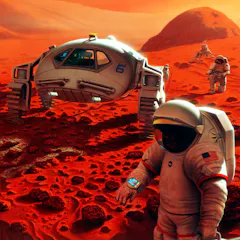
NASA’s InSight Mars lander touches down Nov. 26, part of a careful robotic approach to exploring the red planet. But human exploration of Mars will inevitably introduce Earth life. Are you OK with that?
Following NASA’s latest discovery of organic matter on the red planet, new findings in a salt lake in California could point to where to look for alien life.
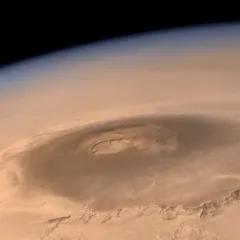
They erupted for billions of years and make Earth’s volcanoes look like molehills. Here’s what we know and what we don’t know about them.

This week, NASA has discovered great similarities between the Earth and Mars and Pluto. But when it comes to the potential for life, Mars is an increasingly hot favourite.
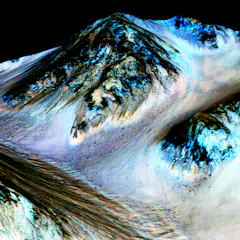
Now that we have discovered liquid water on the surface of Mars, what does this mean for the prospects of finding life there, past or present?
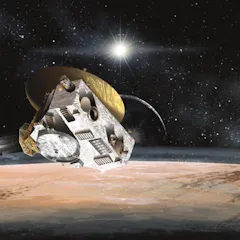
Everything in space is so far away, but probes bring us closer.
Top contributors
-

UKSA Mars Science Fellow, Department of Physics, University of Oxford
-
Assistant Professor of Geology, University of Florida
-
Lecturer in Astronomy, Nottingham Trent University
-
Lecturer in Mathematics, University of Dundee
-
Research Associate (School of Geographical and Earth Sciences), University of Glasgow
-
Senior Lecturer in Earth System Science, Northumbria University, Newcastle
-
Australian Research Council Future Fellow, The University of Western Australia
-
Senior Lecturer in Geology, University of Aberdeen
-
Associate Deputy Vice Chancellor, Research (Interim), Curtin University
-
Director, Binar Space Program, Curtin University
-
University Distinguished Professor of Astronomy, University of Arizona
-
Ph.D. Student in Geological Sciences, University of Florida
-
Distinguished Educator in Residence, Boise State University
-
Honorary Fellow, Space and Astronomy, CSIRO; Western Sydney University
-
Associate Professor of Sociology, Princeton University