
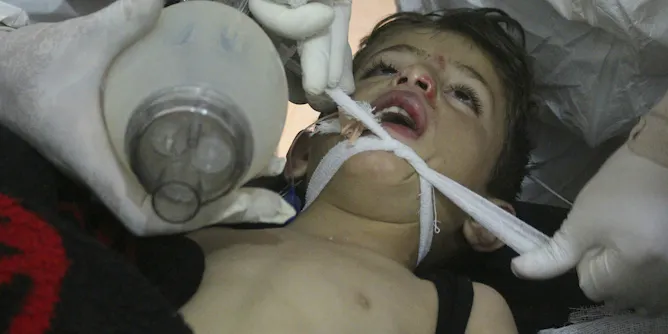
Will recent photos of chemical attack victims in Syria provoke a short-term emotional reaction or a sustained humanitarian campaign?
Articles on Chemical weapons
Displaying 41 - 60 of 85 articles
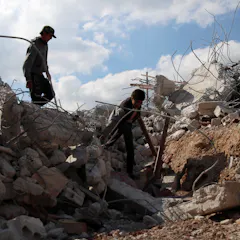
The recent American airstrike in Syria has created a new norm in international law sanctioning the unilateral use of force to punish those who deploy chemical weapons against their own people.

A Russian media expert spent the weekend consuming Russian coverage of America’s response to the chemical attacks in Syria.

The Organisation for the Prohibition of Chemical Weapons Fact Finding Team has not yet revealed the nature of the chemicals used in Khan Sheikhoun.
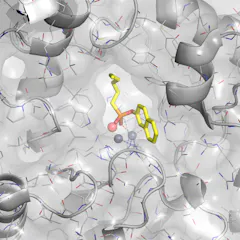
Scientists invented chemical weapons; some are now working to destroy them. New biomolecular design techniques let researchers design proteins that can destroy nerve agents in bodies.
‘America First’ apparently doesn’t mean a step away from playing the world’s policeman – and three more things to note about U.S. airstrikes on Syria.
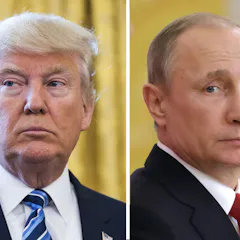
A thawing of tensions between the two superpowers seems as far away as it was under Obama.
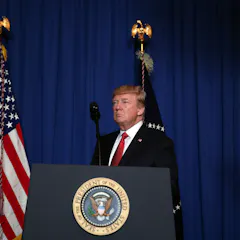
Donald Trump suddenly appears to have been overcome with a sense of responsibility towards the people of Syria. How can that be explained?

The use of chemical weapons will put even more pressure on fragile peace talks.
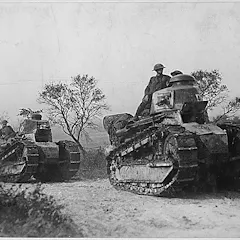
America’s longstanding tradition of isolationism meant that in 1917 U.S. forces needed a lot of support from overseas allies to fight effectively.

The characteristics of chemical weapons also make them weapons of terror. They do not only injure the body. The threat of chemical weapons harms the minds of soldiers and civilians.
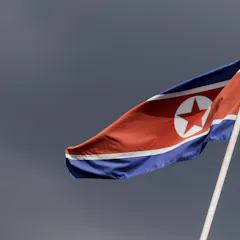
A precise, lethal chemical weapon hit in a foreign capital is a reminder that North Korea knows what it’s doing.

Using nerve agents is banned under the Chemical Weapons Convention, but North Korea is not a party to it.

In early December, the nations of the world are poised to take an historic step on nuclear weapons. Yet Australia sticks out like a sore thumb among Asia-Pacific nations in arguing against change.

The US will only take action on WMD when it suits them.
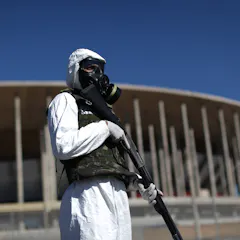
Governments often have limited knowledge of chemical production as it is the preserve of the private sector. Often these facilities are not as well secured as government facilities.
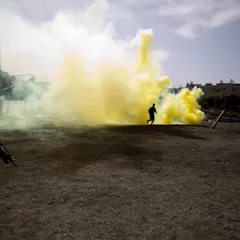
Very few countries remain outside the world’s chemical weapons control regime. Why would Israel want to keep company with North Korea?

The Assad government is accused of using chlorine gas as a weapon against its own people.

The survival of civilians seem forgotten in a new U.S. and Russian agreement to root out IS and other terrorists in Syria.

Syria’s chemical weapons were supposedly all destroyed in 2014, but news reports indicate that nerve gas may have been kept back.
Top contributors
-

Professor of International Relations, Royal Holloway, University of London
-
CBRN defence scientist, Charles Darwin University
-
Lecturer in Security and Public Policy, University of Bath
-
Senior Lecturer in Chemistry, University of Birmingham
-
Senior Lecturer in Epidemiology, Lancaster University
-
Assistant Professor, Institute of Security and Global Affairs (ISGA), Leiden University
-
Associate Professor of Chemical Engineering, The University of Melbourne
-
Professor of Science Communication and Chemistry, University of Hull
-
Emeritus Professor of Chemistry, University of St Andrews
-
Lecturer in International Relations and International Security, University of Bath
-
Professor (Emeritus) of Environmental Toxicology, University of Leeds
-
Senior Research Scholar at the Center for International Security and Conflict, Stanford University
-
Lecturer European Politics, Leiden University
-
Associate Fellow, SPRU, University of Sussex Business School, University of Sussex
-
Senior Lecturer in International Relations, University of Portsmouth