
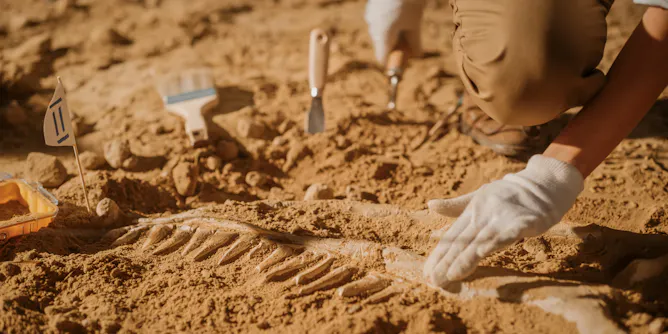
Charles Darwin knew the evidence from fossils contradicted evolution. Researchers are still trying to work out the problem today.
Articles on Charles Darwin
Displaying 21 - 40 of 103 articles
Scientists have discovered a new species of mosasaur, a sea-dwelling lizard from the age of the dinosaurs, with strange, ridged teeth unlike those of any known reptile.

The fossil record tells conflicting stories about what happened to flowering plants after the asteroid.
We may have become the most complex living creature in part by accident and replication of error.
Reef corals grow vigorously in nutrient poor water – new research has found out why.
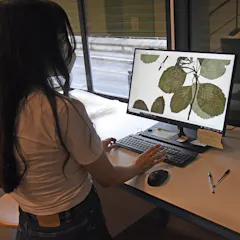
The colonial era profoundly shaped natural history museums and collections. Herbaria, which are scientists’ main source of plant specimens from around the world, are no exception.
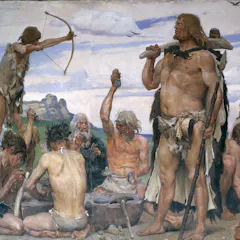
From Aristotle to Darwin, inaccurate and biased narratives in science not only reproduce these biases in future generations but also perpetuate the discrimination they are used to justify.
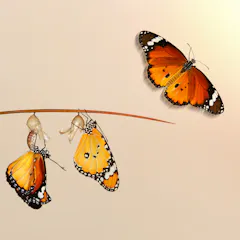
There is more to evolution than the genes species inherit.
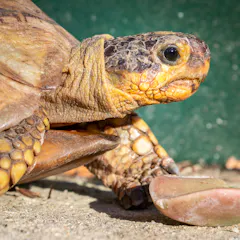
Track marks are a way to fill in the blanks that sometimes exist in the body fossil record.
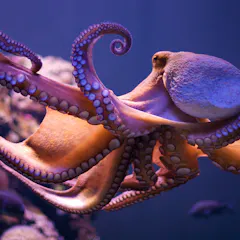
DNA analysis is beginning to reveal how wrong the long-accepted evolutionary tree is.
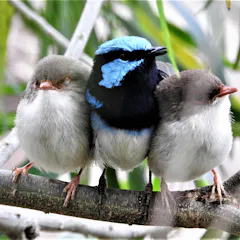
A long-term study of wild animal populations shows each generation is on average almost 20% genetically ‘better’ than their parents at surviving and reproducing.
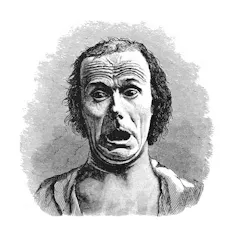
In 1872, Charles Darwin published a book on expressions and emotions that modern science is only beginning to catch up with.
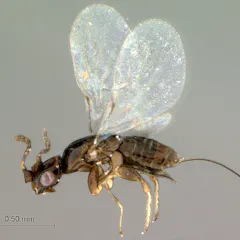
Assuming that natural selection shapes all animal and plant traits is a false impression. Natural selection is a mindless process.
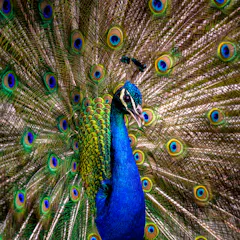
Darwin thought female animals were non-strategic and uniform, making similar decisions.
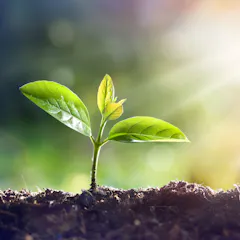
David Attenborough’s new BBC documentary The Green Planet shows plants are stranger than they first appear.
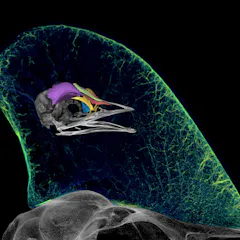
Scientists have been using art to illuminate and share their research with the public for centuries. And art could be one way to bolster K-12 science education and scientific literacy in the public.
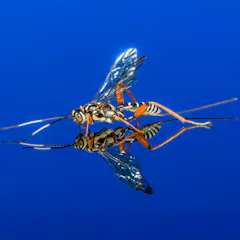
Parasitic wasps are body-snatchers — if you’re an insect. But these much-maligned creatures have saved millions of human lives by controlling the spread of the cassava mealybug.
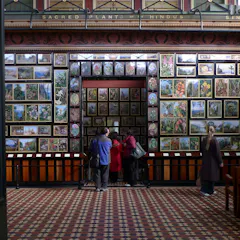
A special gallery in London’s Kew Gardens allows the visitor to travel the world via the 800-plus detailed paintings of Marianne North, Victorian-era adventurer and botanical artist.
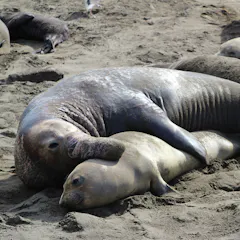
The sexual selection of larger males may be driven by an abundance – not a scarcity – of females.
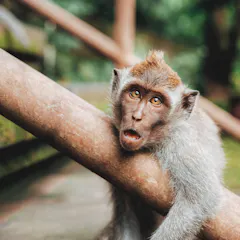
First published 150 years ago, this work is shaped by Victorian-era sexual and racial stereotypes. But at a time when other evolutionists stressed humanity’s uniqueness, Darwin emphasised our ‘lowly nature’.
Top contributors
-

Professor of Evolutionary Palaeobiology at the Milner Centre for Evolution, University of Bath
-
Lecturer in History of Medicine/Life Science, The University of Melbourne
-
Paul Braterman is a Friend of The Conversation.
Hon. Research Fellow; Professor Emeritus in Chemistry, University of Glasgow
-
Emeritus reader in science education and communication, University of Sussex
-
Managing Director, Triple Helix Consulting; Honorary Professor, ANU Fenner School for the Environment and Society, Australian National University
-
Associate Professor of History, The University of Queensland
-
Jenny Graves is a Friend of The Conversation.
Distinguished Professor of Genetics and Vice Chancellor's Fellow, La Trobe University
-
Emeritus Strategic Professor in Palaeontology, Flinders University
-
Senior Lecturer, Zoology, University of Aberdeen
-
Professor of Public Policy, University of Maryland
-
Associate professor in Vertebrate Palaeontology, University of the Witwatersrand
-
Directeur de recherche CNRS, systématicien, directeur de l’Institut de systématique, évolution, biodiversité (ISYEB), Centre national de la recherche scientifique (CNRS)
-
Research Officer, CQUniversity Australia
-
Adjunct Lecturer, Archaeology, Flinders University
-
Professor of Evolutionary Biology and Science Engagement, University of East Anglia