
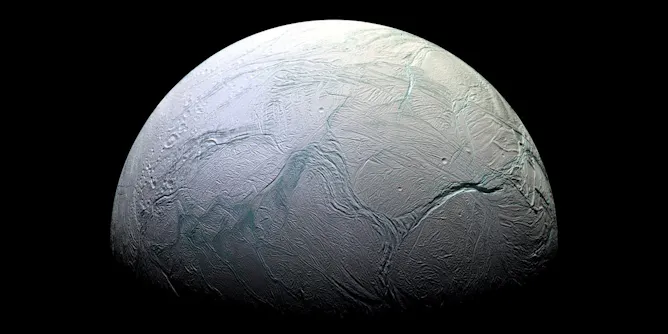
The icy moon appears to have an ocean of liquid water hidden under its outer shell.
Articles on Cassini
Displaying 1 - 20 of 24 articles
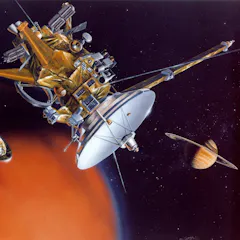
From the International Space Station to the twin Mars rovers, scientists and astronauts often form a deep emotional bond with the space objects they work with.
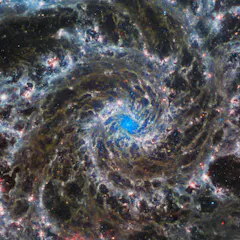
Recent research shows the main alternative theory to dark matter, Milgromian dynamics, is failing.
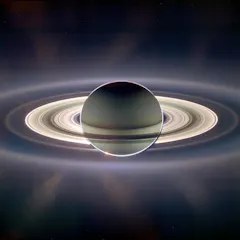
New research suggests Saturn’s rings may be surprisingly young.
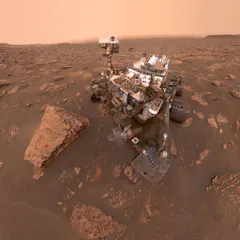
The clouds of Venus may harbour alien life. But where else?
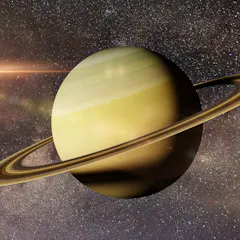
Most people think that many millions of years ago, Saturn didn’t have rings at all. Instead, it had a big moon moving around it. Eventually, the moon burst and broke into pieces.
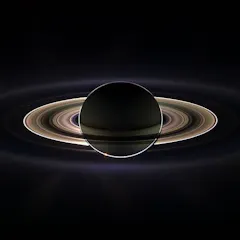
Although the rings of Saturn may look like a permanent fixture of the planet, they are ever-changing. New analyses of the rings reveal how and when they were made, from what and whether they’ll last.
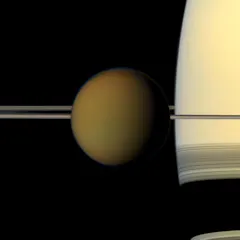
Titan is more than a billion kilometres from our Sun but occasionally it’s shadow can be seen here on Earth, with the right technology. That’s what scientists gathered in Western Australia to observe.
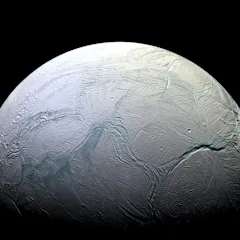
Scientists used to think that the ocean on Enceladus would be transient, perhaps freezing after a few million years. A new study suggests this isn’t the case.
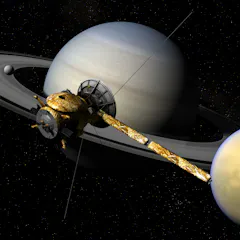
As Cassini’s titanic mission comes to an end, we need to start thinking ahead. A combined mission to explore Saturn’s moons Titan and Enceladus would be a good place to start.
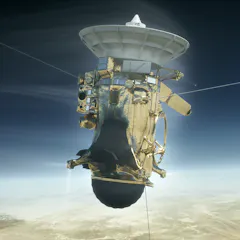
The last signals from Cassini space probe before it burns up in Saturn’s atmosphere will tracked by the Canberra Deep Space Communication Complex.
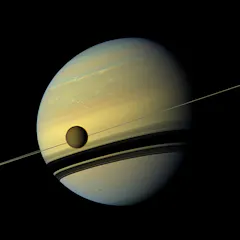
The Cassini space probe discovered liquid lakes, poisonous gases and the basic elements of life on Saturn’s moon, Titan.
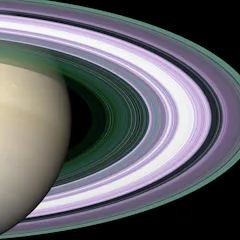
The Cassini space probe took us up close and through the beautiful rings of Saturn. It captured some amazing images, and even the sound of the rings during its mission.
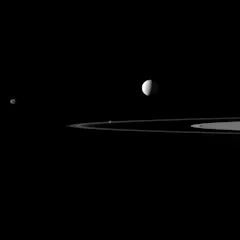
The Cassini space probe discovered several new moons on its mission to Saturn, and revealed fresh views of the moons we already knew about.
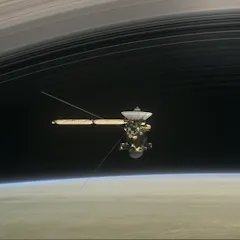
With only days to go before NASA’s Cassini space probe ends its two-decade mission to explore Saturn, what has it revealed about the ringed planet, the second largest in our solar system?
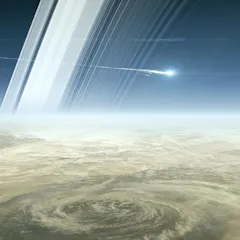
Cassini is about to crash into Saturn to avoid contaminating its habitable moon Enceladus.

Fingers on buzzers.
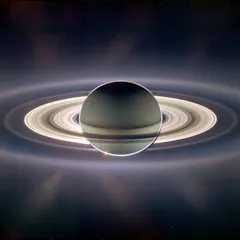
One of the most successful space exploration missions of all time still has a lot left to uncover.
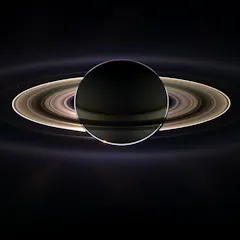
With the probe now on its ‘Grand Finale,’ a Cassini team member describes the amazing discoveries it made about the ringed planet and its many moons.
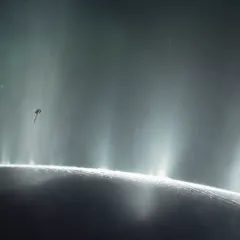
Earth is a relatively dry planet compared to some of the other ocean worlds in our Solar system. Life needs water so what about life on these other places?
Top contributors
-

Senior Curator (Astronomy), Museums Victoria Research Institute; The University of Melbourne
-
Professor of Planetary and Space Sciences, The Open University
-
Postdoctoral research associate, University of Oxford
-
Professor of Planetary Geosciences, The Open University
-
Professor of Planetary Science, University of Leicester
-
Professor of Antarctic Science, University of Tasmania
-
Research Fellow, La Trobe University
-
Facilities Program Director Nasa Operations Canberra Deep Space Communication Complex , CSIRO
-
Professor of Physics & Astronomy, University of Montana
-
Sea ice microbial physiologist, University of Tasmania
-
Professor in Earth Sciences, Nanyang Technological University, Singapore, and Emeritus Professor of Mineral Physics, University of Cambridge
-
Associate professor, The University of Western Australia
-
Research fellow, Macquarie University
-
PhD candidate, Meteorology, University of Reading
-
Senior Research Fellow of Cosmology, University of Portsmouth