
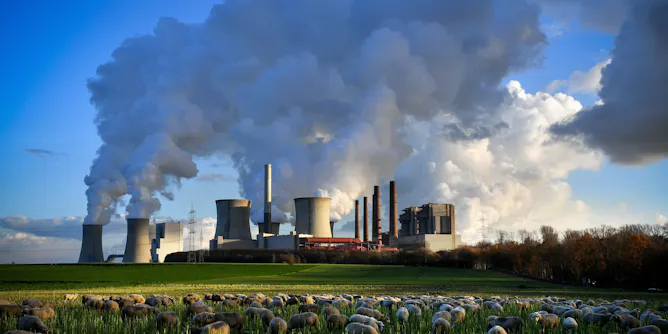
Carbon emissions will hit a record high for the second year in a row, but there is a small silver lining: the rate of emissions growth has slowed dramatically.
Articles on Carbon emissions
Displaying 241 - 260 of 543 articles

There’s no question Tesla’s Cybertruck will face stiff competition in the electric pickup truck market. Here’s why it has the edge.
Effective engineering solutions to tackle climate change already exist but there is a desperate lack of conviction to address the emergency.

Making better use of existing building space is a neglected but essential way to cut our carbon emissions. The key is human behaviour. Good low-carbon citizens will help create good low-carbon cities.

In major cities around the world, dockless scooters and bikes are everywhere, yet the companies themselves are often breathtakingly short-lived. Basic economic concepts give us clues why.

Instead of boycotting palm oil, source it from pastureland and not recently logged forests.
The cement needed to make concrete – the most widely used man-made material – is a major source of global emissions. Researchers are working on a green replacement that could transform the sector.
Recent debates about the future of nuclear power in Australia make much of the potential of the next generation of reactors.

City trees are often short-lived and many others get cut down in their prime. Turning them into mulch both wastes timber and releases stored carbon. A wood rescue program creates a more fitting legacy.
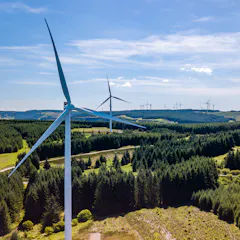
Wales is one small country with big carbon targets but that still needs the policies to deliver them.

The future of zero-carbon transport starts today. First stop, Britain’s railways.

Developers pay more tax to refurbish than demolish and rebuild – but there’s a very easy fix.

Labor productivity doesn’t matter as much as emissions productivity. Workers aren’t a particularly finite resource.
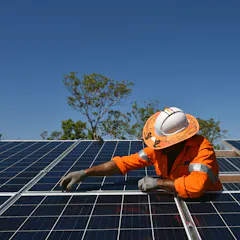
Australia’s renewables revolution proves that there’s cause for hope in our emissions reduction goals. But we cannot rest on our laurels.
Despite voting to remain a member of an Australian coal lobby group, there are growing divisions between fossil fuel extractors and the larger energy industry.

The vast emissions caused by these individuals suggest that a very small share of humanity has a very significant role in global warming.

The fossil fuel industry plans to compensate for declining demand for gasoline by flooding the world with more plastic.

Carbon emissions from international air travel show no sign of abating. In the absence of a tax on jet fuel, are sail boats the best way to travel the world sustainably?
Australia cannot distance itself from moral responsibility for emissions from exported fossil fuels.
Labour’s next manifesto could be defined by a radical proposal for tackling climate change.
Top contributors
-

Chief Research Scientist, CSIRO Environment; Executive Director, Global Carbon Project, CSIRO
-
Professor, Crawford School of Public Policy and Director, Centre for Climate and Energy Policy, Australian National University
-
Royal Society Research Professor of Climate Change Science, University of East Anglia
-
Senior Researcher, Center for International Climate and Environment Research - Oslo
-
Climateworks Centre CEO, Monash University
-
Senior Lecturer, Griffith Business School, Griffith University
-
Senior Researcher, Center for International Climate and Environment Research - Oslo
-
Senior Research Associate, Renewable Energy & Energy Systems Analyst, UNSW
-
Professor, Department of Earth System Science, and Chair of the Global Carbon Project, Stanford University
-
Professor, School of Economics, The University of Queensland
-
Senior Fellow in Energy and Climate Change, Grattan Institute
-
Associate Professor, The University of Western Australia
-
Senior Research Fellow, School of Geography, Earth and Atmospheric Sciences, The University of Melbourne
-
Honorary Fellow, The University of Melbourne
-
Professorial Fellow, University of Canberra