
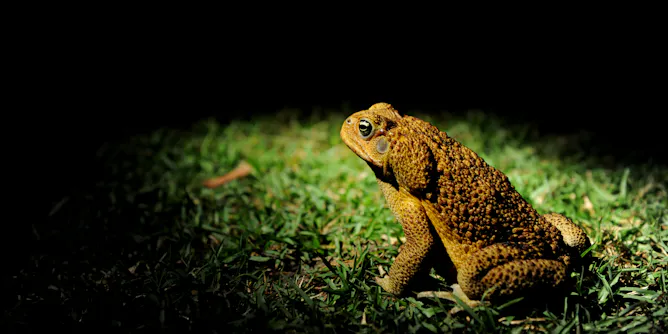
Cane toads will reach Broome in the next couple of years. Creating a waterless “containment zone” is the only way to stop them pillaging the Pilbara.
Articles on Cane toads
Displaying 1 - 20 of 33 articles
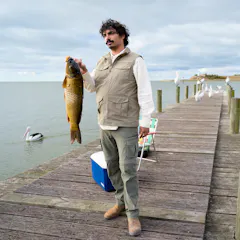
New ABC series Eat the Invaders asks should invasive species be on our dinner plate – and what does it taste like?
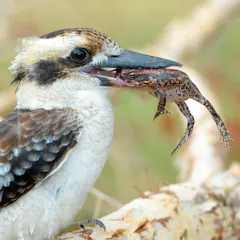
New research suggests if we can’t eradicate cane toads, we can teach wildlife not to eat them.
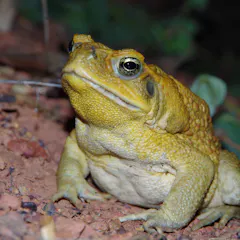
Cane toads are evolving as they spread across Australia. Parasitic lungworms are becoming more infectious to keep up.
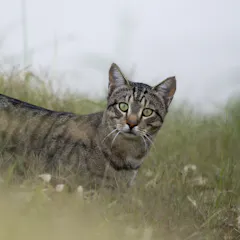
Feral cats double the size of domestic tabbies. Cane toads with longer legs. And dingoes with flexible joints. ‘Selection pressure’ is at work on introduced animals.
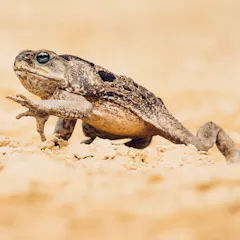
The simulation showed catching cane toads once a week involved 85% less cost and effort than other strategies, but was just as effective.
Biological control strategies curb pests using other species that attack the invader. A biologist explains why it can take more than a decade to develop an effective biological control program.
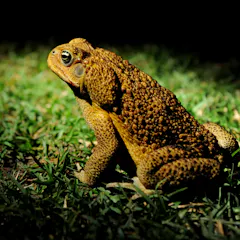
Without urgent action, Australia will continue to lose billions of dollars every year on invasive species.

Australia’s invasive cane toads may be out-evolving their lungworm parasites.

When neatly dissected cane toad corpses began turning up next to a creek in the Kimberley, scientists went on the hunt for the clever killer.
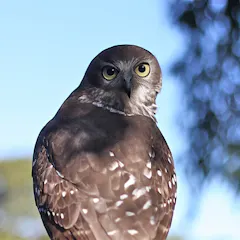
Invasive species are the biggest single threat to Australian plants and animals.

There are exciting synergies between western science and indigenous knowledge. Surprisingly, the success of our Australian predator conservation research was due entirely to its multicultural nature.
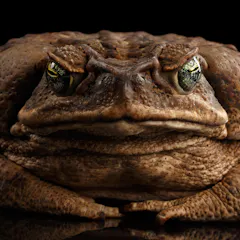
Pauline Hanson’s idea to reduce cane toad numbers is fundamentally flawed, both in economic theory and in practice.

New genetic knowledge about cane toads could give us the knowledge we need to throw some more roadblocks in front of this persistent invader as it marches across Australia.
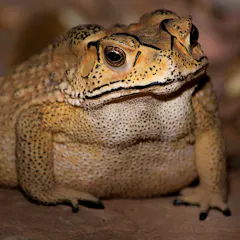
New study confirms fears that the island’s native wildlife can be poisoned by introduced Asian toads.
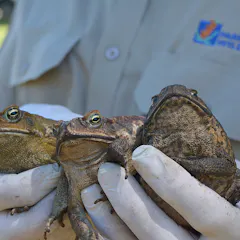
New cane toad traps that carefully imitate mating males successfully target breeding females. Males, meanwhile, will turn up for anything that sounds remotely like a toad.
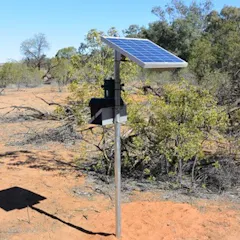
In a global first, hundreds of solar-powered microphones will be placed across Australia, listening out for invasive species, rare animals and the effects of climate change.
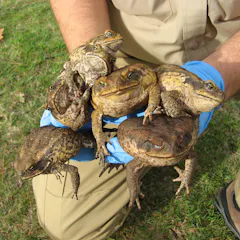
It sounds weird, but releasing small cane toads ahead of the main invasion front can help predators learn to avoid the biggest, most toxic ones. Here’s exactly how it works.
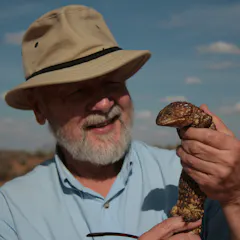
University of Sydney conservation scientist Rick Shine has won a top science honour, for work that uses evolutionary theory to try and keep cane toads from killing Australia’s native wildlife.
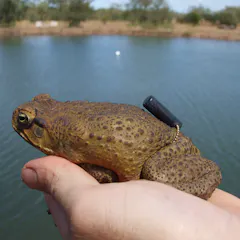
Cane toads, introduced in 1935 to control cane beetles, have now spread across a huge swathe of Australia, from the Kimberley in northern Western Australia to northern New South Wales. They’re still spreading…
Top contributors
-

Professor in Evolutionary Biology, Macquarie University
-
WA Premier's Science Fellow, Curtin University
-
Post doctoral fellow and Conservation Ecologist, Macquarie University
-
Research Director CSIRO Health & Biosecurity, CSIRO
-
Professor, Evolution and Ecology Research Centre, UNSW
-
Professor, Conservation Biology, The University of Queensland
-
Professor of Zoology, Bangor University
-
Adjunct Professorial Fellow in Research Institute for Environment and Livelihoods, Charles Darwin University
-
Senior Lecturer in Science Communication, University of Technology Sydney
-
Professor in Zoology, James Cook University
-
Senior Principle Research Scientist and Group Leader, CSIRO Health & Biosecurity, CSIRO
-
Professor in Ecology, Charles Sturt University
-
Group Leader, Biosecurity Flagship, CSIRO
-
Senior Lecturer in Pharmacology, Adelaide University
-
Professor in Microbiology and Molecular Biology, UNSW