
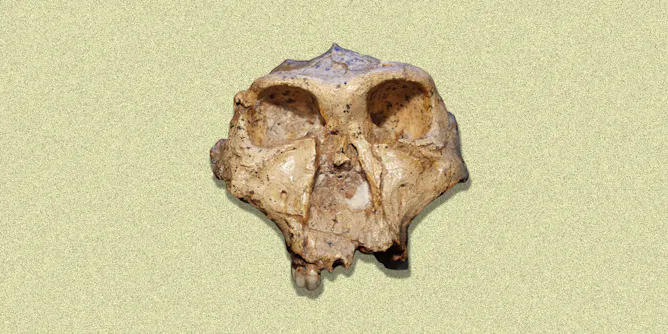
The way we classify humanity’s ancient relatives is a mess. But there’s a simple fix.
Articles on Australopithecus
Displaying 1 - 20 of 21 articles
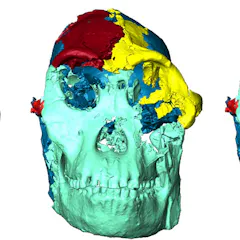
What did the face of our ancestors looks like 3 million years ago? Meet the reconstructed skull of “Little Foot” which provides valuable insights into how our ancestors adapted to their environment.

Global cooling associated with the impact of supernova remnants may have affected plants and animals, including species related to humans.

Using a method applied directly to ancient hominin teeth, researchers have calculated the age of several important fossils.
Africa’s large mammal heritage has formed a deep cultural legacy for all of humankind.

Studying the lower back allows researchers to understand how the species’ anatomy was adapted for different kinds of movement.
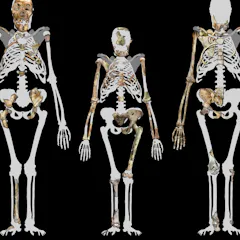
Walking has taken a very long time to develop, with evidence of bipedalism among early humans in Africa roughly 4.4 million years ago.
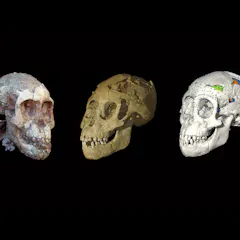
Our findings reveal the slowing down of brain development in our ape-like ancestors began more than three million years ago.
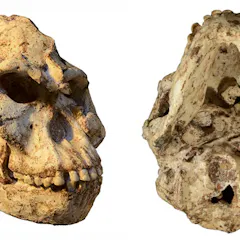
The findings suggest that this specimen could climb and move in trees. But it may also have been able to walk on the ground. This echoes previous studies.
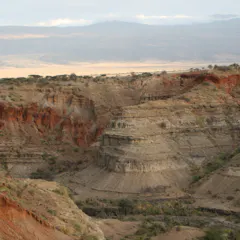
20 years ago, who could predict how much more researchers would know today about the human past – let alone what they could learn from a thimble of dirt, a scrape of dental plaque, or satellites in space.
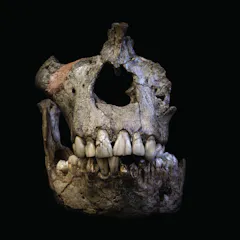
A new study shows the enigmatic hominin species Australopithecus africanus may have breastfed young for around 5-6 years – a very costly practice for the mother.

Thanks to hundreds of fossil remains found in Africa studies can explore new scenarios about how our ancestors lived and evolved.
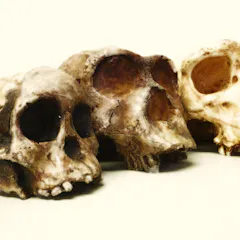
Recent research suggests that humankind’s origins lay outside of Africa. This is the nature of science: a paradigm that cannot be questioned on a regular basis becomes a dogma.
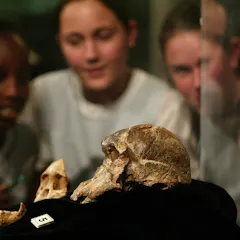
As an intellectual history of the disciplines of paleontology and paleoanthropology, Kuljan’s book is especially adept at narrating the interwoven connections between science and power.
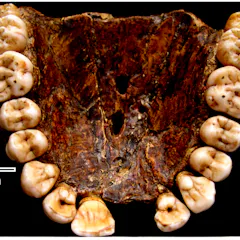
Anthropologists gather clues about how our ancient ancestors lived from their teeth. What will future anthropologists make of us based on the fossilized pearly whites we’ll leave behind?
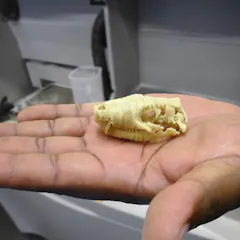
An old technique to explore the inside of fossils unfortunately ended up destroying some unique specimens. New technology has been used to reconstruct one such fossil.
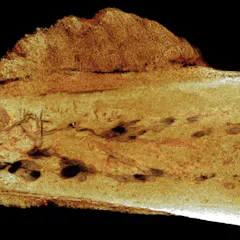
Cancer is not the modern disease many believe it to be. New fossil evidence from two South African caves suggests that its origins lie deep in prehistory.
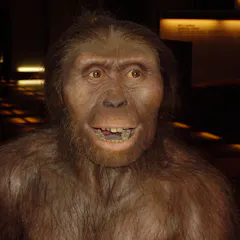
Why being human can’t be traced back to hunting, fire or any other single event.
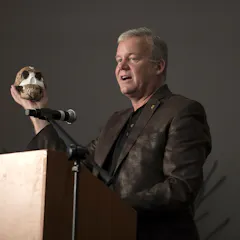
The big question being asked is: where does Homo naledi fit in the evolutionary tree? Assessing the similarity or dissimilarity between fossil skulls has provided a possible clue to the answer.
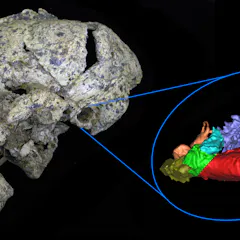
Beyond the cool factor of figuring out hominin hearing capacities two million years ago, these findings could help answer the tantalizing question of when did human vocalized language first emerge.
Top contributors
-

Honorary Research Associate, Evolutionary Studies Institute, University of the Witwatersrand
-
Associate professor in Vertebrate Palaeontology, University of the Witwatersrand
-
Lecturer, University of Cambridge
-
Associate Professor of Osteoarchaeology, Uppsala University
-
Associate Professor at the Wits Institute for Social & Economic Research, University of the Witwatersrand
-
Emeritus Professor of Human Evolution, University of Cambridge
-
PhD Candidate in Anatomical Sciences, University of the Witwatersrand
-
Professor of Anthropology, The Ohio State University
-
Associate Professor of Biological Anthropology, New York University
-
Professor in Geochronology and Geochemistry, Southern Cross University
-
Emeritus Research Professor of African Ecology, University of the Witwatersrand
-
Curator of Human Evolution of the Cleveland Museum of Natural History and Research Assistant Professor of Anthropology, Stony Brook University (The State University of New York)
-
Associate Professor of Anthropology, Rice University
-
Group Leader, Max Planck Institute for Evolutionary Anthropology
-
Professor in the Australian Research Centre for Human Evolution & Griffith Centre for Social and Cultural Research, Griffith University