
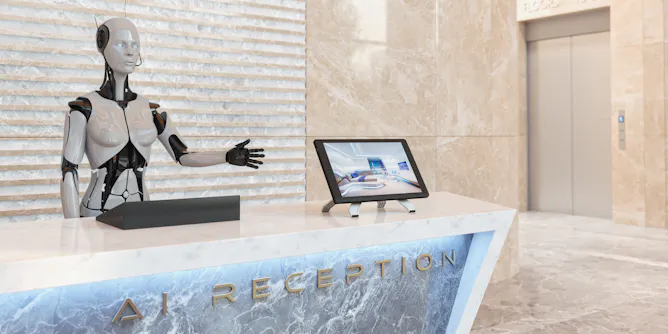
Will the hotels of the future involve fewer front desk clerks and more automated service? A hospitality expert who has written a new book on the subject weighs in.
Articles on Artificial intelligence and jobs
Displaying 21 - 40 of 49 articles

Microsoft Copilot can summarise meetings and even formulate arguments. But as good as that sounds, we shouldn’t blindly trust its accuracy.

Using technology to screen job applicants might be faster than reading CVs and face- to-face interviews but the most suitable candidate could be overlooked.

The explosion of generative AI tools like ChatGPT and fears about where the technology might be headed distract from the many ways AI affects people every day – for better and worse.
At the heart of Silicon Valley lies a powerful admiration for its ‘genius founders’ – but this comes at the cost of accountability.

It’s likely developing countries will be hit the hardest as AI become more common and more affordable.
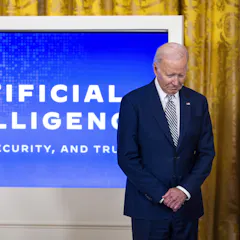
President Joe Biden has issued an executive order to regulate AI. The directives could help avoid AI doom – but they miss some key points.
The movie offers both Hollywood history and Cruise’s presence as weapons of human resistance to the hazards of AI in filmmaking.
The rapid rate of AI adoption is putting workplaces at risk of overlooking its potentially adverse impacts, particularly those that could impact the health and well-being of workers.
Media articles and influencers have helped give the impression that prompt engineering could be a ticket to a six-figure salary. The reality, as always, is a different story.
If you drop advanced AI into a dumb organisation, it won’t make it smart. It will just help the organisation do dumb stuff more efficiently (in other words, quicker).

Don’t fret the AI job ‘apocalypse’. While we can expect disruption across different industries, this will come with opportunities.
Rather than seeing artificial intelligence as the cause of new problems, we might better understand AI ethics as bringing attention to old ones.

AI is inevitably entering the workplace – some people are more OK with it than others. But do we trust this technology?

Google is one of a number of companies getting involved in AI music-generation.

Some think ChatGPT threatens education, but it might benefit educators and students alike.

While ChatGPT has the potential to enhance marketing effectiveness, it can’t replace human creativity or form meaningful connections with customers like humans can.

The technology’s focus on the framing of the artistic task amounts to the fetishization of the creative moment – and devalues the journey that waters the seed of an idea to its fruition.
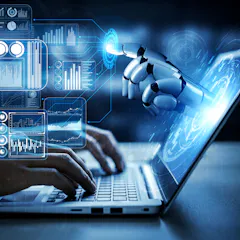
AI is already on the payroll in many workplaces – how well human employees interact with it can depend a lot on their existing attitudes and anxieties.
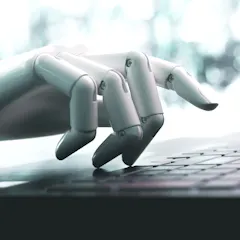
Artificial intelligence can generate text much quicker and cheaper than professional human writers. Soon, AI will have the capacity to produce text that is indistinguishable from a human writer.
Top contributors
-

Professor of Decision Sciences and Management Information Systems, Drexel University
-
Professor of Applied Mathematics, University of Leicester
-
Visiting Professor of Education, University of Wollongong
-
Professor of Management, Co-Director of the MIT Sloan Institute for Work and Employment Research, MIT Sloan School of Management
-
Professor Emeritus of Human Resource Studies and Research Fellow at the Center for Advanced Human Resource Studies, Cornell University
-
Senior Lecturer, Stellenbosch University
-
PhD Candidate, Haskayne School of Business, University of Calgary
-
Professor, University of Toronto
-
Associate Professor, University of Sydney
-
Professor in Computational Intelligence, Australian Catholic University
-
Assistant Professor, Computer Science, University of British Columbia
-
Chair in Trust, Professor of Management, The University of Melbourne; Melbourne Business School
-
Chief Executive, Gradient Institute, University of Sydney
-
Law Lecturer, CQUniversity Australia
-
Professor of Community Information, University of Michigan