
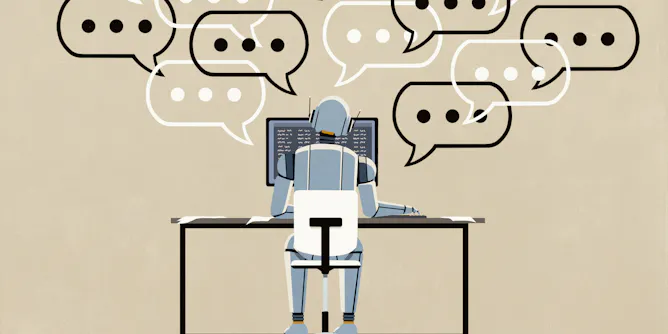
Artificial intelligence is not having widespread effects on the labor market today.
Articles on AI and jobs
Displaying all articles

Many baby boomers see AI as a revolutionary tool, while young people see it as taking away their agency.
AI may assist in the newsroom, but journalism must remain under human editorial control.
Estimates of artificial intelligence’s impact on jobs and the economy range from the apocalyptic to the utopian, but the data tells a more nuanced story.

A new survey by sociologists assessed public attitudes and perceptions about the AI-related threat of job displacement.
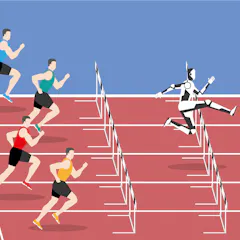
AI’s advantage over humans comes down to 4 dimensions: speed, scale, scope and sophistication. Whether AI can replace you depends on how much one or more of the S’s matter in what you do.

My experience taught me there is a way to embrace AI’s capabilities without losing the human touch in music.

It’s likely developing countries will be hit the hardest as AI become more common and more affordable.

AI could kill our creativity by making us think too alike. It also forces us to question what “creativity” is, and the different forms it can take.
The rapid rate of AI adoption is putting workplaces at risk of overlooking its potentially adverse impacts, particularly those that could impact the health and well-being of workers.
Unlike a human editor, AI cannot explain their decisions or reasoning in a meaningful way. This can be a problem in a field where accountability and transparency are important.

If you drop advanced AI into a dumb organisation, it won’t make it smart. It will just help the organisation do dumb stuff more efficiently (in other words, quicker).

Don’t fret the AI job ‘apocalypse’. While we can expect disruption across different industries, this will come with opportunities.
Top contributors
-

Associate professor, Dalla Lana School of Public Health, University of Toronto
-
Professor in Computational Intelligence, Australian Catholic University
-
Professor in Business Information Systems, University of Sydney
-
Associate Professor of Marketing, Tasmanian School of Business and Economics, University of Tasmania
-
Professorial Fellow (Artificial Intelligence), Melbourne Business School, The University of Melbourne
-
Scholar in Media and Cultural Studies, Macquarie University
-
Adjunct Fellow, Centre for Policy Futures, The University of Queensland
-
Senior Lecturer in Management, University of Tasmania
-
Senior Lecturer, Entrepreneurship & Innovation, University of Tasmania
-
Senior Principal Scientist, Strategy and Foresight, CSIRO
-
Associate Lecturer in Music Technology, University of Sydney
-
Adjunct Lecturer in Public Policy, Harvard Kennedy School; University of Toronto
-
Affiliate, Berkman Klein Center for Internet & Society, Harvard University
-
Professor of Sociology and Canada Research Chair, University of Toronto
-
PhD Student, Sociology, University of Toronto