
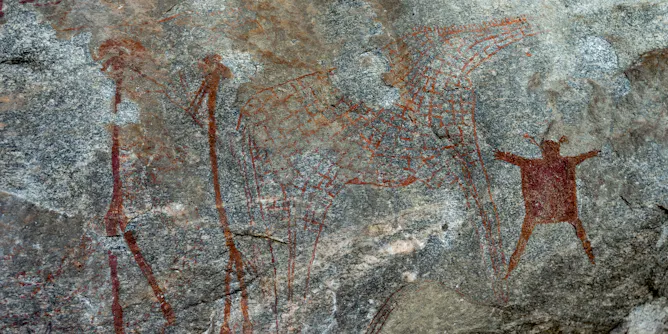
A new study doubles the age of ancient DNA in sub-Saharan Africa, revealing how people moved, mingled and had children together over the last 50,000 years.
Articles on Ancient humans
Displaying 21 - 40 of 49 articles
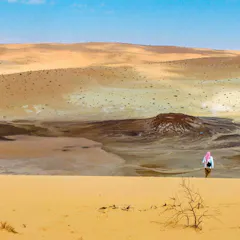
The new work presents the oldest dated evidence for hominins in Arabia, in the form of an ancient handaxe tool uncovered from the Nefud Desert.
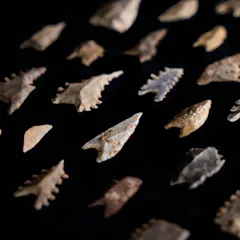
The first ancient human DNA from the Indonesian island of Sulawesi — and the wider Wallacea islands group — sheds light on the early human history of the region.
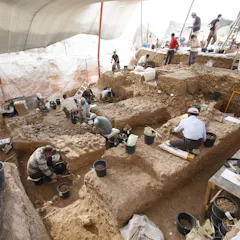
The 140,000-year-old skull fossils are leading to more questions than answers. Also found was the oldest intact campfire ever found in the open air.

Our research has also uncovered major long-term changes in ancient animal populations at Denisova Cave, and has provided the first direct evidence of Homo sapiens having lived there.

Combining evidence from archaeology, geochronology and paleoenvironmental science, researchers identified how ancient humans by Lake Malawi were the first to substantially modify their environment.

Our biggest evolutionary advantages are an ability to walk on two legs and our big brains.
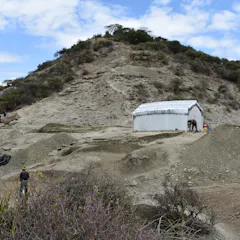
The research shows that 2 million years ago humans were not constrained technologically and already had the capacity to expand their geographic range.

These ancient surfaces, which often preserve the tracks in remarkable detail, are now amenable to inspection and interpretation.
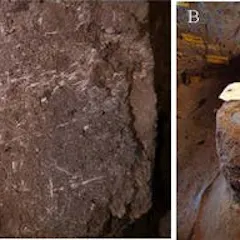
Before 200,000 years ago, close to the origin of our species, people preferred the use of broad-leaved grasses to build their beds and resting areas using ash layers underneath.
Mason tirelessly sought to convince officials of the need to recognise and celebrate the African past, and the role that African people played in the making of modern South African society.

There is not much information on artefacts used by Stone Age humans to make sound and music – but the first comprehensive survey is a good start.
The updated methods are providing a clearer picture of how Earth and its inhabitants evolved over the past 60,000 years - and thus, providing new insight into its future.
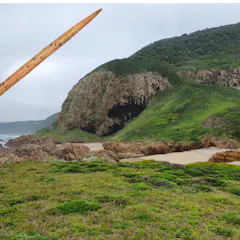
The artefact comes from deposits dated to more than 60,000 years ago. It closely resembles thousands of bone arrowheads used by the indigenous San hunter-gatherers from the 18th to the 20th centuries.
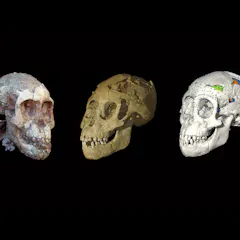
Our findings reveal the slowing down of brain development in our ape-like ancestors began more than three million years ago.

While crocodylian fossil swim traces have been described from other continents, to the best of our knowledge the examples we describe are the first such reptilian swim traces from Africa.
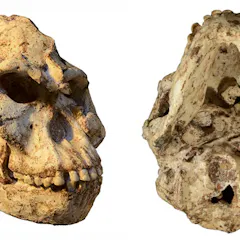
The findings suggest that this specimen could climb and move in trees. But it may also have been able to walk on the ground. This echoes previous studies.

An archaeological site in India sheds new light on how ancient humans dispersed from Africa across the world.

Neanderthals living in a cave in southern Siberia made distinctive stone tools that can be traced to their ancestral homeland in eastern Europe — an intercontinental journey of more than 3,000 km.

Our extinct, distant cousins still lived in Indonesia 110,000 years ago.
Top contributors
-

Research Associate, African Centre for Coastal Palaeoscience, Nelson Mandela University
-
Professor, University of the Witwatersrand
-
Associate professor, University of Johannesburg
-
Director, ARC Centre of Excellence for Australian Biodiversity and Heritage (CABAH), University of Wollongong
-
Associate Professor of Archaeology, Griffith University
-
Postdoctoral fellow, University of Tübingen
-
Director, Australian Research Centre for Human Evolution, Griffith University
-
Honorary researcher, Evolutionary Studies Institute, University of the Witwatersrand
-
Director and Virginia M. Ullman Professor of Natural History and the Environment, Institute of Human Origins, Arizona State University
-
Lecturer in Mediterranean Prehistory, University of Malta
-
Assistant Professor of Anthropology, Yale University
-
Professor in the Australian Research Centre for Human Evolution & Griffith Centre for Social and Cultural Research, Griffith University
-
Professor, School of Natural Sciences, Macquarie University
-
Senior Lecturer in Human Genetics, The University of Melbourne
-
Max Planck Institute of Geoanthropology