
Spatial mapping shows votes for the AfD are concentrated in the east and in the most rural areas, while university towns turn away.
Articles on Alternative for Germany (AfD)
Displaying 21 - 40 of 56 articles
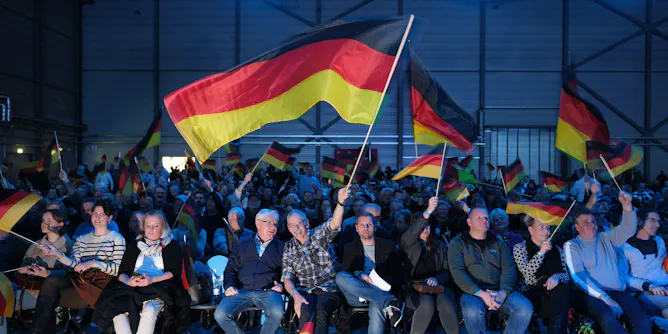
Rolf Frankenberger, an expert on right-wing extremism in Germany, talks to The Conversation Weekly about what kind of Germany the AFD wants to return to.
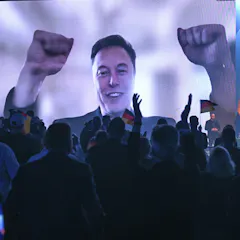
Elon Musk is by no means the cause of the AfD’s popularity, but his embrace of the extremist party has given it a global profile and new credibility in German politics.
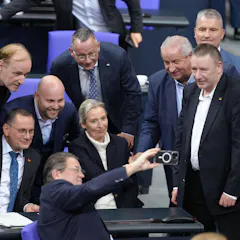
In a dramatic swing to the right, Friedrich Merz’s CDU is proposing Germany breaches EU law by closing its borders to migrants.

Elon Musk is increasingly getting involved in other countries’ politics, but what is his end game?
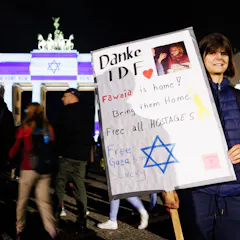
Since World War II, Germany has been uniquely shaped by atoning for the Holocaust. This is reflected in its categorisation of criticism of Israel as antisemitic and its minimal national security.
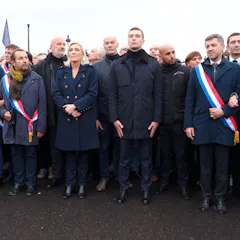
The ‘cordon sanitaire’ is a strategy used across Europe to try to exclude political extremes from the mainstream.
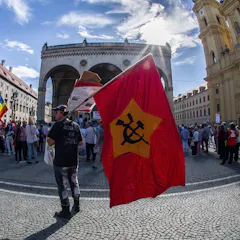
Europe’s far right parties are winning more backing in the polls, and will have increasing influence on policy over the Ukraine war.
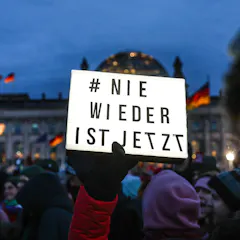
As young people despair that established parties can address their many concerns, far-right parties have found fertile political ground.
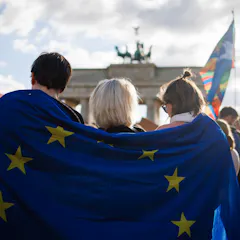
The far-right Alternative for Germany is courting the youth vote on TikTok with great success, ahead of the elections in June.
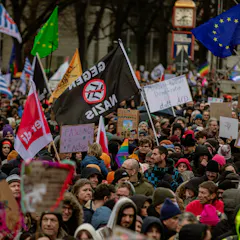
Hundreds of thousands of people in Germany are taking to the streets to push back against the far-right, nationalist policies of the AfD, which currently holds 11% of the seats in parliament.

Worldwide, young women are becoming more progressive than young men. It’s happening in Australia, too – with a twist. An analysis of the Australian Election Study yields surprising results.

In an uncertain world our natural instinct is to seek out answers that reassure, even when they don’t make sense.

Gains in Bavaria and Hesse mark new territory for a radical-right party that once only really enjoyed support in one region.
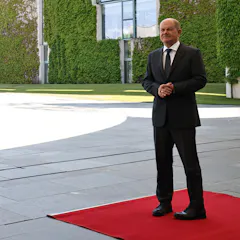
Far-right party Alternative for Germany is leading opinion polls in parts of the country and could pose a major threat in regional contests that lie ahead.

Liberal schools of thought largely inform how Muslims are viewed across Europe, research finds.

How political parties such as Fidesz, Brothers of Italy, and the National Rally form part of the European Parliament.

Research shows that Europe’s far right has deep ideological and practical ties to Putin’s Russia.

Following the German election, all of the country’s major party leaders agreed that Germany needs to move forward. But if the electorate had had its way, it would have re-elected Angela Merkel.
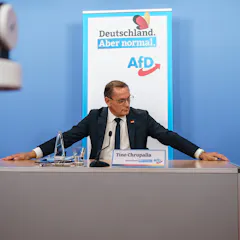
Support for Alternative for Germany continues in the former East Germany in particular. It’s worth really asking why.
Top contributors
-

Reader in Politics, Co-Director, Aston Centre for Europe, Aston University
-
Professor in International History, Flinders University
-
Managing Director Research, Institute for Research on Far-Right Extremism (IRex), University of Tübingen
-
Jean Monnet Professor for Comparative Politics & European Integration, University of Tübingen
-
Professor of German Studies / Chair, Department of Germanic and Slavic Studies / Director, Waterloo Centre for German Studies, University of Waterloo
-
Professeur Associé de marketing, Kedge Business School
-
Professor of Anthropology, Director of the Institute on Globalization and the Human Condition, McMaster University
-
Research Fellow (Henry Jackson Society - Centre on Radicalisation & Terrorism), Royal Holloway, University of London
-
Full professor, IÉSEG School of Management
-
Reader in European Politics, University of Westminster
-
Senior Lecturer, Department of Government, University of Essex
-
Professor of Politics, University of Sussex
-
Lecturer in Modern and Contemporary History, Bangor University
-
Professor of Economics, University of California, Davis
-
Lecturer in the Department for Political Studies, Bar-Ilan University