
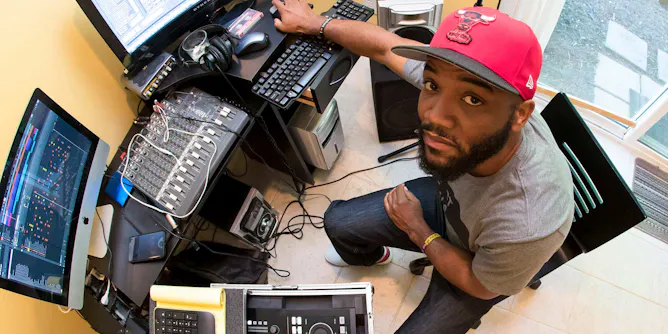
Can college professors rap their way into academic publishing? One professor makes an album to prove they can.
Articles on Academic research
Displaying 21 - 40 of 44 articles
To continue the fast-paced collaborative research and innovation we have seen during the pandemic, here are five ways universities can support health research that responds to societal needs.
If we care that MPs treat all their constituents fairly, we should support work that tests them on their biases – even the implicit ones.

Reading a scientific paper isn’t such a daunting task when you break it down into manageable steps.

The limitations of traditional literature review approaches could be improved relatively easily with a few key procedures.
Journal comments are responses to previously published articles. The gender disparity in the authorship of these comments both reflects and contributes to women’s opportunities in scientific research.

As schools and daycares are closed because of the coronavirus pandemic, academic mothers are finding themselves less able to conduct research and write articles.

Australians aren’t confident that the government can be trusted with their data, or that is has the right safeguards in place to protect it.
Research is changing how artists contribute to the world’s knowledge base.

Money always seems tight for university scientists. A sociologist conducted hundreds of interviews to see how they think about funding sources and profit motives for basic and applied research.

Scientific truth is based on a body of research which has been tried and tested by many researchers over time. Peer review filters the good science from the bad.

Research dollars don’t stay locked up in academia and government labs. R&D collaborations with the private sector are common – and grow the innovation economy.

Populist movements are on the rise. Their supporters distrust the establishment, elites, authority and official sources. The post-truth world is a post-expert world.

What are research dollars actually spent on? Rather than looking at artifacts like publications and patents, a new initiative directly tracks the people and businesses that receive research funding.

With federal support for on-campus R&D dwindling as a percentage of GDP, keeping basic research afloat is a challenge. Schools and researchers are left to try to fill in the funding gaps.

A new clause being embedded in a number of university contracts attempts to restrict academics from speaking freely in public debate about issues that are outside their area of research.
State support for public research universities declined by 28 percent between 2003 and 2013. So, why does it matter?
Nineteen research universities join nine foundations in supporting the work of The Conversation US.

Libraries are warm, dry and safe spaces with free Internet, which many people need. But academics and researchers in the 21st century can get along very well without them.
The Chinese search engine Baidu was found to have cheated in a computer science competition.
Top contributors
-

Professor of Economics, The Ohio State University
-
Professor of Machine Learning, University of Sheffield
-
Previous Vice President of the Academy of Science of South Africa and DSI-NRF SARChI chair in Fungal Genomics, Professor in Genetics, University of Pretoria, University of Pretoria
-
Associate Vice President for Research and Technology Transfer, University of Houston
-
Professor of Higher, Adult, and Lifelong Education, Michigan State University
-
Deputy Executive Dean and Associate Dean (Academic), Faculty of Humanities, Arts and Social Sciences, The University of Queensland
-
University of Minnesota
-
Vice President for Research and Professor of Physics, Washington State University
-
Professor of Aesthetics , Cardiff Metropolitan University
-
Professor of Organisation, Lund University
-
Professor in Stockholm Business School, Stockholm University
-
Professor of E-Learning and Dean of Informatics and Design, Cape Peninsula University of Technology
-
Washington State University
-
Associate Professor of Higher Education, Georgia State University
-
Professor of Sociology, University of Bristol