
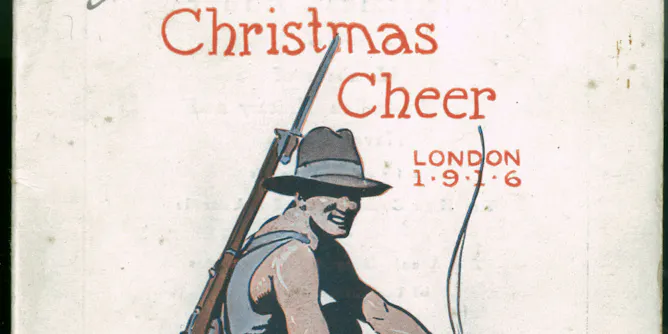
For Australians serving overseas in WWI, Christmas was particularly difficult. Menus reveal how soldiers tried to maintain the traditions of home.
Articles on WWI Centenary
Displaying all articles
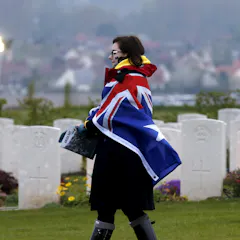
The centenary of the first world war is being memorialised around the world. But as it fades from living memory, our children’s education sits uneasily with the uncritical demands of commemoration.
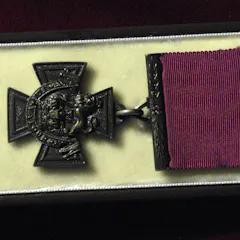
Australians now seem so fascinated by the Victoria Cross that such attention has begun to get in the way of a balanced perspective on its place in military history.

Every country has its most symbolic year from each of the world wars, and can trace the consequences of the bloodletting that accompanied the global realignment of the last century.

For contemporaries and later for historians, shell shock came to encapsulate all the horror of a new form of industrialised warfare.
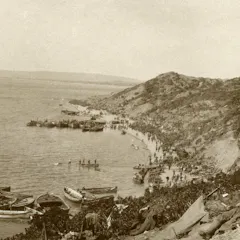
The history of the Gallipoli region enhances the story of the Anzac campaign and situates it in a notably rich cultural context.
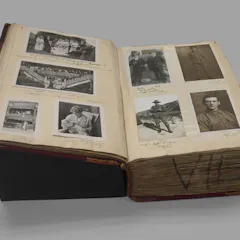
The Melbourne Museum’s World War I: Love & Sorrow exhibition, which opens this weekend, explores the various experiences of Victorians in the Great War, and the war’s effects on them. Museums have…
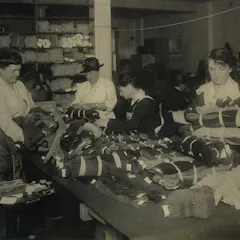
During the first world war in Australia there was a restriction of styles of clothing available to both men and women because of shortages in fabrics. Everyday dress became more sombre due to a lack of…

One of the most iconic images of the first world war, the outbreak of which is being commemorated all over the world, is the deserter – heartlessly tried for cowardice, blindfolded and bound to a post…
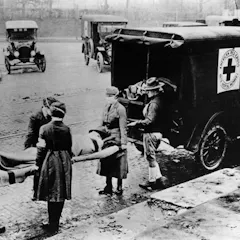
The great influenza pandemic of 1918-19, often called the Spanish flu, caused about 50 million deaths worldwide; far more than the deaths from combat casualties in the World War One (1914-18). In fact…

On July 24 1914 the British cabinet met to discuss the diplomatic situation in Europe, which had deteriorated rapidly since the assassination of the Austrian archduke, Franz Ferdinand, a month before…
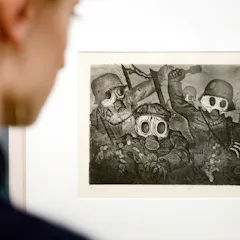
German approaches to the history lessons of World War I are characterised by a sense of distance and an anti-war attitude. But probably the most striking feature of the way Germany teaches its children…
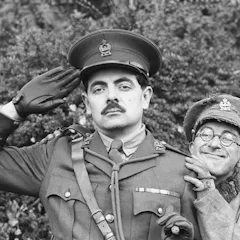
Michael Gove must be off his head. In Germany any politician who tried giving professionals a history lecture would be considered a lunatic. German historians love to argue among themselves, and there…
Top contributors
-

Research Professor in the Australian Centre for the Study of Armed Conflict and Society, UNSW
-
Research Associate, Department of Gender and Cultural Studies, University of Sydney
-
Lecturer in History, Western Sydney University
-
Lecturer in the Department of History, Durham University
-
Lecturer in History of Medicine/Life Science, The University of Melbourne
-
Professor Emeritus of Media and Culture, Griffith University, Griffith University
-
Senior Research Fellow at the Institute of Historical Research, School of Advanced Study, University of London
-
Emeritus Professor of Classics, La Trobe University
-
Honorary Academic, University of Auckland, New Zealand, University of Auckland, Waipapa Taumata Rau
-
Honorary Professorial Fellow, The University of Melbourne
-
Senior Lecturer, School of Fine Art, History of Art and Cultural Studies, University of Leeds
-
Professor in German Studies, The University of Melbourne
-
PhD Candidate, Research Assistant and Sessional Academic, Monash University
-
Senior Curator, Society & Technology Department, Museums Victoria Research Institute