
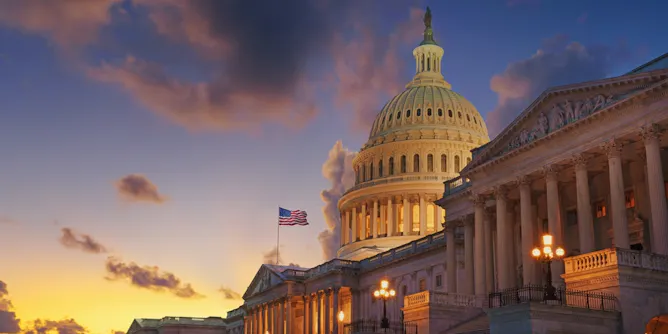
Donald Trump’s scored a major political win, after his mega tax and spending bill cleared its biggest hurdle. It could be signed into law as soon as July 4.
Articles on US Debt Ceiling
Displaying 1 - 20 of 28 articles

The rating agency demoted the US government’s creditworthiness to AA+, its second-highest ranking, on Aug. 1, 2023.

Do environmental reviews improve projects or delay them and drive up costs? Two legal scholars explain how the law works and how it could influence the ongoing transition to renewable energy.
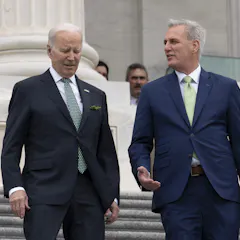
Compromises, no matter how horrible, have long been used to solve seemingly intractable political problems – but at a cost.

If Congress and the White House fail to take action, Social Security beneficiaries would see a sudden 23% cut in their monthly checks in 2034.

The news media spent a lot of time reporting on how much progressive Democrats and conservative Republicans didn’t like the debt ceiling deal. But centrists had enough votes to pass it in the House.
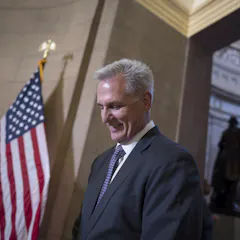
Congress passed and the president signed the deal just days before the US was expected to default on its debt.
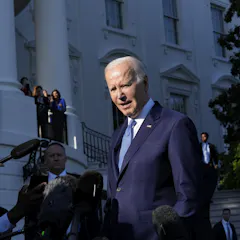
The deal would raise the ceiling for two years, cap some federal spending and impose new work requirements on certain federal benefits. It still needs the blessing of Congress.

Major players in the financial system are pondering the unthinkable as the US inches closer to an unprecedented default.
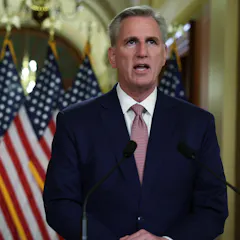
Adults insured by Medicaid who are 19 to 55 years old and don’t have children or other dependents would need to spend 80 hours a month doing paid work, job training or community service.
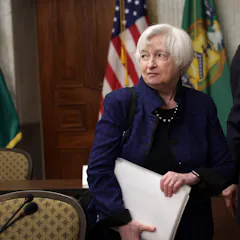
If the US fails to increase its debt ceiling by June 1, it could be forced into an embarrassing – and hugely costly – default on its obligations.

A team of economists looked at what happened after Supplemental Nutrition Assistance Program work requirements were reinstated in Virginia in 2013.
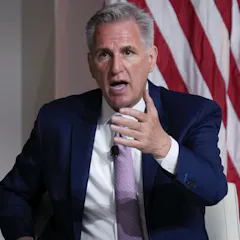
House Speaker Kevin McCarthy agreed to raise the debt ceiling – and avoid an unprecedented US default – but only if Democrats agree to freeze spending and agree to several other demands.
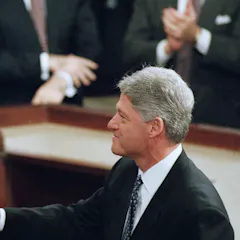
House Speaker McCarthy wants to put the US on a path to a balanced budget as debt ceiling negotiations begin with President Biden. Here’s why it won’t be easy to repeat what Bill Clinton accomplished.

The US spent $232 billion paying interest on the national debt in the first quarter of 2023 as the Fed jacked up borrowing costs.

As President Biden begins meeting with congressional leaders to resolve the debt ceiling showdown, an economist warns the consequences of a default could be dire.
An economist explains why defaulting on the national debt would result in economic crisis.
Republicans and Democrats have negotiated a draft deal that may avert a financial crisis, but why does the US have a debt ceiling in the first place?

The US government reached the limits of its borrowing capacity in March and is fast approaching the point at which it will no longer be able to pay all its bills. What’s the big deal?
The consequences if lawmakers don’t raise the debt ceiling in the coming days are unknown but potentially devastating for the US and global economy.
Top contributors
-

Part-Time Professor of Economics, The New School
-
Deputy Chair of Business Administration, Touro University
-
Daniel Patrick Moynihan Senior Lecturer in Public Policy and Public Finance, Harvard Kennedy School
-
Professor of Economics, University of Georgia
-
Distinguished Fellow in Law and Government, Dickinson Law, Penn State
-
Professor of Public Policy (retired), University of Virginia
-
Ph.D. Student in Public Policy, Harvard Kennedy School
-
Associate Professor of Public Health, The Ohio State University
-
Associate Professor of Political Science, Northwestern University
-
Executive Associate Director of the Private Enterprise Research Center, Texas A&M University
-
Professor of American History, Università di Torino
-
Assistant Professor of Business Economics and Public Policy, University of Michigan
-
Professor of Economics, Florida International University
-
Associate Professor of Political Science, Park University
-
Professor of Environmental Law, Bren School of Environmental Science & Management, University of California, Santa Barbara; University of California, Los Angeles