
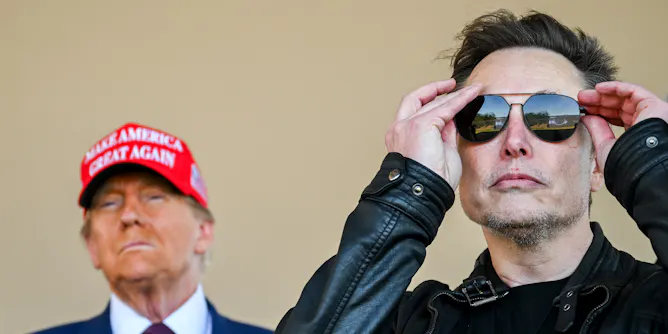
Granting tech leaders direct control over government functions fundamentally alters the relationship between private power and public governance.
Articles on US Constitution
Displaying 121 - 140 of 431 articles
Many of Trump’s executive orders mirror plans laid out in Project 2025, a conservative policy plan developed in part by the Heritage Foundation.
If a federal prosecutor were to put a city’s mayor or a state’s governor in jail, what may be the greatest source of conflict in the Constitution will become clear to the public.
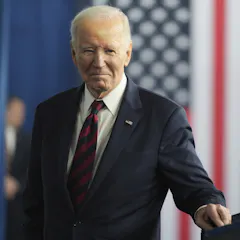
Joe Biden preemptively pardoned his family and others concerned about retribution from Donald Trump. The Constitution says very little about who can be pardoned – or how.
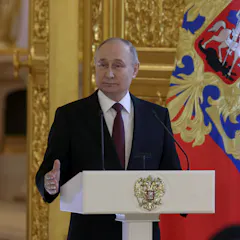
Putin successfully changed Russia’s constitution to allow himself to stay in power.
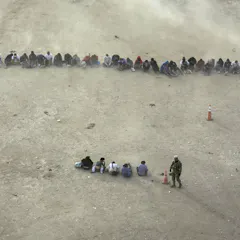
The president has vast authority over the armed forces, but using them to secure the border would quickly unleash legal chaos, say lawyers.
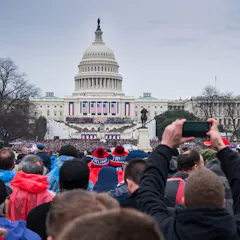
Inaugurations throughout history have come with pomp and ceremony, but the peaceful handover of power is significant.
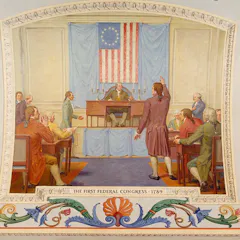
The mechanics of upending American democracy would entail surmounting a thick tangle of constitutional, bureaucratic, legal and political obstacles.
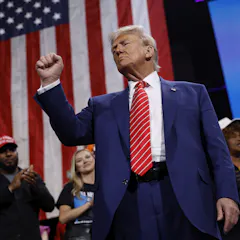
Though the 22nd Amendment prohibits Trump from being elected president again, it does not prohibit him from serving as president beyond Jan. 20, 2029. A scholar of politics and history explains.
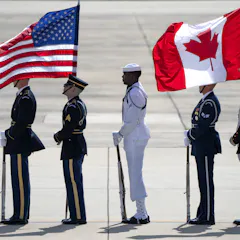
How precisely Donald Trump could make good on his threat to annex Canada can be found in the U.S. Constitution. There is both potential and precedent in American history.

The use of 3D-printed guns in criminal and violent activities is likely to continue to increase. And governments and police will continue to have trouble regulating them.
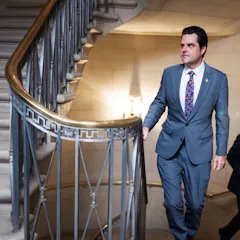
Senators have the power to approve or reject a president’s cabinet nominees. A loophole allows presidents to do an end run around the Senate – but Senate leaders have to agree to it.

The Supreme Court’s approach toward religion in schools has been shifting, adding to uncertainty about legislation such as Louisiana’s.
The lame-duck period in the US is longer than in other Western democracies, which tend to make the transition over a period of just days.
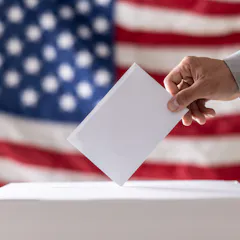
Voters have cast their ballots. Now the 2024 US presidential election comes down to the Electoral College.
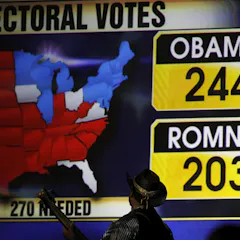
In America’s convoluted system, a presidential candidate can win the popular vote, yet lose the electoral vote in a landslide. Here’s why this system exists.
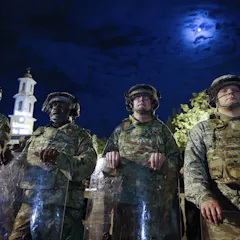
Trump wanted to turn the US military on American citizens while he was president. He has increaslngly said he would do so if he wins the White House in 2024.
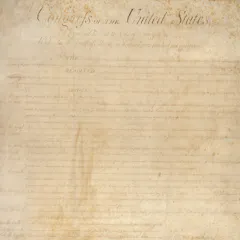
Key freedoms for US citizens against excessive government power are contained in the Bill of Rights, the first 10 amendments to the US Constitution.
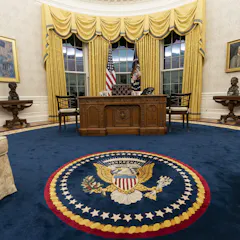
In a landmark 2024 case, the Supreme Court ruled that presidents are immune from prosecution when they exercise their core constitutional powers. So who decides what actions are not immune?
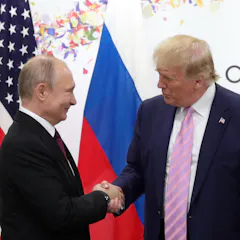
Centralising power in a president is more likely to foster personalised, corrupt governance that is democratically unaccountable.
Top contributors
-

Professor of American Civics, University of Tennessee
-
Associate Professor of Law, Arizona State University
-
William Nelson Cromwell Professor of Jurisprudence and Political Science, Amherst College
-
Professor Emeritus of Government, Wesleyan University
-
Foundation Professor of Law and Political Science, Arizona State University
-
Joseph Panzer Chair in Education and Research Professor of Law, University of Dayton
-
Professor of Law and Director of the Center for Professional Ethics, Case Western Reserve University
-
Associate Professor of Political Science, Westminster College
-
Professor of Law and Adjunct Professor of Political Science, Wayne State University
-
Associate Professor of Political Science, Rochester Institute of Technology; Institute for Humane Studies
-
Associate Professor of Political Science, Boise State University
-
Spécialiste de la politique américaine, Sciences Po
-
Professor of law and ethics, Georgia State University
-
Professor of American History, Università di Torino
-
Professor Emeritus of Communication and Rhetorical Studies, Syracuse University