
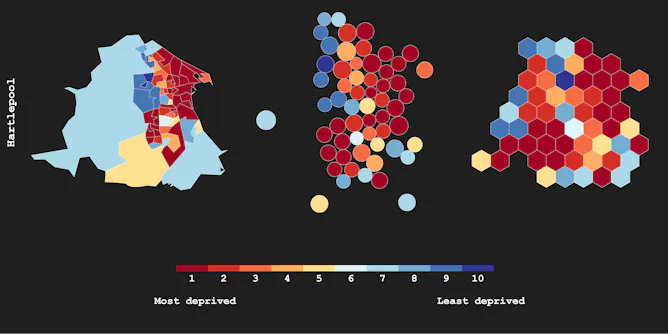
When mapping deprivation, using traditional boundaries can distort the data and distract readers from important information.
Articles on Urban life
Displaying 41 - 60 of 115 articles

According to a new smart cities index, the real test for smart cities is whether citizens feel the benefits.
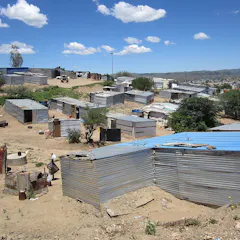
Urban dwellers who live in informal city settlements have limited access to basic services, and many of them don’t own the land they live on.
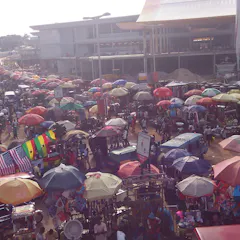
Governments should change their approach by deepening collaboration with citizens to ensure delivery of urban infrastructure
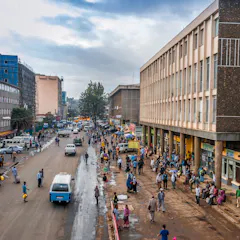
Development should not be pursued at the expense of the very people who helped to create value and meaning in the city.
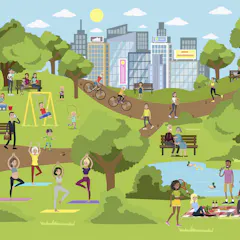
Some parks reduce violence in the local vicinity. Other parks attract crime. The difference has to do with how these urban green spaces are designed, programmed and managed, experts say.

Canadian researchers have mapped smart city technologies throughout the country. The interactive map is intended to inform urban residents of the locations of technologies that may affect privacy.

Run, leap, scramble…it’s parkour! Science can help you run up walls more efficiently, and chose the best way to land from a height.

We see the daily commute as a waste of time. But there’s another way to see the experience: a whole life in the events and memories we form during these journeys, which change us as human beings.
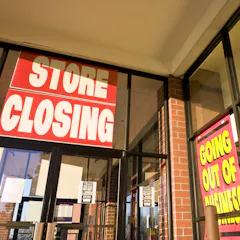
The challenges facing town centres and high streets are intensifying.

London should be one giant pigeon cemetery, but you rarely see the bodies.

In an increasingly urban world, trees can make a major difference. One study found that, for every dollar invested in planting, megacities saw a $2.50 return on their investment.

Recent urban disasters in Ethiopia and Mozambique resulted in high female mortality, which was been largely ignored.
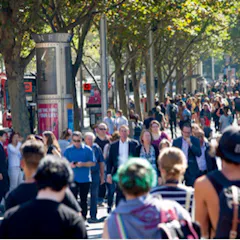
The vitality that defines central Melbourne today did not emerge overnight. Rather than being born of one grand vision, it’s the result of many astute, incremental changes that revitalised the city.
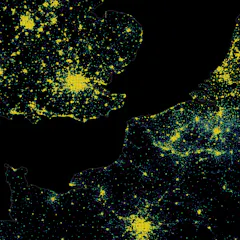
Understanding population density takes more than just arithmetic – that’s where mapping can help reveal which countries and cities are really getting cramped.

Low-density suburbs can cause social isolation that’s harmful for individual and community well-being. But research confirms we can plan neighbourhood centres so they become vibrant social hubs.

Movies often portray the city as a dystopia, particularly in the ‘neo-noir’ genre, which explores postmodern themes. TV shows and ads present an altogether sunnier picture of life in the city.
Millions of Americans rely on public transit to get to school, work or stores, but many can’t get the service they need. ‘Uberizing’ transit by offering more options on demand could fill the gaps.
The physical segregation of cities has a crucial role in poverty and access to public services.

Coffee and sex are both highly marketable commodities. But who would have thought that the capital of one of Latin America’s most socially conservative countries would combine them in its cafes?
Top contributors
-

Professor, Institute for Management & Innovation, University of Toronto
-
Professor of Architecture and Urban Design, The University of Melbourne
-
Associate Professor, Human Resources, Thompson Rivers University
-
Associate Professor, School of Built Environment, UNSW
-
Lecturer, Kumasi Technical University
-
Senior Lecturer in Urban Planning and Urban Design, The University of Melbourne
-
Co-Director, Initiative on Cities, Boston University
-
M.S. Candidate, Community and Regional Planning, The University of Texas at Austin
-
Director, Melbourne Sustainable Society Institute, The University of Melbourne
-
Assistant Professor of Community and Regional Planning and Director, Urban Information Lab, The University of Texas at Austin
-
Professor of Urban Policy and Director, Urban Futures Enabling Impact Platform, RMIT University
-
Adjunct Professor, Global, Urban and Social Studies, RMIT University
-
Associate Professor in Urban and Regional Planning, University of Sydney
-
Lecturer in Quantitative Social Sciences, University of Sheffield
-
Professor Sustainability and Urban Governance, RMIT University