
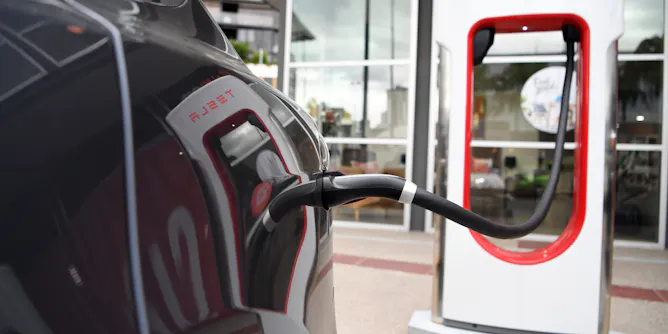
Electric vehicles would lower emissions, but if their lower running costs lead to increased car use that creates a whole lot of other costs for our cities.
Articles on Traffic congestion
Displaying 21 - 40 of 73 articles
COVID led to commuting time savings worth over $2,000 a year for each driver and $5,000 per public transport user. But as workplaces reopen, we may need road user charges to keep traffic flowing.
Motorways were once seen as a way of reducing congestion in our towns and cities. But the more we build, the more they fill with drivers.

First trains, then cars and, now, COVID-19 have all spurred New York to reimagine how its scarce space should be used – and what residents need to survive.
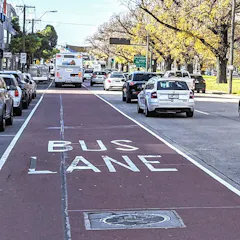
As COVID-19 restrictions are eased, cities face crippling congestion if people shun crowded public transport. More frequent and faster services, using innovations like pop-up bus lanes, can avoid this.
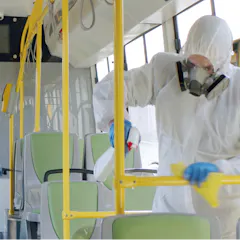
Some new habits we’ve seen emerging during the pandemic could help us solve tricky problems like traffic congestion, which have challenged our cities for a long time.
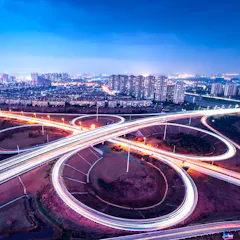
The sweeping introduction of driverless cars could see more vehicles on the road, driving longer distances. But smart planning could solve some of transit-associated environmental and social problems.

Faced with the eye-watering costs of building infrastructure, it makes sense to turn to much more cost-effective smart technology to get traffic flowing.
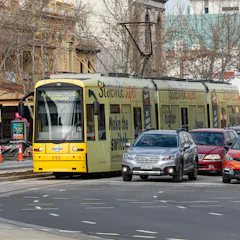
Scenarios based on a survey of Adelaide commuters and analyses of traffic flows show it’s possible the congestion could get worse in the transition to driverless vehicles.

An analysis of trips to school has found the extra time and distance private secondary school students travel is a significant contributor to morning peak-hour congestion.
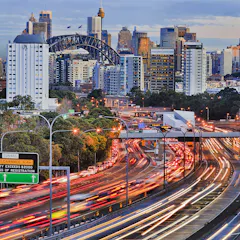
Commuters who drive to and from the CBD typically earn much more than most. Concerns about the fairness of charging drivers who use these busy roads at peak times are overblown.

Parcel and courier delivery vehicles are often blamed for traffic congestion in our cities. But they’re only a fraction of the traffic caused by tradespeople and other services.

The Spanish city is remaking urban neighbourhoods by limiting through traffic in superblocks that give priority to pedestrians and street activities, not cars.

E-changers are the latest group to move from the big cities to escape high living costs and congestion. But because they remain very productive remote workers some employers are embracing the trend.
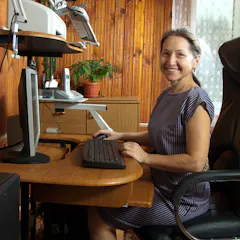
Two-thirds of surveyed workers work from home one day a week on average, but could do at least half their work out of the workplace. If they commuted less often, congestion could be greatly reduced.
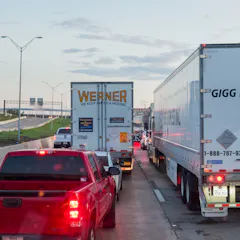
Despite efforts to encourage a shift to sustainable transportation, traffic congestion is often the focus of debates over mobility. Motorists endlessly demand more roads, but is this really a solution?
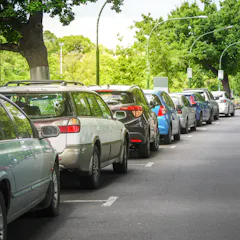
Australian cities have a glut of parking, even as politicians move to protect parking spaces or promise even more. There are better ways to keep congestion manageable and our cities liveable.
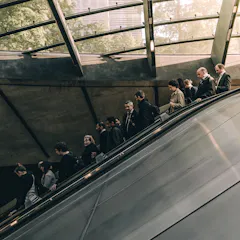
In many cities, convention holds that there’s a lane for walking and a lane for standing on the escalator. But human systems engineers suggest this isn’t the most efficient option for the system.
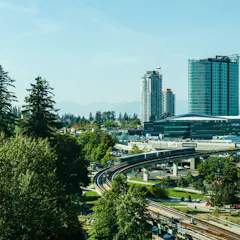
Instead of spending ever more on roads, we can learn from Vancouver’s use of congestion as a ‘friend’ in managing the development of transport networks and of the city itself.
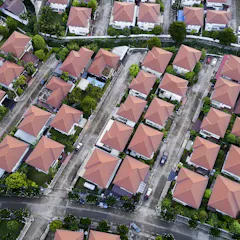
Much of the growth in our cities is in the outer suburbs, now home to around 5 million people. And that creates problems like traffic that detract from the advantages residents see in living there.
Top contributors
-

Transport and Cities Program Director, Grattan Institute
-
Professor of Transport Technology and Sustainability, Swinburne University of Technology
-
Transport Fellow, Grattan Institute
-
Associate Professor in Infrastructure Management, University of Sydney
-
Associate Professor in Urban Planning, The University of Queensland
-
Professor of Human Geography, University of Canterbury
-
Honorary Senior Fellow in Transport Planning, The University of Melbourne
-
Professor of Sustainability, Curtin University
-
Professor of Human Geography and Planning, University of Tasmania
-
Research Fellow, University of Sydney
-
Associate professor in Economics, The University of Melbourne
-
Research Director, University of Technology Sydney
-
Assistant Professor, National Yang Ming Chiao Tung University, Taiwan, Griffith University
-
Research assistant, The University of Melbourne
-
Research Principal, Institute for Sustainable Futures, University of Technology Sydney