
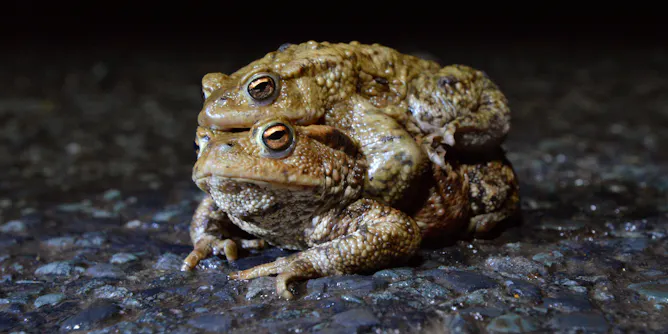
Despite dutiful toad patrols, evidence suggests that the amphibians are declining in the UK.
Articles on Toads
Displaying all articles

Behavior-based interventions could boost conservation efforts, but raise their own set of tricky ethical issues.

Millions of years on. modern frogs and toads still haven’t learnt you can have too much of a good thing.
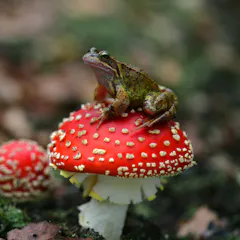
Britain’s native amphibians are in steep decline thanks to wetlands disappearing and ponds drying up.

A new study examines the diet of an invasive population of guttural toads in Mauritius and finds a number of species of conservation concern.
Chytrid fungus has caused declines in 501 amphibian species, according to a new analysis. Most of the damage happened in the 1980s, before the fungus itself was even discovered.

As ponds dry up, so too does our connection to nature.
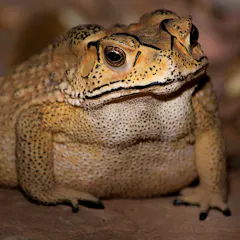
New study confirms fears that the island’s native wildlife can be poisoned by introduced Asian toads.
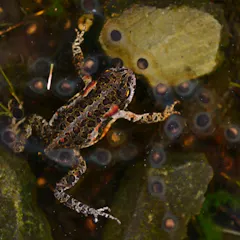
The Rose’s mountain toadlet adapts its breeding habits according to the weather.
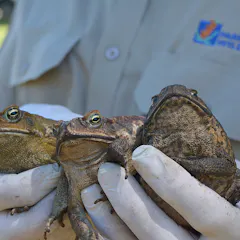
New cane toad traps that carefully imitate mating males successfully target breeding females. Males, meanwhile, will turn up for anything that sounds remotely like a toad.
Meet the brawny bug with a concoction so caustic it’ll make a toad vomit.

Frogs and toads are declining around the world, with many species on the brink of extinction. Acting in time means trying strategies without complete information about how likely they are to work.

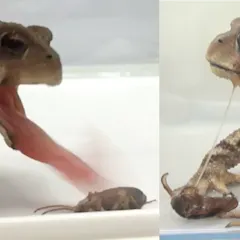
How do a frog’s tongue and saliva work together to be sticky enough to lift 1.4 times the animal’s body weight? Painstaking lab work found their spit switches between two distinct phases to nab prey.
Top contributors
-

Senior Lecturer in Ecology, Royal Holloway, University of London
-
Associate Professor of Fish, Wildlife and Conservation Biology, Colorado State University
-
Postdoctoral Researcher, Penn State
-
PhD Student in Biomechanics, Georgia Institute of Technology
-
Professor of Zoology, Bangor University
-
Professor of Mechanical Engineering and Biology, Adjunct Professor of Physics, Georgia Institute of Technology
-
Associate Professor in Animal Ecology, University of Gothenburg
-
Professor in Zoology, James Cook University
-
Research Fellow in Ecology and Conservation, Australian National University
-
Assistant Professor of Natural Resources Science, University of Rhode Island
-
Reader in Population Biology, University of Salford
-
Professor of Ecology and Evolutionary Biology, Institute of the Environment and Sustainability, University of California, Los Angeles
-
Postdoctoral Fellow, Centre for Invasion Biology (C·I·B), Department of Botany & Zoology, Stellenbosch University
-
PhD Candidate in Wildlife Biology, University of Salford
-
Discovery Early Career Research Fellow, University of Sydney