
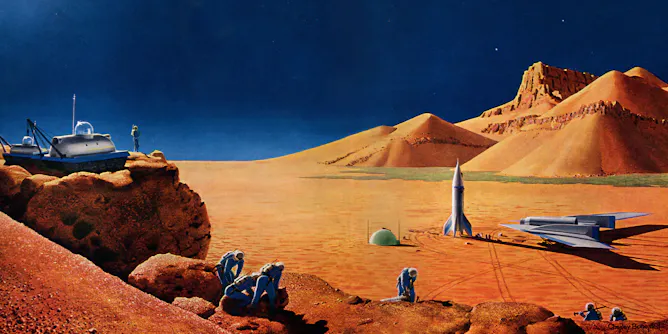
While the 50th anniversary of the first Moon landing is an opportunity to celebrate a remarkable technological achievement, it’s worth reflecting upon the creative vision that made it possible.
Articles on To the moon and beyond
Displaying 21 - 34 of 34 articles
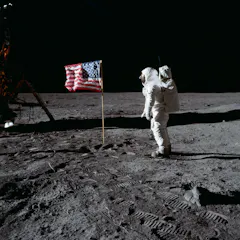
Conspiracy theorists claim NASA used the Apollo special camera to stage the moon landings in a studio and then slowed down the footage to make it look like there was less gravity.
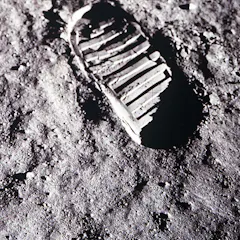
They reflect wider concerns about the US – and its leaders.
CC BY-ND46.8 MB (download)
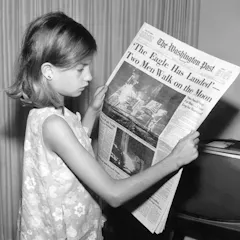
In episode 2 of The Conversation's new podcast series, we look at how people reacted to the moon landing – and why some still believe it was a hoax.

In the future we might get sick of hearing people tell their stories about going to the Moon. Perhaps the Moon will just be like thinking about today’s Antarctica – a remote but accessible place.
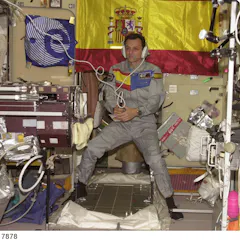
On the 50th anniversary of man’s historic moon landing, Pedro Duque remembers how every child wanted to be an astronaut in 1969.

NASA has made significant steps in making explicit appeals to women to support space exploration, but it might not be doing enough to gather needed political support.
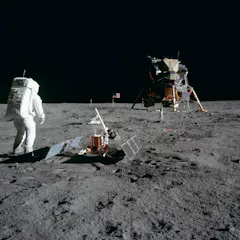
The technologies behind weather forecasting, GPS and even smartphones can trace their origins to the race to the Moon.

Did you know it’s a myth that Teflon came out of NASA?
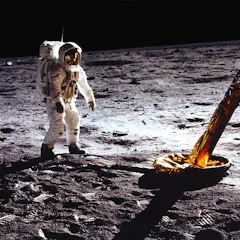
CC BY-NC42.5 MB (download)
The first episode of a brand new podcast series to mark the 50th anniversary of the moon landings looks back at what going to the moon taught us and why we stopped sending people there.
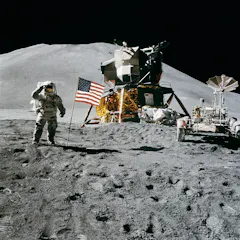
Here is how our mobile phones compare with the computer that landed man on the moon in 1969.

CC BY-ND6.81 MB (download)
A new podcast series from The Conversation exploring the last 50 years of space exploration and the 50 years to come.
A new study suggests that we should limit ourselves to developing just one eight of the solar system.
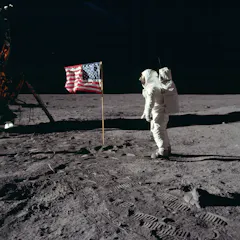
Objects left on the Moon are not just abandoned rockets and rovers. There is a lot of historic and sentimental memorabilia. Some of it hints at a mission that the first Moonwalkers almost forgot.
Top contributors
-

Podcast host, The Conversation
-
Space Plasma Physicist, Imperial College London
-
Associate Professor in Archaeology and Space Studies, Flinders University
-
Postdoctoral research associate, University of Oxford
-
Professor of Business Studies, Trinity College Dublin
-
Professor of American Studies, University of Manchester
-
Lecturer in Astronomy, Nottingham Trent University
-
ARC Future Fellow, School of Earth and Planetary Sciences, Curtin University
-
Professor Emeritus of Political Science and International Affairs, George Washington University
-
Chargé de recherche (CNRS) à l'Observatoire Astronomique de Strasbourg, Université de Strasbourg
-
Professor of Air and Space Law, University of Mississippi
-
Lecturer in English, Loughborough University
-
Reader in Astrophysics, Keele University
-
Political Scientist, University of the Western Cape
-
Lecturer and Topic Coordinator, The University of Melbourne
