
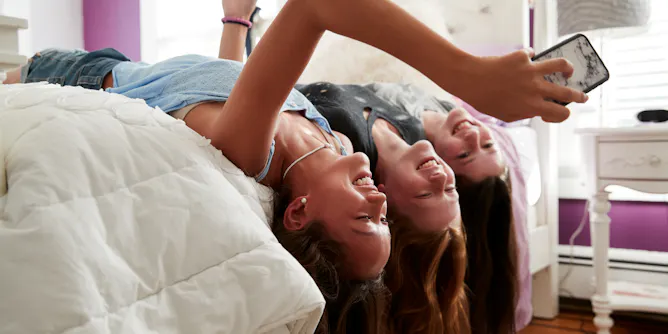
Nearly half of teens say the effect of social media is neither positive nor negative on them; it is just life as they know it. So let’s support them through the highs and lows.
Articles on Teenagers
Displaying 221 - 240 of 377 articles

Want teenagers to be more active? Just talk to them first

A doctor explains how he introduces mindfulness to self-harming youth in the emergency room.

Although a US study found a spike in teen suicides after 13 Reasons Why first aired on Netflix, rates of suicide are generally on the rise. The last thing we should do is shy away from the show.

Despite what the statistics suggest, many teenage parents say having a baby has transformed their lives.

In his new book, Teen Brain, David Gillespie suggests anxiety and other problems are on the rise among teenagers due to smartphones and tablets. This could be true, but his claims are overblown.

Study uncovers what inner-city teenagers really thing about Hamlet et al.

Some of the best players in the world come from this small Caribbean nation, where an entire system of training young talent has blossomed. But few actually make it to the big leagues.

Children now spend more time at home and alone with their parents – new research.

A linguist explains the physical technicalities and sociological meanings of creaky voice’ – a sound found in diverse gender and age groups, yet often associated particularly with younger women.

Teens get a bad rap as selfish, dangerous risk-takers. But neuroscience and psychology research is revising that image: Adolescents are primed to help those around them, with positive benefits for all.

A new study reveals how women’s experiences as teenagers shapes the way they deal with hookup culture at university.

The Conversation has access to top academic experts, and we want them to use their knowledge to answer questions from teenagers.

The Conversation has access to Australia’s top academic experts, and we want to unlock their expertise to answer teenagers’ questions.

A new study reports that school-based physical activity interventions are ineffective in improving young people’s activity levels. But we just need to think outside the box if we want them to work.
Some say the hysteria over screen time echoes parents’ worries that their kids were watching too much TV in the 1980s. But new studies show there’s nothing overblown about parents’ growing concern.

Chronic pain is described as an ‘invisible enemy’ and a ‘malign invader’.

Children need be able to identify potentially harmful sexual behaviours, including sexting, from a young age.

All Australians aged 13-17 are encouraged to do 60 minutes of physical activity a day.

Family is far more important for developing engagement of young people in civil society than previously thought.
Top contributors
-

Research Officer at Medical School, Swansea University
-
Professor of Psychology, San Diego State University
-
Professor in Public Health Data Science, Swansea University
-
Director of the International Gaming Research Unit and Professor of Behavioural Addiction, Nottingham Trent University
-
Emeritus reader in science education and communication, University of Sussex
-
Assistant Professor of Social Work, University of Michigan
-
Associate Professor at the Health Services Management Centre, University of Birmingham
-
Professor of Psychiatry and Neuroscience, Wayne State University
-
Assistant Professor of Psychology, Wayne State University
-
Lecturer, School of Nursing and Midwifery, Queen's University Belfast
-
Researcher, Digital Wellbeing, Western Sydney University
-
Professor, University of Sydney; RMIT University
-
Professor of Psychology, Bridgewater State University
-
Senior Research Fellow in Organizational Leadership, Policy and Development, University of Minnesota
-
Professor of Adolescent Health, Co-Head of the General Practice Clinical School, University of Sydney