

Working with and living in spatially complex environments may help delay cognitive decline, though more research is needed.
Articles on Spatial skills
Displaying all articles
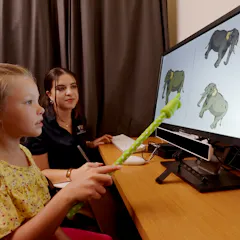
Recent research shows that young children typically manipulate and rotate entire objects in their minds to understand challenges such as puzzles.

When you’re an astronaut landing on the Moon, you can’t rely on the same gravitational cues we have on Earth. But regimented training with sensory devices could one day prevent spatial disorientation.

At about four, children start to understand that someone’s behaviour depends on what that person believes.

Figuring out how jigsaw pieces fit together by visualising moving them in your mind is an example of using spatial skills.

Grid-like cities such as Buenos Aries can have a detrimental effect on navigation ability.
Top contributors
-

Professor of Cognitive Neuroscience, UCL
-
Associate Professor in Psychology, University of East Anglia
-
Research Scientist, Brandeis University
-
Professor of Cognitive Development, University of Surrey
-
PhD candidate in psychology, Florida International University
-
Professor of psychology, Florida International University
-
Professor of Civil and Environmental Engineering, The University of Texas at San Antonio