
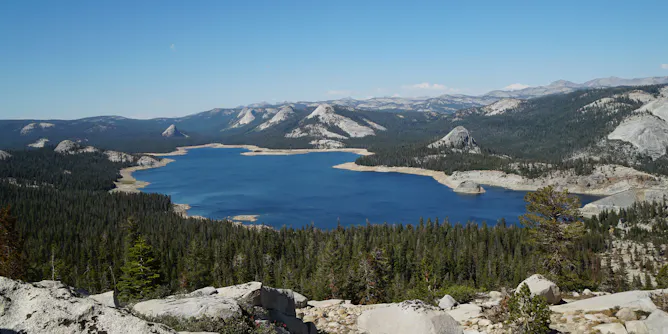
The State Water Project cut its initial allocations for water agencies to 0% for 2022. A California water expert explains why.
Articles on Snowpack
Displaying 21 - 31 of 31 articles
As rivers run dry in the Rocky Mountains and the West, it’s easy to wonder where all the snow you see on mountain peaks goes. Some of it ends up in the air, but researchers aren’t sure how much.
The area’s iconic national parks are home to grizzlies, elk and mountain snowfall that feeds some of the country’s most important rivers. A new report show the changes underway as temperatures rise.

Recent wildfire seasons have been worsened by climate change. But wildfires also lead to additional climate warming when they release carbon dioxide to the atmosphere.
Dust storms are not unusual, but intense ones have a wide range negative impacts upon multiple socioeconomic sectors. How do we address them?
Trees and shrubs in cold-weather climates rely on certain signals, such as temperature and light, to know when to leaf out and bloom. Climate change is scrambling those signals.
Love it or hate it, winter means snow and ice for much of the US. In many places, though, snow is becoming a scarce resource.
New research forecasts that climate change will make multiyear stretches with low snow levels more common across western North America – bad news for water managers, farmers, foresters and skiers.
Climate change is shrinking winter snow cover in Northeast forests, which protects tree roots and soil from repeated freezing and thawing. This could stunt tree growth and forest carbon storage.
Governments and private companies have been seeding clouds to create snow for decades, without proof that it actually works. A recent study peered into clouds in search of answers.
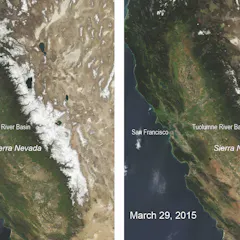
According to scientists, tree-ring analysis shows that California drought is the worst it has been in 500 years.The study underscores the severity of current drought and the challenges of future water management in the state.
Top contributors
-

Assistant Professor of Geology and Geological Engineering, Colorado School of Mines
-
Professor, Director of Ph.D. Program in Biogeoscience, Director of Boston University URBAN Program, Co-Director Boston University Stable Isotope Laboratory, Boston University
-
Researcher of the Atmospheric Composition group, in charge of the WMO Sand and Dust Storm Warning Advisory and Assessment System Regional Center for Northern Africa, Middle East and Europe,, Barcelona Supercomputing Center-Centro Nacional de Supercomputación (BSC-CNS)
-
Assistant Professor, CUNY Graduate Center
-
Adjunct Full Professor of Environmental Conservation, UMass Amherst; U.S. Geological Survey
-
Post-doctoral Research Associate in Paleoclimate, University of Arizona
-
Assistant Professor of Atmospheric Science, University of Wyoming
-
Department of Geography, Assistant Professor, Simon Fraser University
-
Associate Research Professor in Climatology, Desert Research Institute
-
Research and Operations Meteorologist, Center for Western Weather and Water Extremes, University of California, San Diego
-
Project Scientist, University Corporation for Atmospheric Research
-
Adjunct Professor, Department of Renewable Resources, University of Alberta
-
Deputy Lead Scientist, National Snow and Ice Data Center (NSIDC), Cooperative Institute for Research in Environmental Sciences (CIRES), University of Colorado Boulder
-
Senior Scientist, National Snow and Ice Data Center (NSIDC), Cooperative Institute for Research in Environmental Sciences (CIRES), University of Colorado Boulder
-
Associate Professor of Dendrochronology, University of Arizona