
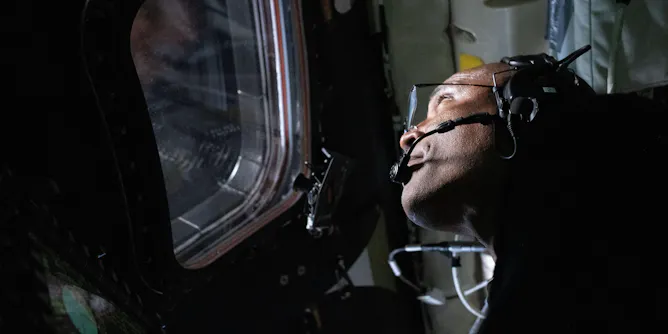
What happens to astronauts’ circadian rhythms when the Sun no longer provides a reliable schedule?
Articles on Sleep cycles
Displaying 1 - 20 of 22 articles
Some parents may dread what’s coming – getting overtired, half-asleep kids out the door on time.

The ‘Scandinavian sleep method’ is having a moment on social media. But what is it? And will it stop you fighting over the doona?

The answer lies in what’s known as the body’s ‘master clock’.

You can train your brain to wake up on time naturally.

Many clues are revealed about people’s sleep thanks to Vicar Rhys Prichard’s poetry from the 1600s.

Sleep appears to play an essential role in a number of brain functions, such as memory. So good quality sleep could play a vital role in preventing dementia.

For over 20 years, I have researched and treated children sleep problems. The research suggests changing sleep patterns over the summer break does not have to be a problem.

Here’s what’s going on in your body when you drink alcohol just before bedtime. And if you want to drink at the Christmas party, we have some tips on how to protect your sleep.
It turns out people who sleep well and those who sleep poorly have different kinds of thoughts before bed.

We live in a world where we frequently do not get enough sleep, but we need sleep if our brains are going to stay healthy and function efficiently.

A few one-off late nights and sleep-ins won’t hurt, but it’s best not to fall completely off the bedtime routine wagon during the holidays.

Research shows that young adults and women are particularly susceptible to seasonal affective disorder.

Why your eyes move during the REM stage of sleep has puzzled scientists for years. Researchers measured mice brains to look for a possible explanation.

An effective alarm is one which should minimise ‘sleep inertia’ – that stage of grogginess we feel between being asleep and becoming fully alert.

LED face masks are popular with celebrities and promise a glowing complexion. But should they come with ‘daytime use’ recommendation?

Kids may not be able to communicate when they’re sleepy, or perhaps can’t even identify this. Then there’s always the fear of missing out on things going on in the waking world.

The mystery of how the brain creates consciousness still puzzles scientists, but the mechanics of waking up are starting to be understood.

Whether our brain decides to wake us or let us keep sleeping depends on the loudness and type of sound, our depth of sleep and sensitivity to noise.

Humans have natural cycles for when they are active and for when they sleep. Modern work and school schedules interfere with this, and more studies are showing why there’s a possible health risk.
Top contributors
-

Professor of Sleep Health, University of the Sunshine Coast
-
Research Fellow and Sleep Scientist at the Thompson Institute, University of the Sunshine Coast
-
Professor and Head of Paediatric Sleep Research, CQUniversity Australia
-
Research Program Manager, Let's Yarn About Sleep, Thompson Institute, University of the Sunshine Coast
-
Associate Professor of Health and Wellness Studies, Binghamton University, State University of New York
-
Researcher, Auditory Perception and Cognition, RMIT University
-
Sleep Researcher, Appleton Institute, HealthWise Research Group, CQUniversity Australia
-
Assistant Professor of Biostatistics, Preventive Medicine and Engineering Sciences and Applied Mathematics, Northwestern University
-
Senior Lecturer, Appleton Institute, CQUniversity Australia
-
Professor of Physiology, University of California, San Francisco
-
Assistant Professor of Psychiatry and Behavioral Neurosciences, Wayne State University
-
Associate Professor of Neurology and Epidemiology, Monash University
-
Associate Professor, Department of Physiology, Monash University
-
Senior Lecturer in Psychology, CQUniversity Australia
-
Research associate, Flinders University