

Mountains of ice far away in the northern hemisphere surely couldn’t change rainfall in Australia – or could they?
Articles on Sahul
Displaying all articles
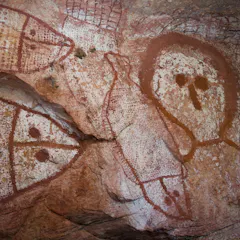
New research confirms humans first reached the Sahul super-continent by two different routes around 60,000 years ago.
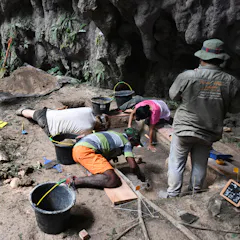
Archaeologists show some of the first people to settle the ancient continent of Sahul arrived on the shores of present-day West Papua, some 50,000 years ago.
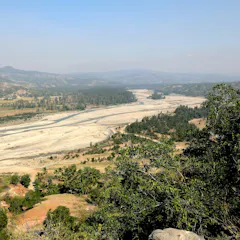
New evidence from Laili rockshelter on Timor hints at a rapid, large-scale human arrival 44,000 years ago.
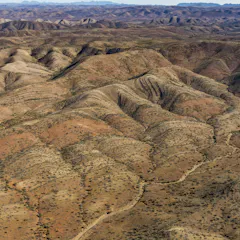
By detailing the landscape at the time of first humans’ migration into Australia, we can better understand how people travelled and where they settled.

Our new study reveals a mosaic of habitable landscapes – now submerged by the ocean – once supported up to 500,000 people living in Australia’s northwest.

There’s no single reason many Asian animals spread to Australia but few went the other way – but climate, geography and the slow drift of tectonic plates all played a role.

Our work provides new evidence against the theory that people living in Sahul drove the megafauna extinction.

It took just 5,000 years for large and well-organised groups of people to populate all corners of the continent.

We now have a glimpse into where early Indigenous Australians likely travelled all those tens of thousands of years ago.

Archaeological discoveries in a jungle cave in central Indonesia suggest humans arrived there 18,000 years ago and decided to stay a while, hunting in the jungle and building canoes.
A drying climate and the arrival of people together finished off Australia’s megafauna.
Top contributors
-

Matthew Flinders Professor of Global Ecology and Node Leader in the ARC Centre of Excellence for Indigenous and Environmental Histories and Futures, Flinders University
-
Senior Lecturer in Ecology and Biogeography, Node & Stream Leader for ARC Centre of Excellence for Indigenous and Environmental Histories and Futures, University of Technology Sydney; Australian Museum
-
Postdoctoral Researcher, Max Planck Institute of Geoanthropology; Griffith University
-
Postdoctoral Researcher, College of Asia & the Pacific, Australian National University
-
Distinguished Professor, School of Culture, History & Language, Australian National University
-
Sean Ulm is a Friend of The Conversation.
Director, ARC Centre of Excellence for Indigenous and Environmental Histories and Futures, James Cook University
-
Partner Investigator, ARC Centre of Excellence for Indigenous and Environmental Histories and Futures, James Cook University
-
Academic Fellow, Archaeology, School of Humanities, University of Sydney
-
Lecturer in Biological Sciences, University of Wollongong
-
Research Fellow, School of Culture, History & Language, Australian National University; UCL
-
Associate Professor and Director, Flinders Microarchaeology Laboratory, Flinders University
-
Professor in Geochronology and Geochemistry, Southern Cross University
-
Associate Professor, School of Geosciences, University of Sydney
-
Professor of Archaeology and Biological Anthropology, School of Social Science, The University of Queensland
-
Postdoctoral Researcher, Macroevolution and Macroecology Group, Australian National University