
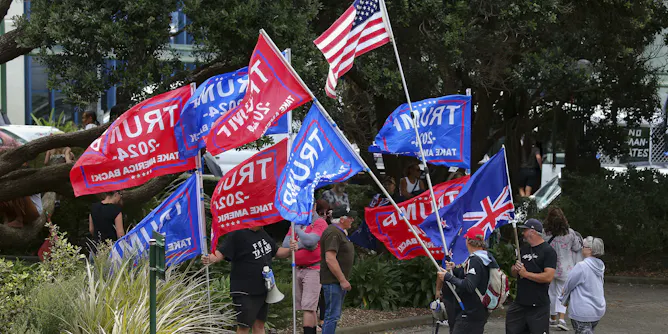
New Zealand has a high concentration of extremist alt-right groups relative to similar countries. The challenge now is to head off hate crime and violence.
Articles on QAnon
Displaying 41 - 60 of 94 articles
Social media isn’t simply awash in conspiracy theories and extremism. It contains pathways designed to lead people to ever more extreme material.

A representative survey of American adults finds broader support for violent insurrection than many would like to think.

Far right nationalists, anti-vaxxers, libertarians and conspiracy theorists have come together over COVID, and capitalised on the anger and uncertainty simmering in some sections of the community.

Despite outbreaks, some church leaders in Alberta have continued to downplay the severity of COVID-19. Choosing to double down on pandemic skepticism.

Child sexual abuse and child sex trafficking are serious problems. Misinformation is harming efforts to combat them.
Online abuse is often dismissed as “just online.” But the rise of QAnon and similar groups demonstrates the very real consequences of online speech.
The followers of QAnon gained national notoriety for their support of former President Donald Trump. But QAnon members are influencing the GOP at the state and local levels, too.

A professor of religious studies argues that describing QAnon followers as brainwashed overlooks their role in accepting and spreading potentially dangerous beliefs.
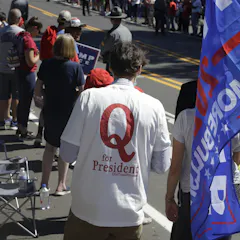
QAnon followers are different from the radicals I usually study in one key way: They are far more likely to have serious mental illnesses.

A revisionist reading of reality, in which social and political events are only understood by a chosen few, is the basis of the QAnon gospel.
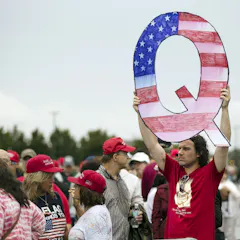
How many Americans really have lost touch with reality?
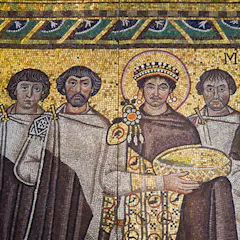
Long overlooked in the West, the Byzantine Empire has recently picked up interest among far-right and conspiracist circles. A historian of medieval culture explains what white supremacists get wrong.
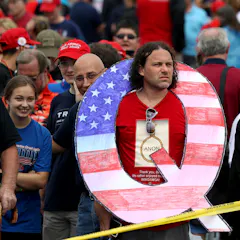
Donald Trump didn’t make a triumphant return on Jan. 20 and is unlikely to on March 4. How a 19th-century religion dealt with a similar disappointment may give clues on how QAnon supporters may react.
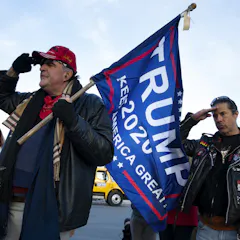
The word ‘patriot’ has a particular meaning to many Americans. But some of them took their idea of patriotism a bit far on January 6.
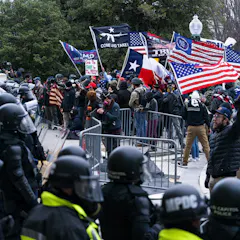
If the new U.S. administration can show that it’s taking action to address widespread grievances, it should be able to move forward from this period of sustained mass protest.

US Rep. Marjorie Taylor Greene of Georgia may have expressed regrets over controversial comments and social media postings. But not to the public, and not in a way that would mitigate harm.
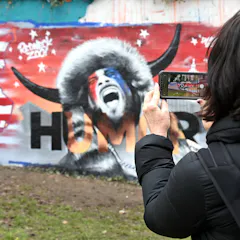
For many extremist groups, a primary goal is to spread their ideology. Costumes and uniforms – even ridiculous ones – are a form of spectacle that can garner attention and interest.

Encrypted messaging services like Telegram provide virtual dark corners where far-right extremists can recruit, organize and plan unhindered.
Analysis shows how Trump and Twitter spread QAnon extremism from the US to Europe, and how hard it will be to undo the damage.
Top contributors
-

PhD candidate Individualized Program, 2020-2021 Public Scholar, Concordia University
-
Research Lead, Center on Terrorism, Extremism, and Counterterrorism, Middlebury College
-
Associate Professor of Sociology, University of Dayton
-
Department of Media & Culture, Faculty of Humanities, University of Amsterdam
-
Chair and Professor of Religious Studies, Radford University
-
Associate Professor of Rhetoric, Politics and Culture, University of Wisconsin-Madison
-
Visiting scholar, postdoctoral fellow in American Studies, Queen's University Belfast
-
Professor of History, Toronto Metropolitan University
-
Assistant Professor of Anthropology, Vanderbilt University
-
Professor of Media, Film, and Communications, Lakehead University
-
Professor of Social Work and Criminology, Chatham University
-
Spécialiste de la politique américaine, Sciences Po
-
Professor of Intelligence and National Security & Dean of Faculty, University of Hull
-
Professor of AI and Behavioral Data Science, University of Technology Sydney
-
Professor of Religion, Carleton University