
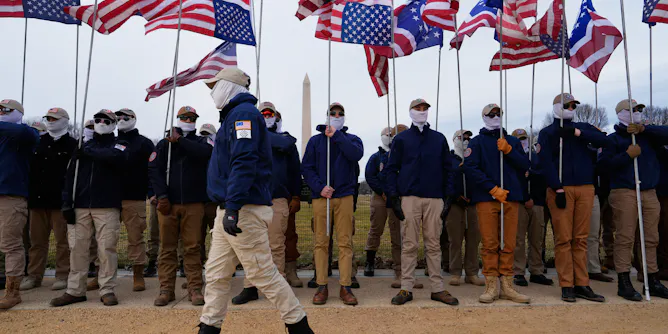
Nearly 1 in 7 white men under 30 in the US support white nationalism, and partisanship alone doesn’t explain who’s drawn to it.
Articles on Public opinion
Displaying 1 - 20 of 160 articles

The people of northern Virginia have been living with data centers for many years. But even they are resisting new developments. And they have specific wishes for how to regulate them.

A public opinion researcher explains why this group’s declining faith goes beyond partisanship and reflects a fundamental question about its sense of belonging.

People are hardwired to believe they’re in danger – and politicians can tap into this.

More Americans now hold absolutist positions, supporting legal access to abortion in all or most cases and opposing government regulation altogether.

Data center proposals are often local controversies with significant underlying principles at stake.

A statewide survey finds majorities in farm country at odds with the deportation push reshaping their workforce.

A new study by the University of Liège that takes a closer look at the situation in Belgium shows that there is public support for granting undocumented migrants who work legal status.

Polls indicate majority support for abortion rights in most states, but laws differ greatly between places that uphold such rights and those that ban the procedure.
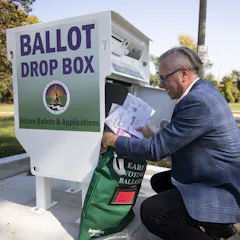
Officials from 70% of Michigan’s 1,856 cities, villages, counties and townships completed the survey.

The term ‘pro-life’ can seem simple – but how Americans and advocacy groups interpret it varies widely.
Well-known flaws in conventional polling methods may be creating the incorrect perception that many Americans think political violence is justified.

In the most recent YouGov poll on this issue, 54% of Conservative voters and 72% of Reform voters were in favour of leaving.
New study finds both MPs and the public underestimate how quickly global emissions must be cut.

Anger at the other side, as represented by the political party opposing yours, is a powerful motivator to engage in protests.

What if airport security checks were more of a security spectacle, whose effectiveness was primarily symbolic and social?

As global opinion turns against Israel and its traditional Western allies distance themselves, the country finds itself increasingly isolated.
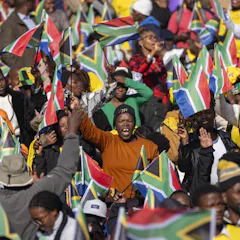
Pre- and post-election surveys in South Africa show a surge in optimism and pro-democratic sentiment.

Compared to 20 years ago, more Europeans (in many, but not all countries) feel immigration makes their country a better place to live.
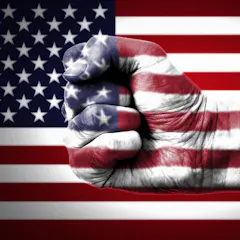
The early 1920s in the US offers historical lessons on how current pessimism about the state of the country can manifest in dangerous, discriminatory ways.
Top contributors
-

Professor of Public Policy and Director of the Policy Institute, King's College London
-
Owen L. Coon Endowed Professor of Policy Analysis and Communication, Northwestern University
-
Professor of Human Factors, Embry-Riddle Aeronautical University
-
Associate Professor of Communication (Clinical) and Co-Director of Eurasian Security and Governance Program, The Ohio State University
-
Lynton K. Caldwell Professor of Public Affairs, Indiana University
-
Professor of Political Science, University at Buffalo
-
Assistant Professor of Graduate Studies, Embry-Riddle Aeronautical University
-
Professor of Political Science, Boise State University
-
Professor of Politics, Queen Mary University of London
-
Associate Research Scientist, Michigan State University
-
Professor of Sociology and Criminal Justice, City University of New York
-
Professor of Public Relations, Michigan State University
-
Associate Professor of Political Science, University of Maryland, Baltimore County
-
Assistant Professor, University of Michigan
-
Professor of Political Science, LaGrange College