
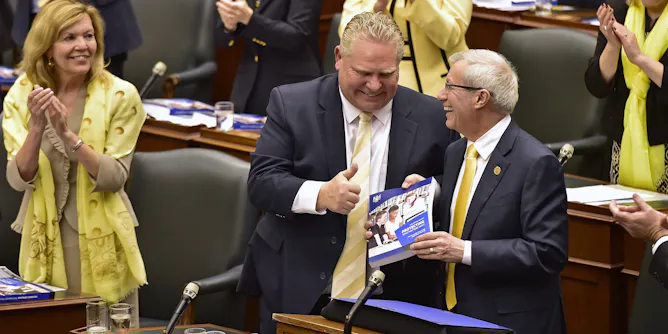
The Progressive Conservative government’s call to modernize education invokes long-standing rhetoric about progressive education in paradoxical ways.
Articles on Propaganda
Displaying 101 - 120 of 197 articles
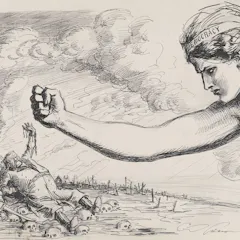
Many citizens are searching for certainty and control in uncertain times. But that means too many are spurning democracy and being seduced by fake news and political strongmen. Democracy needs our help.
Many positive “qualities” associated with the British character and institutions can be traced to wartime propaganda.
European countries, especially the Baltic states of Estonia, Latvia and Lithuania, have confronted Russian disinformation campaigns for decades. The US can learn from their experience.
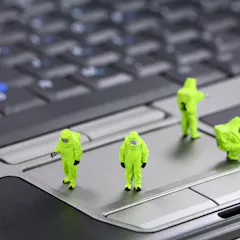
Protect yourself from hackers, trolls, bots, social media executives and programmers in need of ethics training.
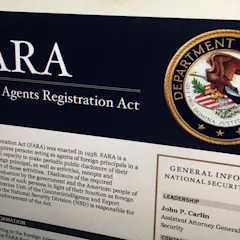
The initial aim of the 1937 Foreign Agents Registration Act was long forgotten: the prosecution of Nazis for interfering with American democracy. But that law is startlingly relevant to the US now.
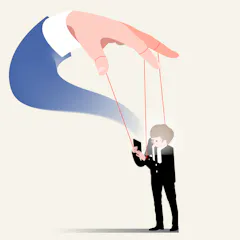
Academic research highlights the dangers – personal and societal – of giving too much time and attention to social media.
Without much delay, Facebook and Twitter could make significant changes to limit political manipulation and propaganda. Will they? And will users ask it of the social media giants?
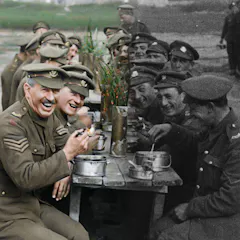
It’s beautiful, clever and moving. But Peter Jackson’s use of colour and added sound essentially fictionalises this account of life in the trenches.
The Iffy Quotient measured misinformation on social media in the run-up to the recent elections. Facebook has gotten better at combating untrustworthy links, but Twitter still struggles.
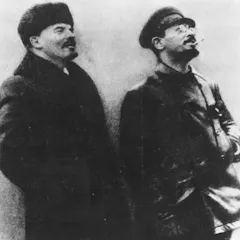
Forged documents were used by the US government 100 years ago to justify hostile actions against Russia. All but one US newspaper accepted the government’s propaganda. The lessons for today are stark.
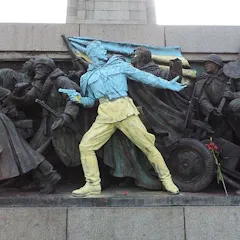
The Soviet programme of building war memorials in Eastern Bloc countries was a bid to win the hearts and minds of future generations.
Russian hackers are coupling old propaganda strategies with new technologies to attack and exploit not just computers and stored data, but how people think.

Cybersecurity experts in the US knew about Russian intelligence agencies’ activities, but may not have had any idea how comprehensive and integrated they were – until now.
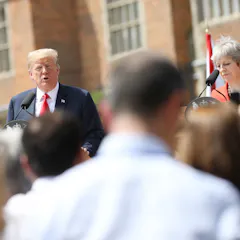
‘Fake news’ is a meaningless term that is used for anti-democratic propaganda. We should all stop using it.
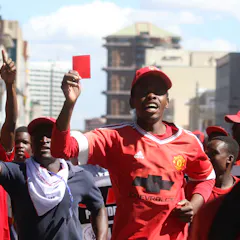
Zimbabwe’s upcoming elections potentially marks the start of a new order in the country, where the stakes are extremely high.
Companies, such as Google, Facebook and Microsoft are working together to take down terrorist propaganda.
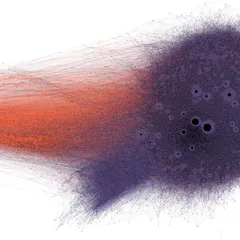
Information on social media can be misleading because of biases in three places – the brain, society and algorithms. Scholars are developing ways to identify and display the effects of these biases.

During the war, few Americans actually saw the ‘Rosie the Riveter’ poster that’s become a cultural icon.
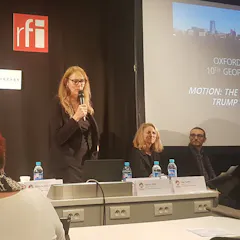
As part of the Grenoble École de Management’s 2018 Geopolitics Festival, four scholars explored the art of debate – an antidote for toxic conversations in the fake-news era.
Top contributors
-

Director of Undergraduate Studies, School of Journalism, Media and Cultural Studies, Cardiff University
-
Associate Professor in Digital Media, Queensland University of Technology
-
Senior Lecturer in Political Communications, Nottingham Trent University
-
Global Scholar at Woodrow Wilson International Center for Scholars, Washington, DC and Hopkins P Breazeale Professor, Manship School of Mass Communications, Louisiana State University
-
Professor of Informatics and Computer Science, Indiana University
-
Senior Lecturer in Journalism, University of Essex
-
Professor and Chair, Department of Journalism, Stellenbosch University
-
Associate Professor of Communications (Social Media), Syracuse University
-
University Fellow in Law, Charles Darwin University
-
Adjunct Instructor in Cybersecurity, Johns Hopkins University
-
Lecturer European Politics, Leiden University
-
Ph.D. in Political Science and International Relations, USC Dornsife College of Letters, Arts and Sciences
-
Professor of Human Centered Design & Engineering, University of Washington
-
Professorial Lecturer, American University School of International Service
-
Faculty member & Research Group Leader, Max Planck Institute for Software Systems