
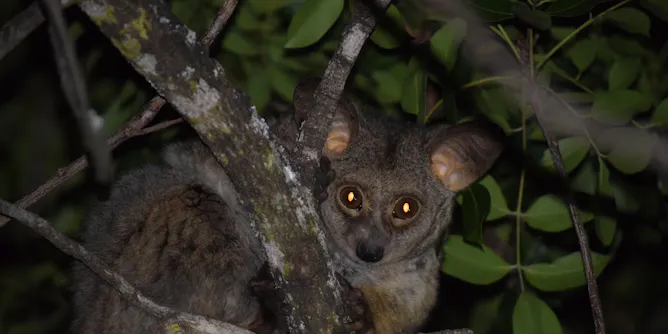
Little is known about what physiological mechanisms African primates use to cope with environmental and social changes such as climate change and human encroachment on their habitat.
Articles on Primates
Displaying 61 - 80 of 133 articles
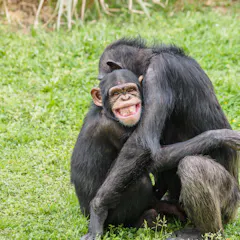
We studied 8,000 primate teeth and finally confirmed that humans are not the only living primate to suffer from cavities. But there are interesting differences.
Differences between male and female skulls in some species of gibbon may shed light on how our extinct ancestors lived.
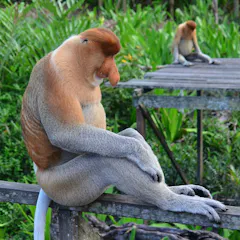
Less attractive endangered species don’t tend to receive the same public attention as their more beautiful counterparts: new studies show how we might help change that.

New research calls into question the validity of ‘Dunbar’s number’.

The virus is always present in nature and when circumstances allow, it may jump from one species to another.
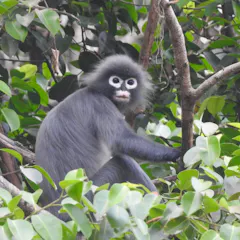
How scientists discovered the ‘Popa langur’ was a separate species of just 200 monkeys.
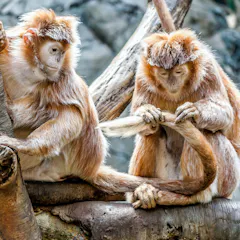
Without adequate information, we can’t prioritise efforts and funding to best protect our primate relatives.

The ‘good’ side of our nature is much more deep-rooted than the ‘evil’ side.
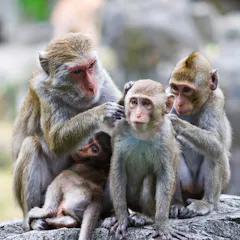
Primates have evolved behavioural strategies that can minimise the risk and costs of conflict.
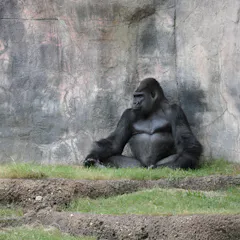
Freedom of movement for survival.
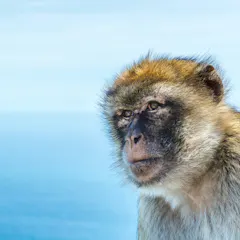
New research suggests African monkeys crossed the ocean to South America earlier than previously thought.

People can still learn a great deal about these mammals while keeping a safe distance.
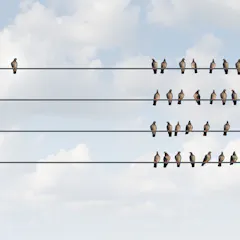
The evolution of the strong human bond.
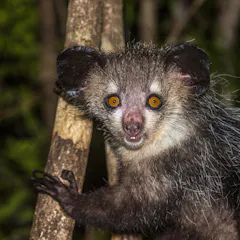
Previously undocumented, this tiny extra digit – called a “pseudothumb” – is a structure on each wrist made of bone and cartilage.

Scientists don’t ask how some people evolved to be tall. In the same way, asking how homosexuality evolved is the wrong question. We need to ask how human sexuality evolved in all its forms.

Ancient frescoes suggest Europe and south Asia had trade links as long as 3,600 years ago.

New research shows that slowing deforestation is the most essential step for saving Madagascar’s lemurs, and can help protect them against the longer-term threat of climate change.
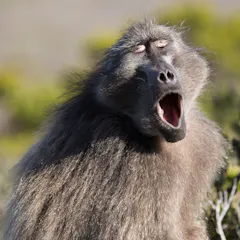
Researchers say it’s time to finally discard a decades-old theory about the origins of human language – and revise the date when human ancestors likely were able to make certain speech noises.

The human scream – a response we share with our primate relatives – is more nuanced than you might think.
Top contributors
-

Associate professor, Adelaide University
-
Senior Lecturer in Biological Anthropology, University of South Wales
-
Lecturer in Wildlife Conservation
-
Asso. Professor in Anthropology, University College London, UCL
-
Senior Lecturer in Zoology, Bangor University
-
Associate Professor of Evolutionary Biology, Anglia Ruskin University
-
University of Hull
-
Associate professor in Vertebrate Palaeontology, University of the Witwatersrand
-
Lecturer in the School of Applied Sciences, Edinburgh Napier University
-
Senior Lecturer in Biological Anthropology, Australian National University
-
Professor of Anthropology, Durham University
-
Postdoctoral Researcher in Evolutionary Biology, University of Oxford
-
Professor of Primate Biology, Liverpool John Moores University
-
Research Fellow in Biological Anthropology, Monash University
-
Professor of Earth System Science, UCL