

Governments and universities have failed to prepare for an increase in housing demand amid planned enrolment growth in higher education and a crisis driven by treating housing as an investment.
Articles on Post-secondary education
Displaying 41 - 60 of 96 articles

Engineers say the current ‘iron ring’ ritual is steeped in colonial worldviews and excludes the public from understanding engineers’ ethical obligations.
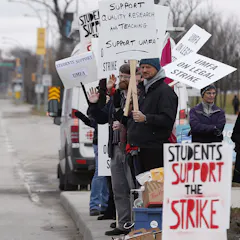
Education strikes by university and public school workers are political fights about diminished respect for education as a public good and workers’ rights in an economy that perpetuates inequality.
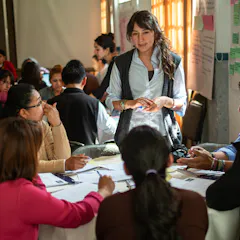
Harmful research practices have done serious damage to Indigenous communities and created distrust. The Collaborative Indigenous Research Digital Garden is one way to repair that damage.
A survey of disabled students found that some university accommodations they value became more widespread in the pandemic, like flexible course deadlines.

As Latin American communities continue to grow, universities must teach students about Latin America and Latinx communities in interdisciplinary ways.

Through the Scarborough Charter, many Canadian universities committed to fostering alternative ways of knowing. But more must be done to realize that commitment.

Universities should look to democratic innovations seen in society like ‘mini publics’ where citizens deliberate about critical issues in representative forums.

Internships and work-integrated learning for social sciences and humanities students can be part of how post-secondary institutions increase their capacities to contribute to social innovation.

Teaching approaches should be rooted in learning objectives or students’ experiences, and these considerations aren’t the same as whether course components are online or in-person.

Students gain control over their own academic records or professional certifications, but blockchain’s immutability means mistakes cannot be erased.

During times of stress and change, people are often advised to practice self-care by looking after themselves, yet what about the benefits of showing kindness to others?

Women’s studies programs should continue to be supported to ensure the fight for women’s rights are not reversed or forgotten.

To understand how tuition waivers and associated supports can help former youth in care complete post-secondary education and positively affect their health, evidence-based practices are needed.

Recognizing and accrediting students’ prior learning and competencies is one way universities can tweak business-as-usual approaches.

Research by geographers in Canada, the United States and Hong Kong identifies lessons for universities and colleges from the 2020 move to online learning.

Year-round academic and extracurricular opportunities that encourage cultural exchange between international students, their peers and the wider society are important.

Universities can draw on health research about patient/health-care practitioner shared decision-making to centre the voices of BIPOC students when creating policies and practices to dismantle racism.

COVID-19 planning needs to take disability justice seriously. Universities must design courses to be accessible to all learners, and offer ongoing remote learning.

A medical genomics professor reflects on how lab simulations offer some advantages for student learning, but developing the muscle memory of performing hands-on lab work is important.
Top contributors
-

Full Professor and Associate Vice-President, Research, Mount Saint Vincent University
-
Innovation Lab Director and Professor, Educational Technology and Innovation Mindset, Concordia University
-
PhD candidate (health), Dalhousie University
-
Professor, Faculty of Education, Memorial University of Newfoundland
-
Professor, Urban and Regional Planning, Toronto Metropolitan University
-
Architecture and Urbanism Researcher, Toronto Metropolitan University
-
Professor, Department of Communication Arts, University of Waterloo
-
Associate Professor of Psychology and Clinical Director, Regional Assessment & Resource Centre, Queen's University, Ontario
-
Professor, School of Public Policy and Administration, York University, Canada
-
Associate Professor, Educational Technology, Université Laval
-
BCL/JD Candidate, McGill University
-
Post-Doctoral Fellow, Johnson Shoyama Graduate School of Public Policy, University of Saskatchewan
-
Associate Professor, Department of Psychology; Director, Trent Centre for Aging & Society, Trent University
-
Associate Professor, Psychology, Acadia University
-
Canada Research Chair in Occupational Health Psychology and Professor of Psychology, Saint Mary’s University