

Long before coronavirus hit Australia we were moving less between states and regions. Some worry about economic impacts, but a greater concern is inequality if some people find themselves ‘trapped’.
Articles on Population
Displaying 101 - 120 of 222 articles

The number of births in the United States have been falling for the last three decades, reaching their lowest number in 32 years.

To be clear, I’m not advocating compulsory population control, here or anywhere. But we do need to consider a future with billions more people, many of them aspiring to live as Australians do now.

The number of old people will increase, while the proportion of white Americans will continue to fall.

There is substantial difference in what’s happening to migration from inside and outside the EU.

The government wants more people to live in Australia’s north. So we looked at three scenarios to increase the population and the results don’t always look good for the north.

Talk of moving people out of Japan’s cities into rural areas is changing after the recent cyclone hit near Tokyo. Smarter, more connected cities may be a safer way to go.

A little bit of statistics can explain the great mystery of why only girls are being born in Miejsce Odrzanskie.

The UK is facing a population crisis with birth rates at an all-time low.

July 29, 2019 is ‘Earth Overshoot Day,’ a date coined by the nonprofit Global Footprint Network to publicize overuse of Earth’s resources. But their estimates may actually understate the problem.

Demographers have figured out a simple and effective way to estimate the number of unauthorized immigrants – even without information on citizenship.

There were an extra 623,000 deaths in the UK in the year to mid-2018 – an increase of 3%.

The UN’s new global population projections include some surprises – in particular, that the global population in 2100 will be 3% less than they projected in 2017.

Whatever happens with Brexit, the UK population is projected to increase in size, become more ethnically diverse and shift to a structure which is older.

As DNA testing becomes cheaper, it becomes more feasible to screen large numbers of healthy people for their risk of disease.

Immigration is neither the problem nor solution in many areas where Australia is off-track, from government debt to environmental action.

When President Trump declared the US full, little did he know he was wading into a centuries-old economic debate.

Population growth has pros and cons, and the Morrison government’s plan is less about a change in immigration numbers than about increasing the benefits and minimising the costs.

Capital city populations are growing twice as fast as the rest of Australia, because of the employment and business opportunities and lifestyle on offer to both new migrants and long-term residents.
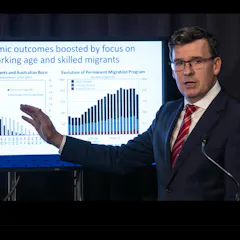
Australian evidence backs up the governments contention that immigration boosts rather than cuts living standards.
Top contributors
-

Demographer, POLIS Centre for Social Policy Research, Australian National University
-
Gilles Pison is a Friend of The Conversation.
Anthropologue et démographe, professeur émérite, Muséum national d’histoire naturelle (MNHN); Ined (Institut national d'études démographiques)
-
Professor of Demography and Social Statistics., Obafemi Awolowo University
-
Honorary Professor of Demography, Macquarie University
-
Principal Research Fellow, Charles Darwin University
-
Professorial Fellow, University of Canberra
-
Senior Research Fellow, Centre of Policy Studies, Victoria University
-
Partner Investigator, ARC Centre of Excellence for Indigenous and Environmental Histories and Futures, James Cook University
-
Distinguished Professor of Sociology and Demography, Penn State
-
Adjunct Associate Professor, University of Tasmania
-
Visiting Fellow, Crawford School of Public Policy, Australian National University
-
Associate professor, University of Ibadan
-
ARC Australian Professorial Fellow, Adelaide University
-
Adjunct professor, School of Media and Communications, RMIT University
-
Director of the Complex Adaptive Systems Research Group, University of Newcastle