
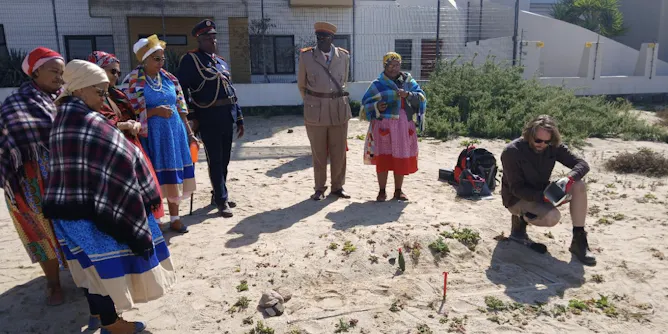
Without intervention, the important surviving physical evidence and the opportunity for commemoration will be lost.
Articles on Namibian genocide
Displaying all articles
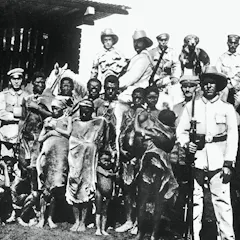
Germany’s genocide of the Ovaherero and Nama has been well documented, but the massacre of the Bushmen from 1912 to 1915 is seldom discussed.
Campaigners in Namibia are demanding that the government and industry halt the expansion plans on Shark Island, and meaningfully engage with reconciliation.
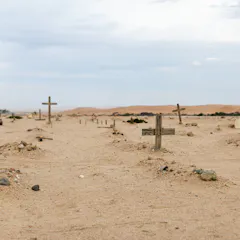
The Long Shadow of German Colonialism tells of a brutal history, and how this past lives on today.

The European bourgeoisie could not forgive Hitler because he applied in Europe colonialist procedures previously reserved for the supposedly inferior Arabs, Indians, and Africans.
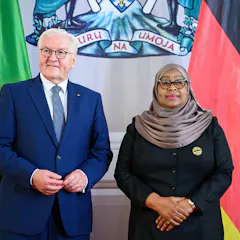
The evidence suggests that atrocities committed against civilians and communities were indeed intended to destroy an identifiable group.
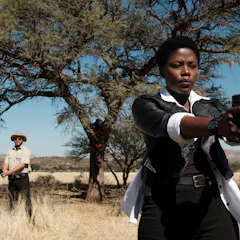
The genocide of the Herero people lives on in today’s Namibia and Perivi Katjavivi’s film illustrates this.
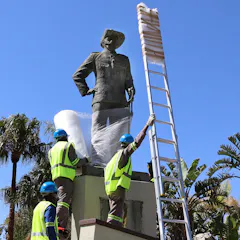
The erasure of indigenous people living in Windhoek before the German colonisers arrived has angered activists.
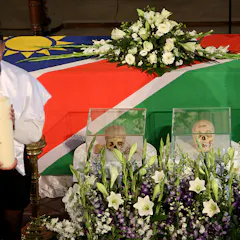
German’s commitment of €1.1bn for development projects in Namibia over 30 years is too cheap a price to pay for remorse.
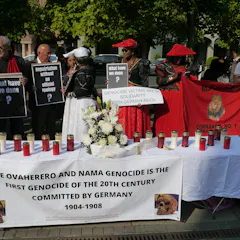
The culture of remembrance in Germany is viewed by many as exemplary. But it has some grave shortcomings.
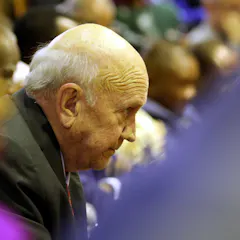
It seems that former president FW De Klerk continues to find it hard to accept that apartheid was a crime against humanity.
Top contributors
-

Extraordinary Professor, Department of Political Sciences, University of Pretoria
-
Professor in Political Science, Arnold Bergstraesser Institute
-
Professor of Political Studies, University of Johannesburg
-
Professor of Political Science, SWPS University
-
Professor of Literature and Applied Linguistics, Namibia University of Science and Technology
-
Professor of Criminal Law, University of the West of England
-
Postdoctoral Research Fellow, University of Victoria
-
Researcher, School of Environmental Science, University of Victoria
-
Emeritus Professor, University of Vermont and Research Associate, University of the Free State
-
Reader of Archaeology, Centre of Archaeology, University of Huddersfield
-
Lecturer in Archaeology, University of Huddersfield
-
Professor of Sociology, University of the Witwatersrand