
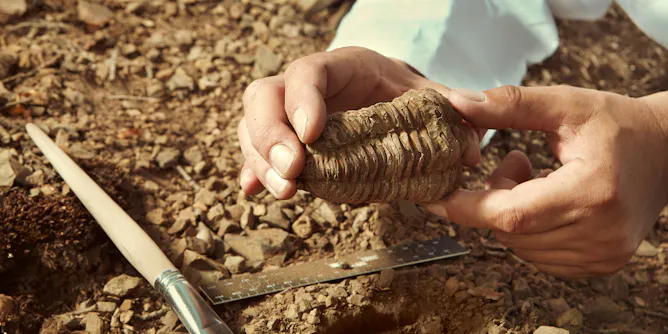
Scientists have long been confused about ‘missing’ animal fossils.
Articles on Molecular clock
Displaying all articles
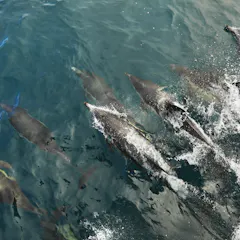
New research has developed the first molecular ‘clock’ for common dolphins. It could be a game-changer for conservation.
Charles Darwin knew the evidence from fossils contradicted evolution. Researchers are still trying to work out the problem today.
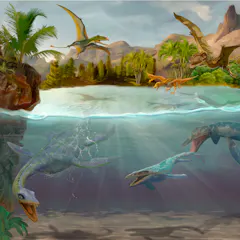
New research shows that placental mammals survived the mass extinction that killed the
dinosaurs.
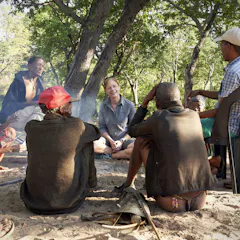
Genetic analysis has traced the evolutionary footsteps of modern humans all the way back to a prehistoric wetland that spanned parts of modern-day Botswana, Namibia and Zimbabwe.
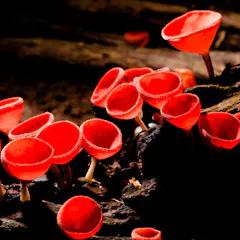
Newly discovered billion-year-old fossilised fungi are more than twice as old as previous finds, and suggest that fungi may have been preparing Earth’s lands for plant life for millions of years.
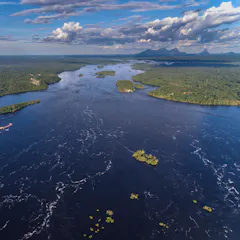
Rivers are natural boundaries for evolving populations. But scientists don’t agree whether they create new species or just help maintain them. Research using birds’ molecular clocks provides some answers.

How do scientists figure out when evolutionary events – like species splitting away from a common ancestor – happened? It turns out our DNA is a kind of molecular clock, keeping time via genetic changes.
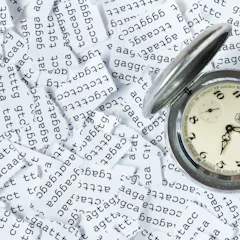
The molecular clock is helping us deepen our knowledge of evolution and completing the tree of life. But how does it actually work?
Top contributors
-

Professor of Zoology, Universidade Federal de Pernambuco, Brazil and Visiting Scholar, Harvard University
-
Lecturer, California State University, Long Beach
-
Research Software Engineer, University of Bristol
-
Postdoctoral Research Fellow in Biological Sciences, Columbia University
-
Professor, Garvan Institute of Medical Research and, University of Sydney
-
Research Fellow in Palaeobiology, University of Oxford
-
PhD student in Palaeobiology, University of Bristol
-
Jodrell Professor of Zoology and Comparative Anatomy, UCL
-
Professor in Plant-Soil Processes, University of Sheffield
-
Postdoctoral Fellow in Genetics, CSIRO
-
PhD Candidate in Marine Science, Te Kunenga ki Pūrehuroa – Massey University
-
Professor of Marine Ecology, Te Kunenga ki Pūrehuroa – Massey University
-
Lecturer in Biological Sciences, University of Wollongong
-
Research Officer in Cetacean Ecology, Te Kunenga ki Pūrehuroa – Massey University