
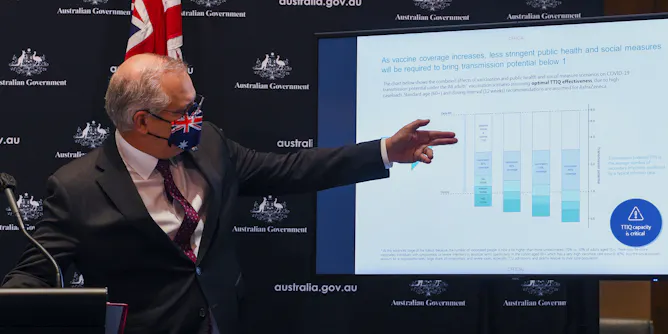
The Australian people will be best served by separating science from politics.
Articles on Modelling
Displaying 21 - 40 of 76 articles
An 80% adult vaccination rate corresponds to 64% of the overall population, leaving plenty of people susceptible to the virus if restrictions ease too quickly.
Governments cannot keep making unrealistic promises about easing restrictions at 70% and 80% adult vaccination, a plan that relied on optimistic scenarios in the first place.
Not vaccinating children means living with the knowledge we haven’t done everything possible to ensure they don’t transmit COVID to more vulnerable people.
Different groups of researchers give different predictions. And it’s easy to be bewildered, especially if you’re in lockdown and looking for answers. Here’s what to make of it all.

But herd immunity is not our only option. If we don’t vaccinate children, we may have to settle for lesser protection of the population.

If we open up the international borders before enough of the population is vaccinated, hospitals could become overwhelmed and deaths would be unacceptably high.
The good news is Victoria is more likely to reach zero case of community transmission sooner if vaccination rates pick up, even modestly.
It may take until the end of the year to get case numbers close to zero, unless more stringent measures are introduced.
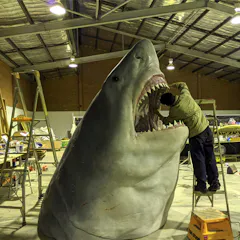
Two museum exhibits, one in the Smithsonian and one in Australia, have opened public displays featuring the spectacular meg. But while both models are mega impressive, they’re not the same. Why?

With the Australian Open about to start this year’s grand slam series, a crunch of the data from past performances gives a hint at who is the current best male player, possibly.
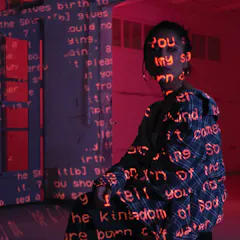
Cybersecurity risks are evolving rapidly. How can they be more effectively assessed and managed ?

Studying how SARS-CoV-2, the virus that causes COVID-19, travels through indoor air spaces can help reduce transmission risk.
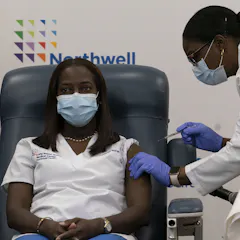
Here’s what we still need to find out before we can know when we’ll be able to return to our pre-coronavirus ways.
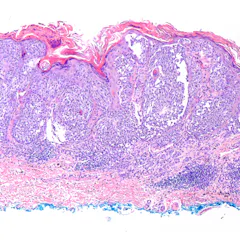
To better understand how cancer tumors grow, mathematicians use diffusion models.

We’re on the road again. Getting enough COVID-19 vaccine to where it’s needed in a given time frame is the next logistical hurdle.
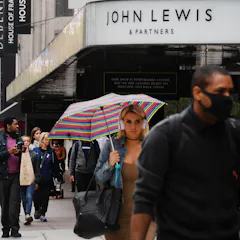
The R number fluctuates more as case numbers fall.

Many of the more formal models for predicting the pandemic try to understand why changes happen – but often it can be more accurate to ignore the reasons and simply look at the data.
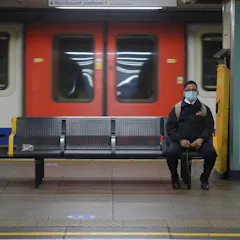
The UK locked down too late and has been in catch-up mode ever since. But with contact tracing, it can turn things around.
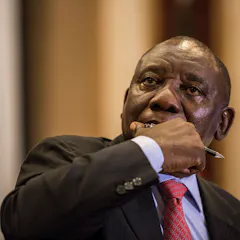
The South African government and some of its advisors want to have the best of both worlds. They want to use incorrect predictions by early models about the COVID-19 pandemic to claim success.
Top contributors
-

Lecturer in Probability and Statistics and Senior Research Fellow in Infectious Disease Modelling, University of Oxford
-
Professor, Systems and Computer Engineering, Carleton University
-
Deputy Director (Programs), Burnet Institute
-
Head of School of Population Health and Professor, Infectious Diseases Dynamics and Interventions, UNSW
-
Honorary Enterprise Professor, School of Population and Global Health, and Department of General Practice and Primary Care, The University of Melbourne
-
Professor of Infectious Disease and Epidemiology, James Cook University
-
Professor of Biostatistics and Epidemiology, Adelaide University
-
Head of Modelling and Biostatistics, Burnet Institute
-
Professor of Civil and Environmental Engineering, Adelaide University
-
Associate Professor of Human Dimensions of Natural Resources, Colorado State University
-
Research Fellow, School of Civil, Environmental and Mining Engineering, Adelaide University
-
Chief Executive Officer, Monash University
-
Senior Lecturer in Applied Mathematics, Queensland University of Technology
-
Professor of Mathematics, Heriot-Watt University
-
Adjunct professor, UNSW