
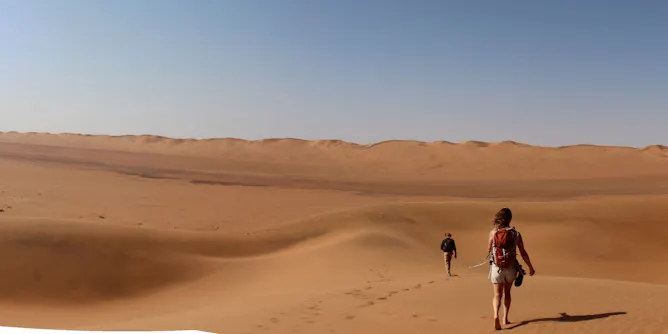
New research provides the foundation for larger, regional-scale analyses of early human adaptive strategies in the Namib Sand Sea, Namibia.
Articles on Middle Stone Age
Displaying all articles

The sculpture might have begun with tracing a blue stingray specimen in the sand.
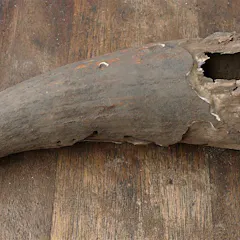
The medicine container was found in a painted rock shelter. A radio carbon date of the horn container places it at around AD 1461-1630.

Combining evidence from archaeology, geochronology and paleoenvironmental science, researchers identified how ancient humans by Lake Malawi were the first to substantially modify their environment.

A new environmental record for a prehistoric site in Kenya helped researchers figure out how external conditions influenced which of our ancient ancestors lived there, with what way of life.
Until now the search for early evidence of alcohol has fixated on residue analysis.

CC BY-NC-ND4.84 MB (download)
The sounds our ancestors made are important because they teach us about spaces and behaviour and rituals of the time.
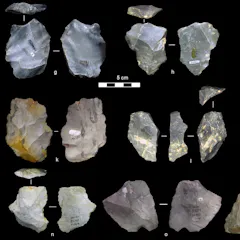
A fresh look at museum artifacts fills in a gap in the Asian archaeological record and refutes the idea that an advanced technique was imported from the West by early modern humans.
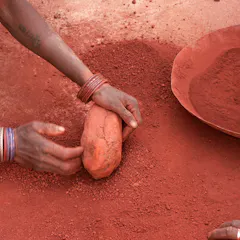
Ochre has many uses. It can be used to shed information on the evolution of the modern mind.
Top contributors
-

Curator at the Origins Centre Museum, University of the Witwatersrand
-
Postgraduate Student in Earth and Environmental Sciences, University of Wollongong
-
Professor, Environmental Futures Research Centre, School of Science, University of Wollongong
-
Professor of Archaeology, University of Washington
-
Professor of Archaeology, Conservation and History, University of Oslo
-
Professor, University of the Witwatersrand
-
Reader in Physical Geography, University of Manchester
-
Director of the Human Origins Program, Smithsonian Institution
-
Assistant Professor of Geosciences, Penn State
-
Emeritus Chief Scientist, NRF-SAIAB, National Research Foundation
-
Research Associate, University of the Witwatersrand
-
Postdoctoral fellow, University of Tübingen
-
Professor of Archaeology, University of the Witwatersrand
-
Associate professor, University of Johannesburg
-
Research Associate, African Centre for Coastal Palaeoscience, Nelson Mandela University