
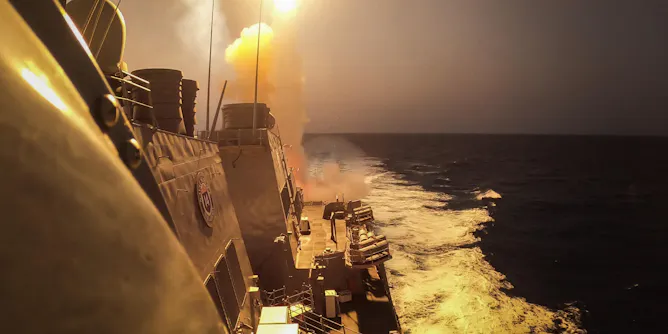
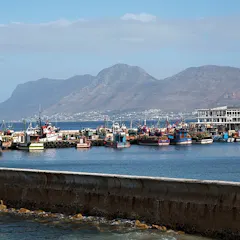
The African shoreline is now much more valuable to outsiders who want to monitor, contain or outflank the waterway opposite them.
Articles on Maritime security
Displaying 1 - 20 of 47 articles
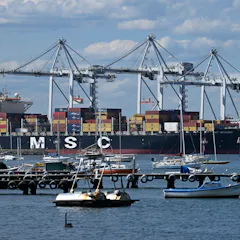
Fuel is not the only critical thing Australia imports by sea. We need to make maritime resilience a priority.
Our war game simulations showed how vital it is to protect shipping routes across the entire ocean, not just in waters close to Australia.

From 19th century British navy to US destroyers in the Caribbean, diplomacy at seas has been accompanied by military might.
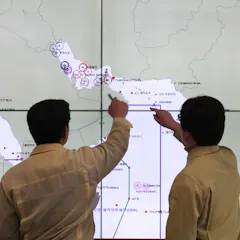
The Middle East crisis continues to escalate and a decision to close the strait of Hormuz is a dangerous moment.
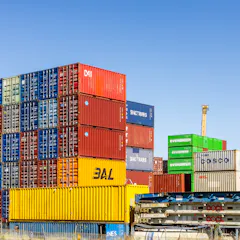
Our trade routes are long and exposed. We need other options to safeguard our trade that don’t necessitate the building of warships.
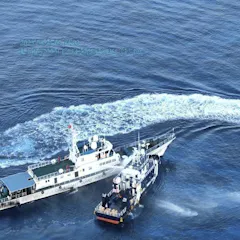
History teaches that once coercion goes unchecked, it tends to escalate. Any disruption to our seaborne supply lines is a major risk.
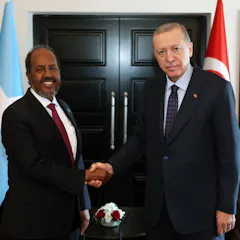
All states have limited security capabilities and they generally prioritise them close to home. where it matters.

Suez Canal ship traffic has dropped sharply due to frequent attacks at sea.
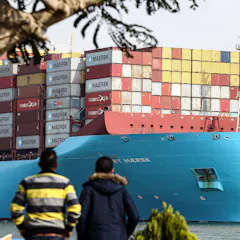
With the Panama Canal in drought and the Strait of Hormuz also vulnerable to Iran, global trade routes are under severe pressure.

The raid follows warnings from Washington to cease attacks in the Red Sea − but it could serve to strengthen rebels and reignite civil war.
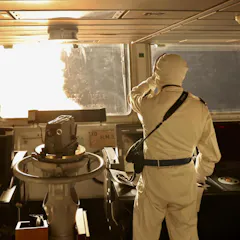
The Iran-backed Houthi rebels have the power to significantly destabilise global trade by endangering maritime activity in the Red Sea.
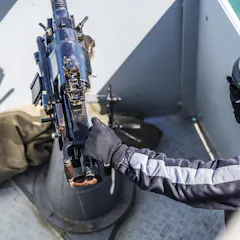
Piracy off the Somali coast remains a high-risk undertaking with a low probability of success.

A new documentary has tracked a Russian vessel apparently collecting data on energy and communications infrastructure in the North Sea and Baltic.
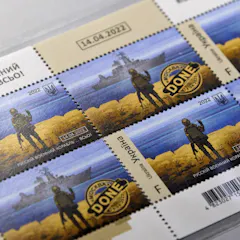
Most of the fighting has been on land, but key developments at sea have put Russia at a disadvantage.

Europe needs to coordinate surveillance of its underwater infrastructure to safeguard vital gas power and data supplies.
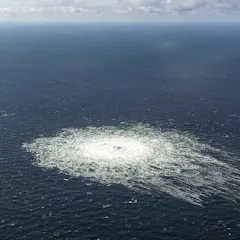
If the Nord Stream attacks were an act of sabotage, this shows how energy infrastructure can be strategically targeted as an act of ‘hybrid warfare’.
The trend globally is for countries to be explicit about their maritime interests, underpinned by a sound security strategy.
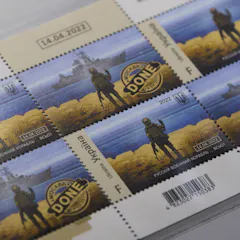
As the war drags on and its maritime dimension intensifies, Russia is more likely to be strategically defeated in the long term.
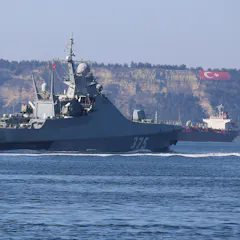
The Montreux Convention Regarding the Regime of the Straits gives Turkey control over the water route between the Black Sea and the Mediterranean.
Top contributors
-

Professor of International Security, School of Global Affairs, Lancaster University
-
Professor of International Relations, University of Copenhagen
-
PhD (Maritime Security)
-
Assistant Professor in Maritime Security, Coventry University
-
Research Coordinator, Security Institute for Governance and Leadership in Africa, Stellenbosch University
-
Assistant Professor, University of Warwick
-
Adjunct Professor, Defence and Security Institute, The University of Western Australia; UNSW
-
Professor of International Security at University of Bristol and Director of the Centre for Global Insecurity, University of Bristol
-
Lecturer, University of Aberdeen
-
Research Fellow in Maritime Security, Coventry University
-
Postdoctoral Fellow, Nelson Mandela University
-
Maritime Logistics Expert, Centre for Supply Chain and Logistics (CSCL), Deakin University
-
Lecturer in Operations Management Operations and Supply Chain Management, University of Liverpool
-
Professor of Sociology in the Department of Sociology and Social Anthropology., Stellenbosch University
-
PhD candidate, Centre of Criminology, University of Cape Town