
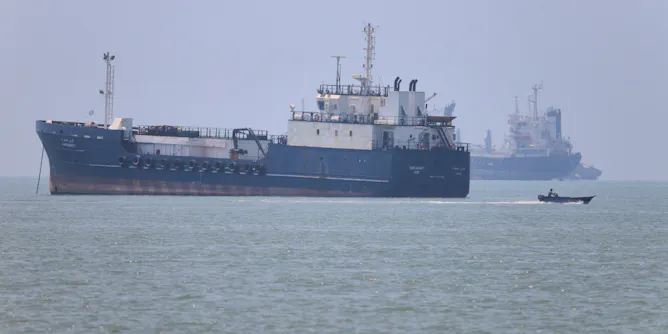
New strikes from the US and Iran continue to put the future of the crucial shipping channel in doubt, but a permanent toll is neither legal nor workable.
Articles on Maritime law
Displaying 1 - 20 of 52 articles
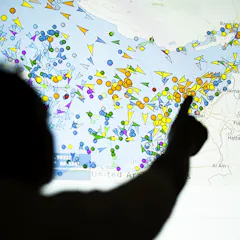
Iran’s decision to levy tolls on ships passing through the crucial choke hold has an unlikely connection to the site of Shakespeare’s ‘Hamlet.’

Even at the best of times, most seafarers face extremely difficult working conditions, while contending with geopolitical crises and unpredictable trade cycles.

Tehran and Washington look to different rules to govern their conduct in the key choke point.
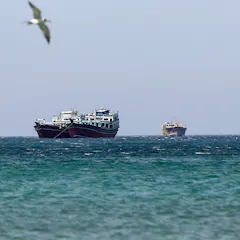
The ceasefire between the US, Israel and Iran has done little so far to getting shipping through the vital waterway. It’s going to take more than just words to fix.

In the law of naval warfare, the line between belligerents and neutrals is not always an easy one to draw.
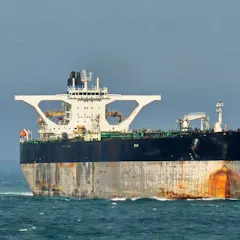
The use of unresigistered or falsely registered ships by Russia and other countries trying to avoid sanctions is becoming an increasing feature of global conflict.
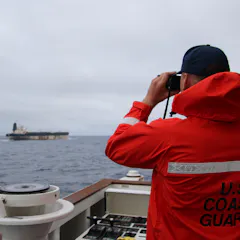
An expert in international maritime law spells out what the international law of the sea has to say on incidents of this sort.
The US and its allies have long used violence and ‘targeted killings’ to further their foreign policy aims.
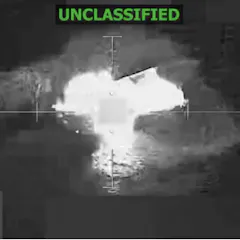
A landmark 1884 court ruling essentially outlawed ‘murder by necessity’ on the high seas. Is Donald Trump running afoul of the law with his boat strikes in the Caribbean and eastern Pacific?

From 19th century British navy to US destroyers in the Caribbean, diplomacy at seas has been accompanied by military might.
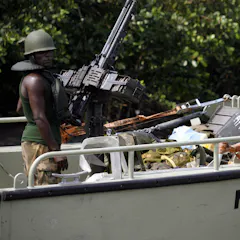
Instead of a winner takes all approach, Africa’s coastal countries should share contested resources.
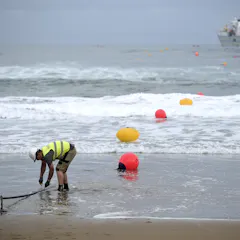
Incidents of accidental and suspect breaches of submarine cables in northern Europe and around Taiwan concern security experts.
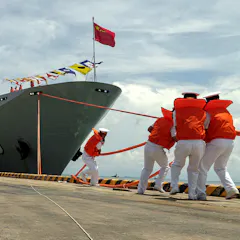
Recent tensions between the US and China can be explained by the geopolitics of sea power and the geography of near and far waters.
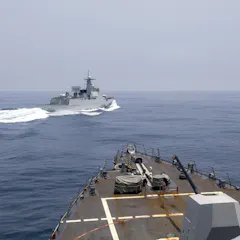
What was behind the latest encounter between US and Chinese military vessels in contested waters?

The South China Sea is of strategic and economic importance to Beijing and the US, setting up a potential power struggle that could spark conflict.
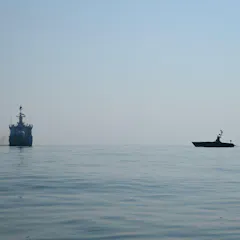
A recent attack by Ukrainian ‘robot ships’ in Crimea shows how effective these unmanned surface vessels can be. Now maritime law needs to keep up with technological developments.
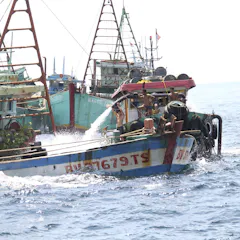
Understanding when, where and why fishing vessels sometimes turn off their transponders is a key step toward curbing illegal fishing and other crimes on the high seas.

Ghana’s maritime economy faces significant challenges in becoming viable.
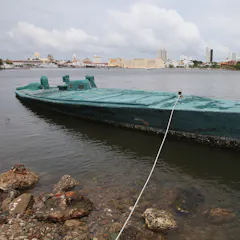
International and Australian laws need to be updated to cope with the newest drug-trafficking technique threatening maritime security: remote-controlled narco-drones.
Top contributors
-

Assistant Professor in Maritime Security, Coventry University
-
Professor, Faculty of Law, UNSW
-
Lecturer in Law, Deakin University
-
Professor of the Public International Law of the Sea and former Director of the Institute of Maritime Law, University of Southampton
-
Adjunct Professor, Defence and Security Institute, The University of Western Australia; UNSW
-
Assistant Professor, University of Warwick
-
Professor of International Security, School of Global Affairs, Lancaster University
-
Professorial Fellow, Australian National Centre for Ocean Resources and Security, University of Wollongong
-
Associate Professor, Deakin Law School, Deakin University
-
Lecturer, Western Sydney University
-
Professor, Management and Economics of Resources and the Environment, University of Southern Denmark
-
Professor of Law, University of Wollongong
-
PhD candidate in Public International Law, University of Bristol
-
Challis Chair of International Law, Sydney Law School, University of Sydney
-
Associate Professor, Director of the Centre for Employment and Labour Relations Law, The University of Melbourne