
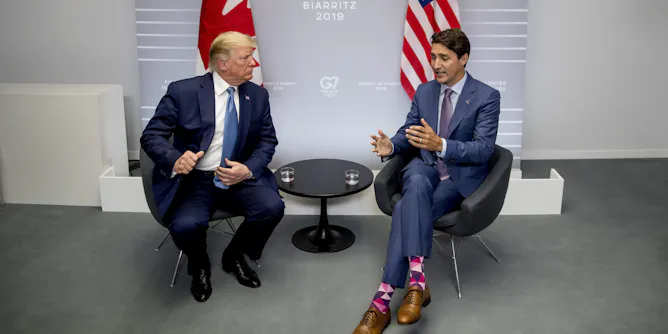
Whoever’s governing Canada in the next four years must prepare for how to respond to — and preferably, pre-empt —Donald Trump’s rhetoric and ensuing actions to preserve and promote Canadian interests.
Articles on Justin Trudeau
Displaying 41 - 60 of 339 articles
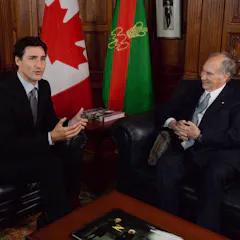
If trust in government matters to Canadians, then ethics issues must be kept in public view and political parties pressured to offer meaningful reform ideas in their campaign and party platforms.
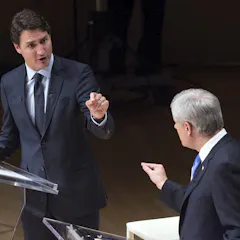
There have been major similarities between Justin Trudeau’s approach to foreign policy and Stephen Harper’s. But Canadian governments have limited flexibility in how they manage external affairs.

Without a shared understanding of the pro-Khalistan issue between Canada and India, the relationship between the two countries is likely to remain strained.

Sharp increases and decreases in the number of immigrants are nothing new in Canada. Historically, immigration levels increase when the unemployment rate declines, and fall when unemployment rises.

More than 70 years ago, right-wing W.A.C. Bennett became a B.C. political powerhouse after a failed Liberal-NDP coalition. There are parallels to today’s rise of the B.C. Conservatives.

Liberal strategists plan to increase the prime minister’s exposure, thrusting the most unpopular politician in the country right in the face of Canadians. Here’s why it isn’t likely to work.

NDP Leader Jagmeet Singh has pulled his party out of the supply-and-confidence agreement that’s helped keep Prime Minister Justin Trudeau’s minority Liberals in power. What’s behind the move?

After the Donald Trump presidency, Kamala Harris joined President Joe Biden in restoring a more conciliatory tone with Canada. But it didn’t really apply to actual policy.
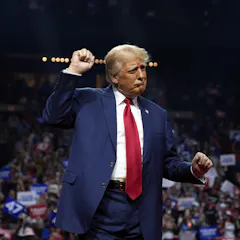
If campaign ethics are no longer important to politicians or voters, the U.S. and Canada will face more contested elections, greater political division and further erosion of trust in politicians.
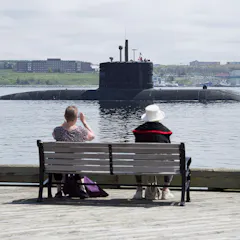
A closer look at Canada’s announcement that it’s buying 12 new submarines makes clear that it’s ‘business as usual’ in terms of defence spending. Canada is doing the bare minimum.

The historic Ottawa/Ontario Liberal/Conservative seesaw will likely play a role in informing when Justin Trudeau and Doug Ford choose to hold the next election.

It’s a unique moment in North America: the prime minister of Canada and the president of the United States are being asked to step aside for the betterment of their parties and their countries.

In democracies around the world, voters aged 18-34 are abandoning the incumbent in favour of opposition parties, often choosing populist-style politicians. Why? Blame the broken social contract.

Canada must readjust its foreign policy to adapt to changing global conditions, and ground that policy in its history. It must be orderly, flexible and in the country’s long-term interests.

The stunning byelection loss in a reliably Liberal Toronto riding doesn’t bode well for the political future of Prime Minister Justin Trudeau.

Both Liberals and Conservatives have invested a lot of resources into an upcoming Toronto byelection. If the Liberals lose the riding, it will be an ominous sign for Justin Trudeau’s Liberals.

The 20-year timeline of Canada’s new defence policy, and the fact that several proposed investments will “be explored,” raises serious questions about its commitment to pull its weight in NATO.

Refugee programs in Canada have always been politicized, but more so in recent years, evidenced in discrepancies between programs for refugees from Gaza and Sudan and those from Ukraine.

Why the public resistance to carbon tax policies? New research suggests a few key factors that may play a role in influencing popular support for carbon tax efforts in Canada.
Top contributors
-

Professor, School of Public Policy and Administration, York University, Canada
-
Professor, Environmental and Urban Change, York University, Canada
-
PhD Candidate, Political Science, Western University
-
Lecturer, Political Science, University of British Columbia
-
Associate Professor of Disaster and Emergency Management, York University, Canada
-
Adjunct assistant professor, International Relations, Carleton University; L’Université d’Ottawa/University of Ottawa
-
Assistant Professor, Public Administration, Queen's University, Ontario
-
Associate Professor of Political Science, Brock University
-
Professor of Political Science, Carleton University
-
Executive Fellow, School of Public Policy; Distinguished Fellow, Asia Pacific Foundation of Canada, University of Calgary
-
Associate Professor of Economics, University of Manitoba
-
Director, Centre for Refugee Studies & Associate Professor, Osgoode Hall Law School, York University, Canada
-
Associate Professor in North American History, University of Birmingham
-
Professor, Political Science, Acadia University
-
Professor of Defence Studies, Canadian Forces College