
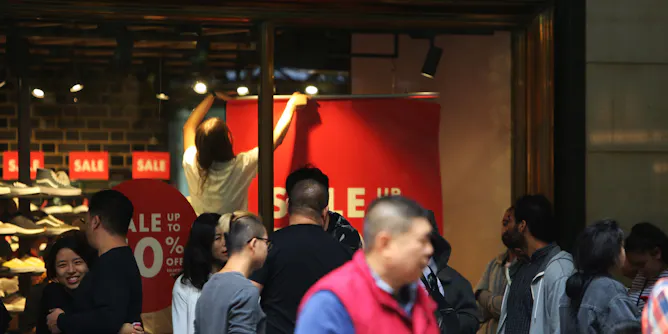
Most workers are still employees, not casuals or gig workers. So what has changed to increase the insecurity of workers?
Articles on Insecure work
Displaying 21 - 39 of 39 articles

The Pakistani women who make the majority of the world’s high-quality soccer balls belong to one of the most vulnerable groups in the global economy.

The black economy is more common than we think – how many of us have paid tradies, gardeners or cleaners cash without the exchange of relevant paperwork?
Despite relatively stable and low levels of unemployment, workers are increasingly concerned that their jobs are at risk.

Data show that people don’t feel more insecure in their jobs now. In fact, that feeling is decreasing.

The arguments for an universal basic income have emerged from a rising disillusionment in classic economics and expectations of more security.

External pressure has led to delivery giant, Hermes, being referred to the chief tax man over whether or not its workers should be classified as ‘self-employed’.
Young people’s transition to work is prolonged and highly precarious. An entry-level job becomes a career, savings become subsistence, weekend shifts become lifelines. It doesn’t have to be this way.

Australians are used to casual work, but there’s not yet any evidence the gig economy is taking off.
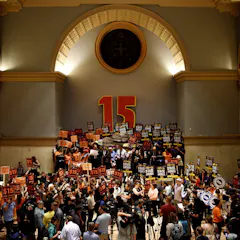
Australia doesn’t have many of the employment problems still troubling OECD countries, but structural unemployment is one.

With the momentum of the sharing economy growing, we’re only just starting to come to grips with what it means for the future of work.
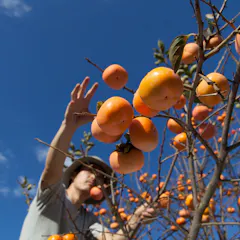
With another fruit picking season in Australia have come the usual reports of “dodgy” labour hire contractors operating in farms around the country. Italian satirical news program Striscia recently picked…

The norm of permanent full-time terms of employment is under serious challenge. In Australia today more than one-third of employed people work on more variable terms – in particular as casuals (19%), independent…

Some of the newest enterprises online are those which link workers to anyone who wants a job done. They’re not concerned with employment or jobs but with “tasks”. These are small, one-off, discrete portions…
With a major review of workplace awards underway, the Federal Government has asked the Fair Work Commission to consider whether penalty rates and other minimum conditions are still relevant. In this Viewpoints…

In recent years, job insecurity among young people has risen to unsettling proportions. Last year, The Economist reported that as many as 290 million 15-24 year olds were not participating in the labour…

If you were to choose one buzzword that, despite its vagueness, has dominated industrial relations debate over three decades, it would be “flexibility”. It has emerged again in rhetoric surrounding Toyota’s…

The Fair Work Commission’s recent wage review may have struck an increased pay deal for low-paid workers but its decision overlooks the growth of a worrying new divide in the Australian workforce. With…

Welcome to the Future of Work, a series from The Conversation that looks at the ongoing evolution of the workplace. Today, Monash University’s Veronica Sheen examines the consequences of the increasing…
Top contributors
-

Laurie Carmichael Distinguished Research Fellow at the Centre for Future Work, Melbourne; and Professor Emeritus, Griffith Business School, Griffith University
-
Professor of Economics, University of Canberra
-
Research Associate, School of Social Sciences, Monash University
-
Senior Lecturer, Management and Organisations, The University of Western Australia
-
Associate professor, University of Sydney
-
Senior Lecturer, Management and Organisations, UWA Business School, The University of Western Australia
-
Public Health Lecturer (University of Tasmania) and PhD Candidate, Southgate Institute for Health, Society & Equity, Flinders University
-
Professor of Economics, University of Newcastle
-
PhD Candidate and Research Fellow, Centre for Employment and Labour Relations Law, The University of Melbourne
-
Professor of Education Policy and Practice, Youth Studies, Monash University
-
Dean of Programs, EM Lyon Business School
-
Assistant Professor, University of Sargodha
-
Lecturer in Management, Employment and Organisation, Cardiff University
-
Professor in Organization and Management, UNSW
-
Professorial Associate in the Centre for Public Policy, The University of Melbourne