

This whirlwind tour of social history describes how infectious diseases have shaped humanity at every stage. It suggests reducing inequality will give us our best chance of surviving future plagues.
Articles on Hunter-gatherers
Displaying 21 - 40 of 45 articles
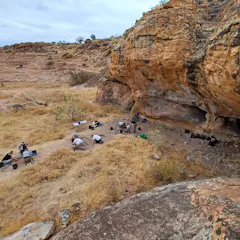
Hunter-gatherers were an important part of the development of the Mapungubwe Kingdom in southern Africa – a fact that history has tended to neglect.

45,000 years ago, people first started arriving in what’s known as Europe today. We thought a worsening ice age made them disappear – but it seems some lineages survived.
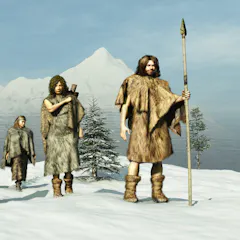
When, how, where and why did complex hierarchical societies evolve? Understanding how we got to this point in time may help us address global challenges, like climate change.

New genetic research shows humans’ famed ability to adapt our behaviour and develop new tools and techniques has not always been enough to survive when times have grown tough.
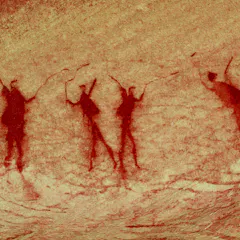
Sometimes archaeologists can “hear” the ancient past using acoustic methods.
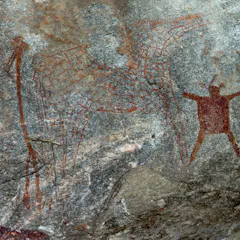
A new study doubles the age of ancient DNA in sub-Saharan Africa, revealing how people moved, mingled and had children together over the last 50,000 years.

The moth cocoons are the first archaeological evidence of shamanic ritual paraphernalia in southern Africa.
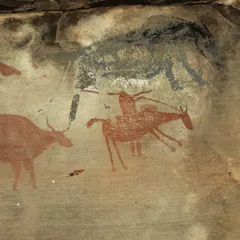
Runaway slaves joined indigenous Khoe-San people and raided colonial farms. The rock art they left in their hideouts tells a fascinating story.

A new book by an eminent anthropologist and archaeologist mounts a rigorous critique of Dark Emu, repudiating notions of ‘primitive’ hunter-gatherers.

We’re the only species that can throw at speeds that kill.
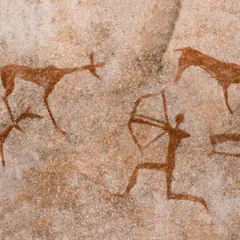
Anthropologists believed that before the implementation of agriculture, men hunted and women gathered, but new evidence suggests that this might not have been the case.
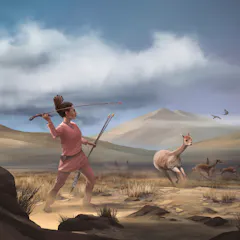
New research is challenging the hypothesis that men did the hunting in prehistoric societies.

By studying the DNA of people who lived in East Asia thousands of years ago, scientists are starting to untangle how the region was populated.
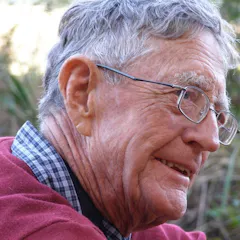
Mason tirelessly sought to convince officials of the need to recognise and celebrate the African past, and the role that African people played in the making of modern South African society.
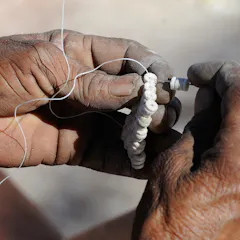
A survey of San ostrich eggshell beads - a common find at archaeological sites - paints a bigger picture of hunter-gatherers, herders and shifting cultural tradition.

Play and learning are one and the same for Mbendjele children.
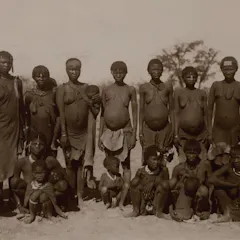
Contrary to the colonial view, Bushmen of southern Africa had a complex and meaningful practice of dress.

‘Eat breakfast like a king’ is flawed advice, new study finds.

Analysis of bones from over hundreds and thousands of years ago suggests that our skeleton today is more fragile than that of our ancestors.
Top contributors
-

Curator of Human Evolution of the Cleveland Museum of Natural History and Research Assistant Professor of Anthropology, Stony Brook University (The State University of New York)
-
Assistant Professor of Anthropology, Yale University
-
Assistant Professor of Anthropology and Archaeology, University of Calgary
-
Professor of Genetic Epidemiology, King's College London
-
Visiting Research Fellow, King's College London
-
Postdoctoral fellow, Australian National University
-
Postdoctoral research fellow, Mochtar Riady Institute for Nanotechnology
-
Associate Professor of Anthropology, Rice University
-
Professor of Biology, Grand Valley State University
-
Professor of Prehistoric Archaeology, University of Glasgow
-
Assistant Professor in Sport and Exercise Sciences & Fellow of the Wolfson Research Institute for Health and Wellbeing, Durham University
-
PhD Candidate, Université Grenoble Alpes (UGA)
-
Professor with Research Focus in Stone Age Archaeology, Palaeo-Research Institute, University of Johannesburg
-
Professor of Archaeology, Durham University
-
Professor in Geochronology and Geochemistry, Southern Cross University