
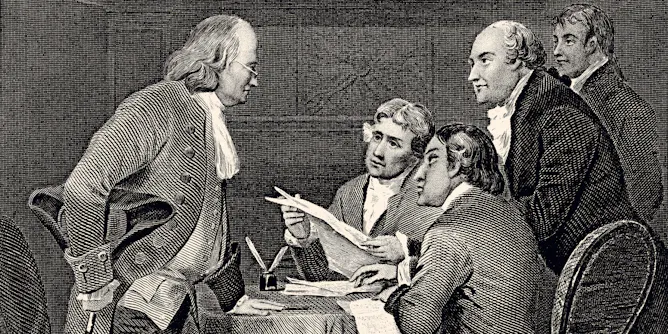
The founding generation in America was not of one mind. John Adams and Thomas Jefferson differed on crucial ideas, but exemplify the capacity for people to disagree and yet work for a common cause.
Articles on Human nature
Displaying all articles

People from many different cultures across the globe and across millennia largely agree about which body parts are most valuable – and how much compensation they warrant when injured.

Gifting has evolved dramatically in Africa since humans first evolved the instinct to give.

One yawn, a second, a third and it’s your turn. Many biological explanations have been put forward, but what is the scientific consensus?

Human interactions with fish can result in three kinds of interspecies encounters that strengthen people’s connections with wildlife and natural environments.

A new book argues our philosophical and intellectual responses to technology have not kept pace with events.

Feeling uneasy about a life choice? Cognitive dissonance could be the culprit.

What people consider to be fair and just today are in line with the laws of ancient Mesopotamia and the Tang Dynasty in China – suggesting that these intuitions are part of human nature.

They say to improve your mood you should fake a smile and roll with the crowd. But research suggests the more pressure you feel to be happy, the worse you’ll end up feeling.

Here’s how governments can get more people to follow COVID-19 guidelines.

What world will tech billionaires move us towards if they believe that humans are fundamentally dangerous?

Social media is the refined sugar of human communication.

Still going strong in its 30th year, The Simpsons follows a strict animation style guide based on Matt Groening’s own rules, and has much to teach young animators

Why research that links our social behaviour to our genes is still controversial today.

The defining characteristics of our species will make us and our labour relevant in a new era.

Collapse porn. Apocalyptica. Eco-rapture. A growing genre of environmental writing that sees endless economic growth as the enemy.

In order to make young children “school ready”, the English government is now encouraging parents to place their children in school nurseries shortly after their second birthday. But there is evidence…
Top contributors
-

Assistant Professor of Psychology, Oklahoma State University
-
Lecturer in Management, SPRU, University of Sussex Business School, University of Sussex
-
Senior Lecturer: Director MSc Animation and VFX MDes Comics & Graphic Novels, University of Dundee
-
PhD Candidate, University of Cambridge
-
Adjunct Professor, University of Tasmania
-
Senior Lecturer in Psychology, Charles Darwin University
-
Associate Professor in Clinical Psychology and Neuropsychology, Trinity College Dublin
-
Assistant Professor of Legal Studies, University of Central Florida
-
Professor, Melbourne School of Psychological Sciences, The University of Melbourne
-
Associate Professor, School of Arts, Western Sydney University
-
Professor of Computer Science and Human Performance, University of Southampton
-
Marketing Professor
-
Postdoctoral Researcher, KU Leuven
-
Assistant Professor, Markets, Innovation, and Design, Bucknell University
-
Professor of Consumer Research, University of Bristol